


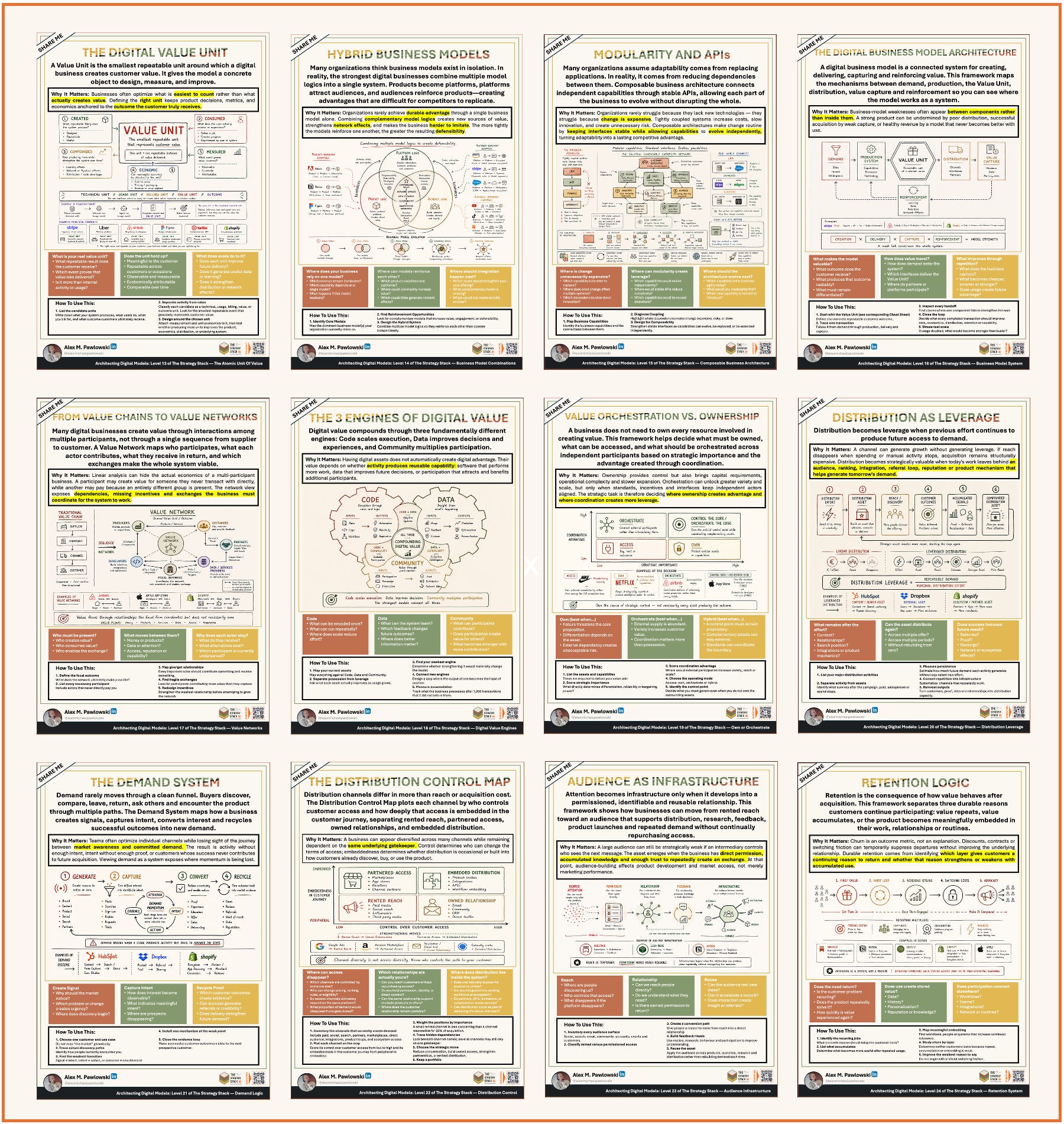
If growth has felt channel-dependent, monetization premature, or retention mysterious, it is often because the business model was never designed as a system.
Phase One of The Strategy Stack mapped the foundations of digital value - leverage, learning, independence, and the stack underneath durable firms.
Phase Two exists to do the next job.
It maps how digital businesses are architected: how value units, model logics, interfaces, networks, distribution, demand, audience, and retention connect - so advantage compounds instead of leaking through weak links.
With the publication of Level 24, Phase Two is now complete.
This article is the map.
Why Phase Two Exists
Most scale failures aren’t caused by weak ambition.
They’re caused by incomplete architecture.
Teams confuse:
Growth with distribution control
Channel diversity with access diversity
Ownership with strategic control
Activity metrics with customer value
Features with retention
Phase Two dismantles those confusions.
It establishes a shared logic for how digital models actually work - not at the surface of campaigns and roadmaps, but at the structural level of value units, control points, demand systems, and compounding engines.
If Phase Two does its job, later strategy becomes harder to fake - and easier to execute.
The Twelve Frameworks of Architecting Digital Models
Each level answers a specific strategic question. Individually they’re useful. Together, they form a coherent system.
Level 13 - The Digital Value Unit

What should you measure, price, and improve?
Separates technical, usage, and billing units from the value unit - the smallest repeatable event that creates customer value. Get this wrong and product metrics, unit economics, and pricing all drift.
Level 14 - Hybrid Business Models

When is one model logic not enough?
Shows how product, platform, and audience logics combine - and why hybrids work only when a second logic reinforces the first, not when it is bolted on.
Level 15 - Composable Business Architecture

Why is adaptability an interface problem?
Treats the firm as a network of capabilities connected through stable contracts. Modularity localizes the cost of change instead of propagating it through the stack.
Level 16 - Digital Business Model Architecture

Where does a weak link constrain the whole system?
Connects demand, production, value unit, distribution, capture, and reinforcement into one architecture - so strategy stops optimizing parts that fight each other.
Level 17 - Value Chains vs. Value Networks

Why does linear analysis miss platform economics?
Moves from supplier → firm → customer maps to multi-participant networks: who participates, what moves between them, and why each actor stays.
Level 18 - Digital Value Engines

What actually compounds once the model is live?
Frames code, data, and community as engines of digital value creation - reusable capability, not static asset ownership.
Level 19 - Own vs. Orchestrate

What must you own - and what should you coordinate?
Separates ownership from control. Own the control point; orchestrate the rest when coordination advantage beats capital intensity.
Level 20 - Distribution Leverage

When does yesterday’s effort still reach tomorrow’s customers?
Treats distribution as leverage: persistence and declining marginal effort - not vanity channel metrics.
Level 21 - The Demand Generation System

Why do funnels fail where demand systems succeed?
Maps generate → capture → convert → recycle as states of demand, and shows where transitions break.
Level 22 - The Distribution Control Map

Is channel diversity the same as access diversity?
Plots rented, owned, partnered, and embedded distribution so gatekeeper risk becomes visible before it becomes existential.
Level 23 - Audience Infrastructure

What makes reach reusable?
Builds permission as infrastructure - from rented attention to owned relationships that support launches, learning, and compounding demand.
Level 24 - Customer Retention Framework

Why do customers stay - and what does advocacy actually signal?
Treats retention as a system of repeat value, accumulation, and embedding - not a feature checklist or a churn dashboard.
What Phase Two Gives You
Taken together, Levels 13–24 provide:
A shared language for digital business model design
A diagnostic lens for weak links and gatekeeper risk
A system-level view of distribution, demand, and retention
Clear sequencing from value unit → architecture → compounding
Phase Two doesn’t tell you which market to enter next.
It tells you how to design a model that can survive scale - and compound once it gets there.
How to Use This Collection
Founders: Read it before locking distribution and monetization assumptions
Product leaders: Use it to diagnose growth that doesn’t stick
Strategists: Apply it as architecture, not a content checklist
Return to these levels whenever:
Growth depends on rented channels you don’t control
Monetization arrives before value is clear
Retention decays while usage metrics look fine
“Platform strategy” means features, not control points
That’s usually a signal that model architecture has drifted.
Sequential path: 13 → 14 → 15 → … → 24
Best when you are building or auditing a full digital business model.
By constraint: Jump to the level that matches the current problem - value unit if metrics and pricing feel misaligned; distribution control if channels feel fragile; retention if churn rises without a diagnosis.
With Phase One: Start from Foundations of Digital Value (Levels 1–12) if the vocabulary of leverage, learning, and the strategic stack is not yet shared. Phase Two assumes that foundation - but you can enter wherever the constraint is sharpest.

What Comes Next
Phase One is about foundations.
Phase Two is about architecture.
Phase Three will move into:
Automation systems that free attention for strategy
Scale dynamics - volume, scope, and network
Digital unit economics and pricing architecture
Value capture in attention and data markets
Strategic moats and compounding advantage
Aggregator logic and feedback systems for decisions
But none of that works without what comes first.
Durability is built from the bottom up - foundations, then architecture, then scale and defensibility.
Closing Thought
Most companies don’t fail because they lack growth ideas.
They fail because they never fully designed how value, distribution, and retention connect.
Phase Two of The Strategy Stack exists to fix that.
Because once the model is clear, scale stops being improvisation.
And once architecture is sound, execution finally has something durable to compound.
What Comes Next
Phase III - SYSTEMS & STRATEGY: Scaling and Defensibility moves beyond architecture and into durable advantage - where scale compounds, moats form, and strategy becomes a closed learning system.
You now have the competitive architecture most teams never articulate - let alone design.
👉 Unlock the Strategy Stack
…and access the Business Model Series, advanced Cheat Sheets, the Operator Vault, and various essays at the intersection of strategy and technology.
A customer got on a call with me back in July sure he had a runaway loop somewhere. He'd built over 200 custom events for exactly the questions he wanted answered, and left the default click capture running underneath all of them, so he was paying for every click on every page and querying none of it. Your Level 13 names exactly what he'd skipped. His value unit was the 200 events, his billing unit was every click on the page.