
Beyond Headcount Reduction: Building AI-Era Organizations That Create Work, Not Just Automate It
Companies have poured hundreds of billions into AI over the past three years.


Hi, Operator 👋🏼
I’m John, and welcome to another edition of The Strategy Stack.
Yes, you read that right. The Strategy Stack.
Today, we’re tackling a topic that’s lighting up every boardroom — and confusing every operator.
AI promised a productivity boom. Instead, we got 1.5% growth and a lot of “so-so technologies.”
The problem? We’re using AI to replace work, not reinvent it.
Let’s talk about why the real opportunity isn’t automation — it’s reinstatement: creating new kinds of work where humans and AI build value together.
Let’s stack it up.
Productivity growth? A paltry 1.5% annually, barely half the postwar average. The Wall Street Journal recently captured the disconnect:
“Investment in AI ignited a fire under the U.S. economy. But the technology hasn’t yet fulfilled the promise of making humans work more efficiently.”
Economists call this the “trough of disillusionment.” Companies are frustrated and disappointed with AI deployments that consume resources but deliver minimal returns.
Something fundamental is broken in how we’re deploying these technologies. The culprit isn’t AI itself. It’s that we’re treating AI as purely a displacement technology, replacing human tasks, when history shows that balanced technological progress requires equal parts automation AND the creation of new tasks where humans excel.
Drawing on Daron Acemoglu and Pascual Restrepo’s foundational task-based framework and the emerging “Coasean Singularity” thesis on AI agents, a different path emerges: building organizations that use AI not to shrink the workforce, but to fundamentally expand what work means.
The Dominant (Flawed) Mental Model
Most AI strategies follow a simple equation:
AI = Automation = Efficiency = Lower headcount = Higher margins.
This shows up everywhere, customer service bots replacing agents, automated underwriting replacing analysts, AI coding assistants positioned as “reducing engineering needs.” The implicit theory: technology makes labor obsolete, so smart companies minimize human involvement.
This logic fails for a critical reason Acemoglu and Restrepo identified: “so-so technologies.” Automation that displaces workers but generates minimal productivity gains. Think low-quality chatbots that frustrate customers, premature factory automation (Tesla’s notorious failed experiment), or AI tools that create as much work as they save. Indeed, the Wall Street Journal found that employees using AI report their “prize for saving time at work” is simply more work, the Jevons Paradox in action.
MIT economist Daron Acemoglu’s recent macroeconomic analysis projects that AI will deliver only 0.55% total factor productivity gains over the next decade, far below the hype, because most tasks fall outside the “easy-to-learn” category where AI excels. Yet, companies continue to deploy AI primarily for displacement, missing the deeper opportunity.
What Automation Actually Does: The Task-Based Framework
The Acemoglu-Restrepo framework rejects the idea that technology uniformly enhances productivity. Instead, production requires completing discrete tasks, each allocated to either capital or labor based on comparative advantage. Technology changes the task content of production, which actor does what.
Three types of technology matter:
Automation technologies replace labor with capital in existing tasks, creating two opposing effects: a displacement effect (directly reduces labor demand) and a productivity effect (increases output, indirectly raising labor demand). Critically, when productivity gains are modest, displacement tends to dominate.
New task technologies create entirely new activities where labor has a comparative advantage. Think line workers and machinists during industrialization, software developers and data analysts in the digital era. These always increase labor demand through a “reinstatement effect”.
Factor-augmenting technologies make capital or labor more productive at tasks they already perform, generally producing positive but modest effects on labor demand.
The historical evidence is striking. From 1947-1987, U.S. productivity grew at 2.4% annually. Displacement effects reduced labor demand by 0.48% per year, but reinstatement effects added 0.47%, balanced innovation that maintained strong wage growth.
But from 1987 to 2017, the balance broke. Productivity slowed to 1.54% annually. Displacement effects strengthened to -0.70% per year (50% stronger), while reinstatement effects weakened to +0.35% per year (25% weaker). For the first time, automation accelerated while new task creation collapsed, explaining both wage stagnation and disappointing productivity
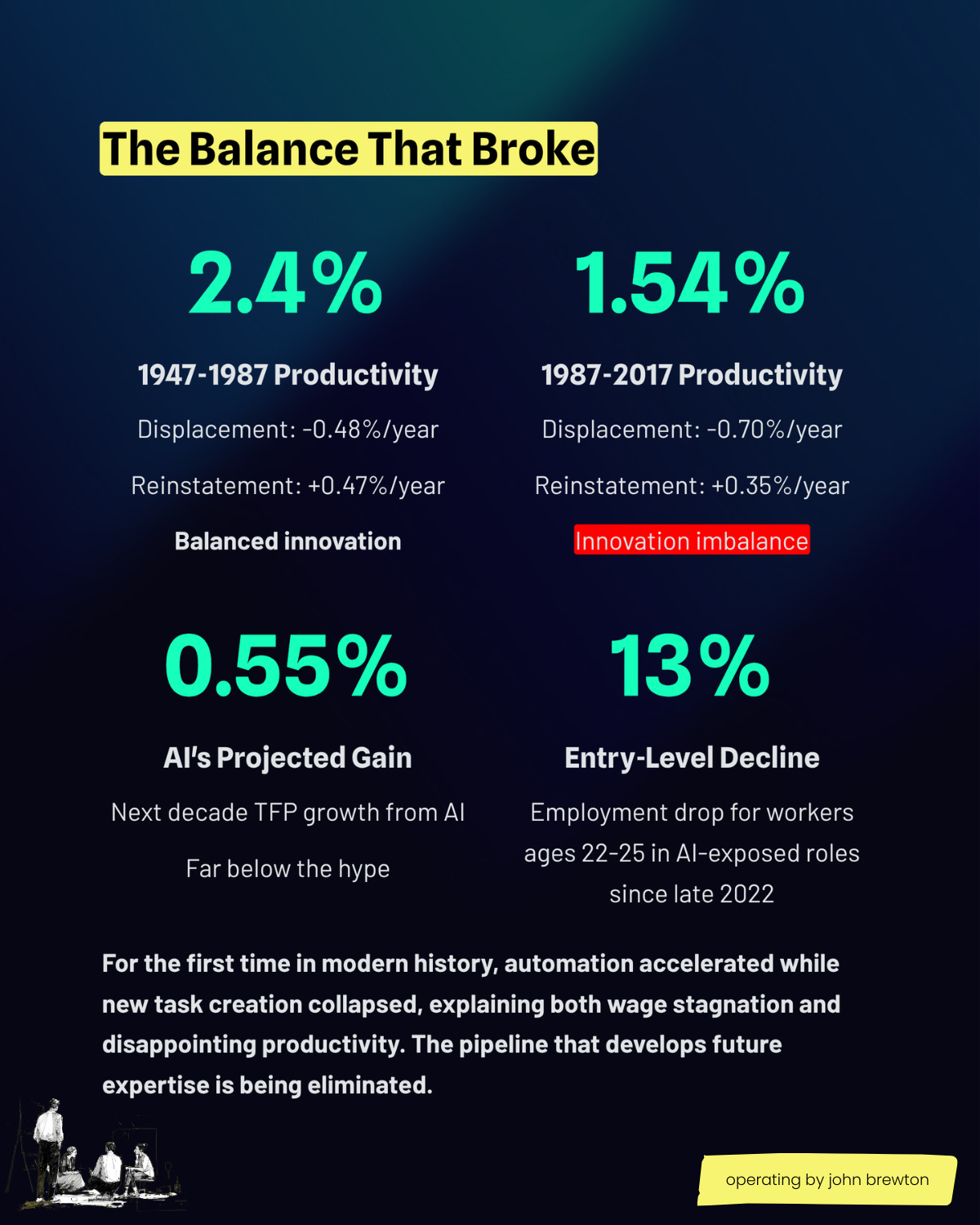
Automation without reinstatement explains both the productivity paradox and the entry-level employment crisis
Stanford’s recent “Canaries in the Coal Mine” study confirms this pattern continues: early-career workers (ages 22-25) in AI-exposed occupations experienced a 13% relative employment decline since late 2022, while experienced workers saw stable or growing employment. The jobs most vulnerable aren’t complex knowledge work, they’re the routine entry-level tasks that once served as training grounds.
Harvard Business Review warns the implications are severe: with 50-60% of typical junior tasks now executable by AI, “slashing entry-level jobs simply to cut costs is dangerously short-sighted.” It eliminates the pipeline that develops future expertise.
What Reduced Transaction Costs Enable: The Coasean Dimension
While Acemoglu and Restrepo examine automation’s effect on labor, recent NBER research explores how AI agents transform firm boundaries. Ronald Coase’s foundational insight, that firms exist because markets have transaction costs, suggests that AI agents capable of autonomous search, negotiation, and contracting could trigger a “Coasean Singularity” where coordination costs approach zero.
This creates external pressure: activities once kept internal because market coordination was expensive can migrate to specialized providers. Harvard Business Review notes that “to unlock the value of agentic AI, companies must redesign not just how they think about their workforce but also how their organizations are structured to deliver outcomes.”
But there’s an internal dimension too: AI agents automate the coordination tasks that justified the existence of middle management. The result is compression from both sides, with smaller boundaries externally and flatter hierarchies internally.
Here’s where the frameworks converge powerfully: AI agents reduce transaction costs (Coasean effect), while simultaneously displacing coordination tasks (Acemoglu-Restrepo displacement effect). Whether this creates value depends entirely on whether we build new, valuable tasks that leverage human strengths.

The Strategic Pivot: From Automation-First to Task-Creation-First
The Productivity Paradox exists because we’re optimizing for displacement instead of reinstatement. Companies that master task creation, not just task automation, will define the next economic era.
This requires a fundamental reframe: competitive advantage comes from “reinstatement capacity.” The ability to continuously identify and create new valuable tasks where humans have a comparative advantage.
Consider MIT Sloan research showing generative AI produces 40% productivity gains for workers operating inside AI’s capability boundary, but a 19-point performance drop for those pushed outside that boundary. Or the Quarterly Journal of Economics finding that AI delivers 30% productivity gains for less skilled workers but minimal or negative effects for top performers, evidence of skill-leveling, not skill-biasing.
These patterns reveal that AI’s impact depends critically on task design. When we automate routine tasks and create new high-judgment roles, productivity soars. When we simply eliminate positions, we get disappointing results.
Every AI initiative should pass two tests:
Test 1: Does this create genuine productivity gains?
Not “does it reduce headcount?” but “does it increase value per unit of input?” Red flags include technologies that shift work rather than eliminate it, create new oversight needs, or require extensive human correction.
Test 2: Does this enable new tasks where humans have comparative advantage?
What new capabilities emerge? What new human roles develop around it? Does it complement human judgment or merely substitute for it?
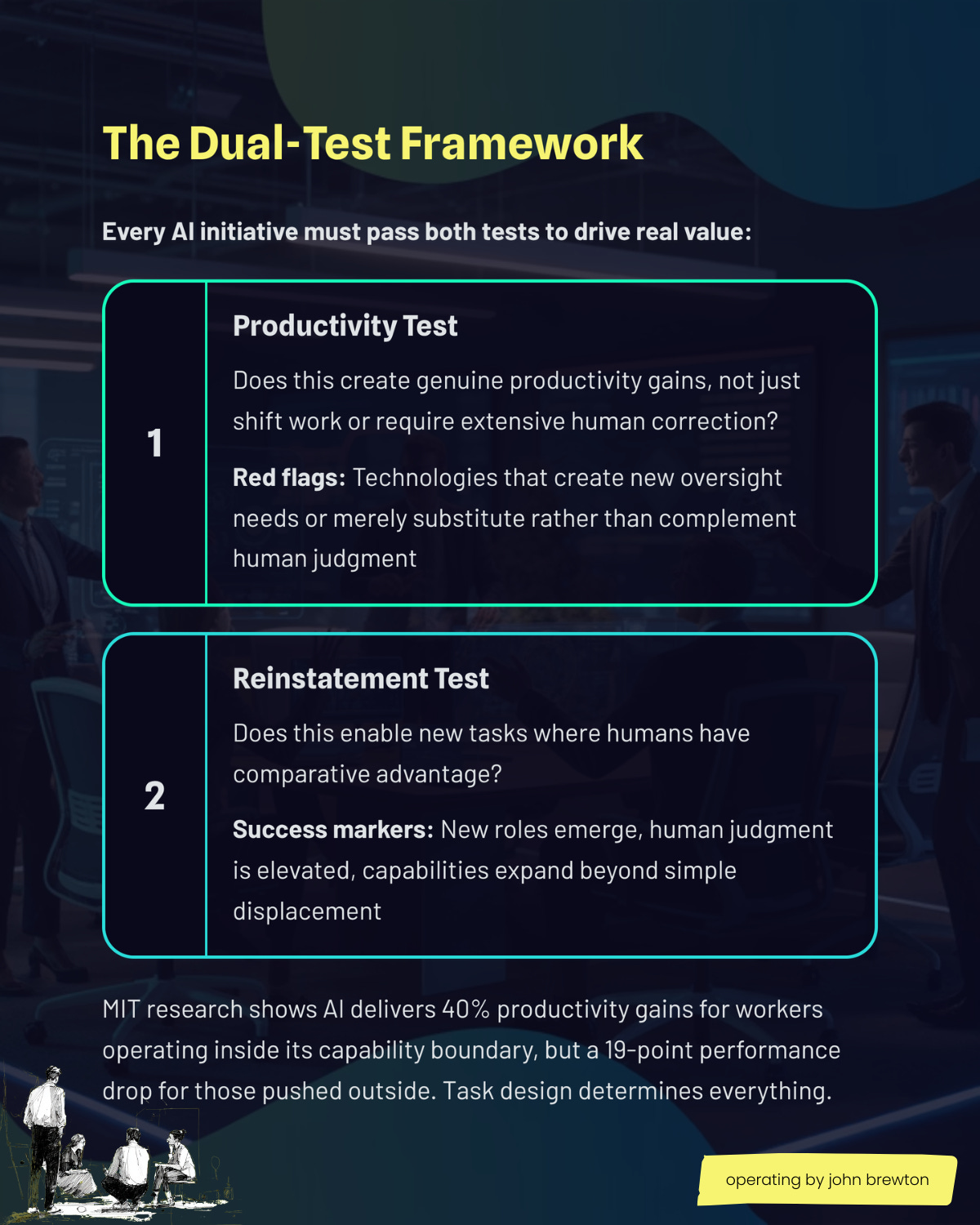
Before approving any AI investment, require sponsors to answer both questions. If a proposal only addresses displacement, send it back.
Stanford’s Erik Brynjolfsson, analyzing 250,000 task taxonomies through Workhelix, observes that “most jobs consist of dozens of specific tasks...AI never seems to run the table and do everything...we’ll see a lot of restructuring and reorganization.” The question becomes: will we organize that restructuring around displacement or around new task creation?
Bad: Automating customer service with low-quality bots (so-so technology: modest productivity, high displacement, no reinstatement).
Good: Using AI to handle routine queries while creating “customer success strategist” roles that use freed capacity plus AI insights to proactively solve complex problems (high productivity, some displacement, strong reinstatement).
David Autor’s recent research at Stanford clarifies the mechanism: automation both replaces AND augments expertise depending on whether routine or expert tasks are removed or added. “Expertise is much closer to a supply chain.” Remove the entry-level links, and the whole system breaks down.
Three Principles for Execution
Principle 1: Measure new task emergence, not just efficiency gains. Add to your AI dashboard: number of new job titles created in the past 12 months, percentage of workforce in roles that didn’t exist five years ago, rate of new task job descriptions. Target: reinstatement rate should roughly match displacement rate.
Principle 2: Build hybrid human-agent teams around complementarity, not substitution. The design question is “What can agents do that frees humans for higher-value work?” not “What human work can agents replace?” Human comparative advantage: judgment in ambiguous situations, ethical reasoning, contextual interpretation. Agent comparative advantage: pattern recognition at scale, 24/7 availability, rapid iteration.
Principle 3: Invest in “reinstatement infrastructure.” MIT Sloan and Mercer research emphasizes that “simply deploying AI is insufficient; [companies] must deconstruct existing jobs and processes, redeploy work and reconstruct new operational frameworks”. This requires formal mechanisms for identifying new task opportunities and pilot programs testing new human roles around AI capabilities.
The training gap is the critical bottleneck: companies spend billions but don’t see returns because workforces lack skills to use tools fully. Reinstatement requires not just identifying new tasks but building capabilities to perform them.
The Implementation Path
Step 1 (30 days): Audit your current AI portfolio. For each initiative, assess productivity gain, displacement effect, and reinstatement effect. Identify “so-so technologies” (high displacement, low productivity, zero reinstatement). Flag these for redesign or sunset.
Step 2 (immediate): Establish the Dual-Test as approval criteria. Modify your AI investment approval process to require sponsors to articulate both productivity gains AND new task creation. If a proposal only addresses displacement, send it back.
Step 3 (60 days): Create a “New Tasks” working group. Cross-functional team tasked with identifying reinstatement opportunities, with monthly deliverables of three new potential human roles enabled by current automation.
Step 4 (90 days): Revise metrics and incentives. Add reinstatement metrics to executive scorecards. Adjust incentives to reward balanced innovation, not just cost reduction.
The Reinstatement Imperative
The productivity paradox isn’t a mystery; it’s a choice. We’ve chosen to optimize for displacement while neglecting reinstatement. The result: disappointing returns for companies, stagnant wages for workers, and slower economic growth for society.
But this is correctable. The same technologies that automate routine tasks can enable entirely new categories of work. The Wall Street Journal reports that big U.S. employers are “making the calculation that they can keep headcounts flat—or let people go—and see little negative effect.” That’s the displacement path, and it leads to the productivity disappointment we’re experiencing.
Companies that master reinstatement will define the AI transition. The frameworks exist. The evidence is clear. The question for strategy leaders is whether that transformation will make you smaller and more fragile, or different and more capable.
Build organizations that create work, not just automate it. That’s where the productivity, and the sustainable competitive advantage will come from.
- John Brewton -

Hit subscribe to get it in your inbox. And if this spoke to you:
➡️ Forward this to a strategy peer who’s feeling the same shift. We’re building a smarter, tech-equipped strategy community—one layer at a time.
Let’s stack it up.
 | A guest post by
|
Excellent article! Thanks for sharing
This analysis makes it clear that AI’s real potential lies in creating new, high-value tasks, not just cutting headcount; reinstatement, not displacement, drives sustainable productivity gains.