


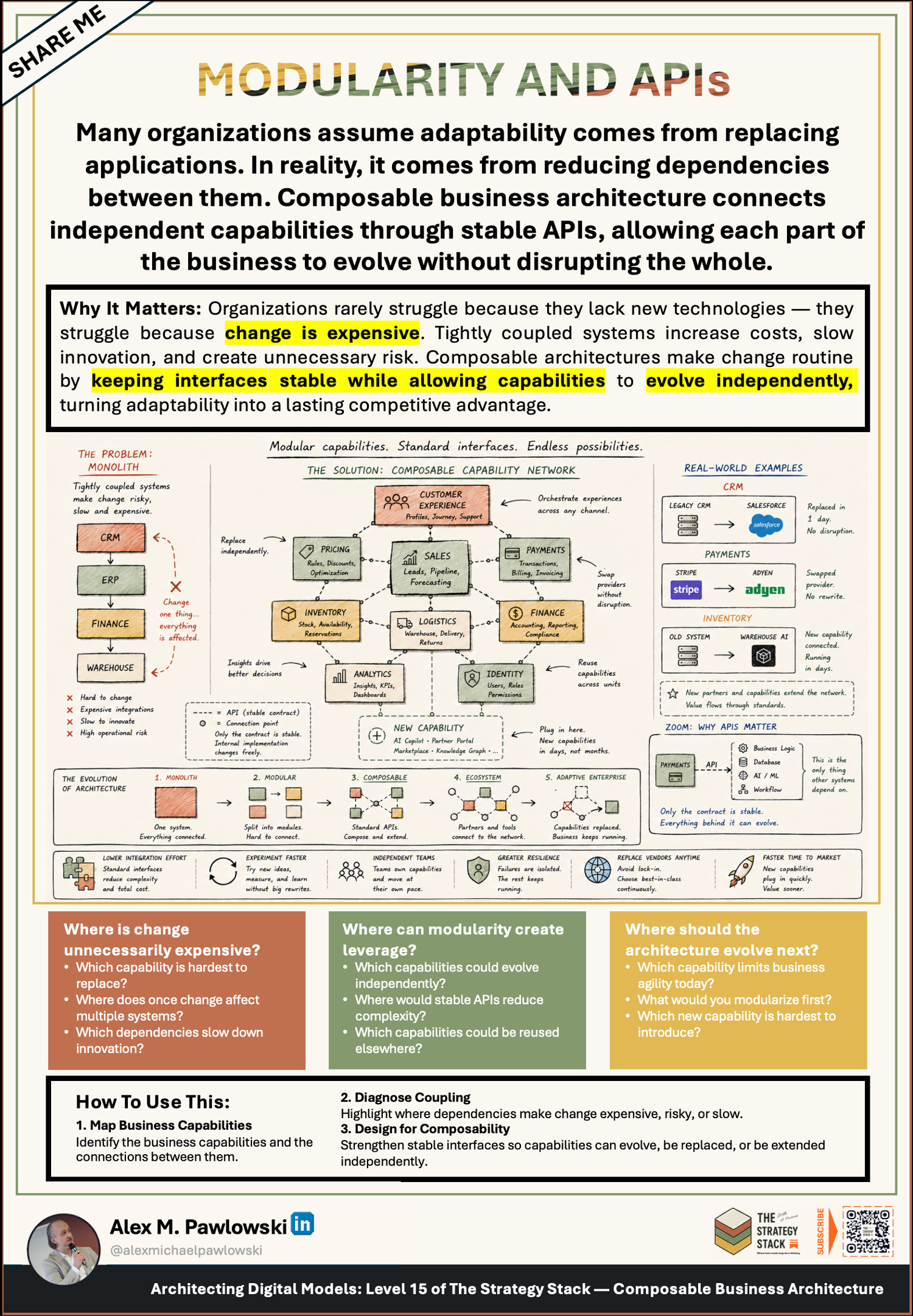
Many organizations assume adaptability comes from replacing applications.
In practice, it comes from reducing dependencies between them.
The monolith pattern — CRM, ERP, finance, warehouse, all tightly coupled — makes every change expensive. A pricing rule change ripples through checkout, reporting, and fulfillment. A vendor swap triggers months of reintegration.
Composable business architecture treats the firm as a network of capabilities connected through stable interfaces, not a single stack where everything depends on everything else.
The Mechanics
Each capability — customer experience, pricing, sales, payments, inventory, logistics, finance, analytics, identity — should expose a stable contract (typically an API) that other systems depend on.
Behind that contract, the implementation can evolve: different vendors, refactored logic, new AI models, updated workflows. What other systems see stays consistent.
Stable interfaces localize the cost of replacement instead of propagating it through the entire system.
That is the precise claim — not that swapping vendors is effortless. Replacing a payments provider still requires reconciling data models, auth flows, failure handling, reconciliation logic, and downstream assumptions. But those costs are bounded to the payments boundary rather than rewriting every system that touches money.
The same applies to CRM, inventory, or identity: composability reduces blast radius. It does not eliminate migration work.
The Evolution Path
Most enterprises move through recognizable stages:
1. Monolith — one system, everything connected
2. Modular — split into modules, still coupled internally
3. Composable — standard interfaces allow composition and extension
4. Ecosystem — partners and external tools connect to the network
5. Adaptive enterprise — capabilities replaced without stopping the business
Most firms are stuck between monolith and modular. The strategic work is strengthening interfaces so stage three becomes reachable.
The Failure Pattern
Composability initiatives fail when:
APIs are thin wrappers around monolith internals — stable in name only
Every team builds its own integration patterns with no shared standards
“Microservices” multiply without clear capability ownership
Replacement is attempted without investing in contract design upfront
The interface is the product for other systems. Treat it that way.
How to Use This Framework
1. Map business capabilities
Identify functions and how they connect today — not org chart boxes, actual data and process dependencies.
2. Diagnose coupling
Where does one change force changes elsewhere? Which capability is hardest to replace, and why?
3. Design for composability
Strengthen stable interfaces so capabilities can evolve, be replaced, or extended with bounded cost.
Diagnostic questions:
Where is change unnecessarily expensive?
Which capabilities could evolve independently if interfaces were stronger?
What would you modularize first if agility were the constraint?
👉 Unlock the Strategy Stack
…and access the Business Model Series, advanced Cheat Sheets, the Operator Vault, and various essays at the intersection of strategy and technology.
In this series →

Read next →

Go deeper →

