
Digital Business Models for Founders: Why Value Fails to Circulate
#137: Where value compounds before it’s captured — and why most monetization weakens the system

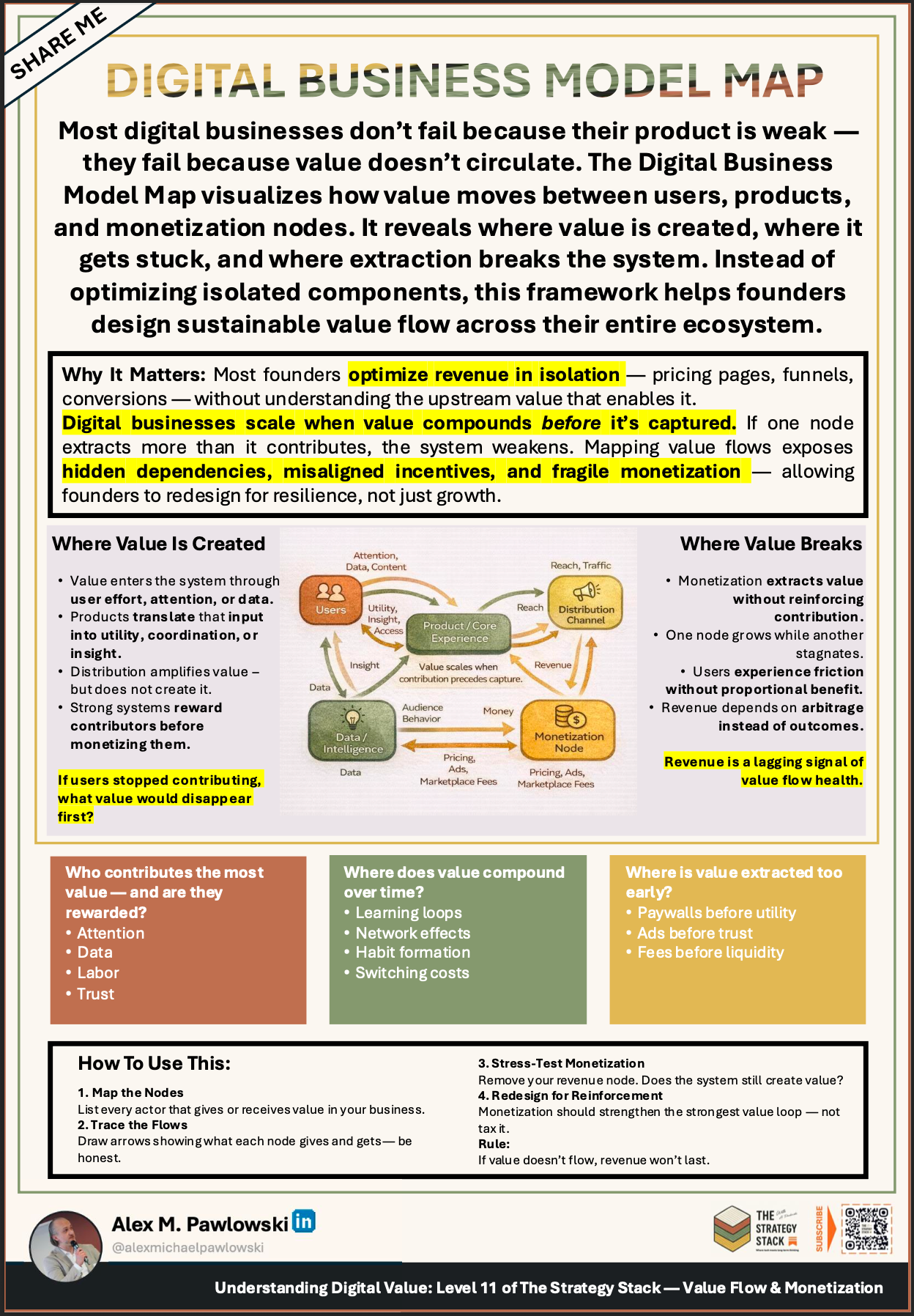
Most digital businesses don’t fail because their product is weak.
They fail because value doesn’t circulate.
Founders obsess over pricing pages, funnels, and conversions — but those are downstream symptoms, not root causes.
Revenue doesn’t break first.
Value flow breaks first.
Until you can see how value moves between users, products, data, distribution, and monetization, you’ll keep optimizing isolated components — and wondering why growth stalls anyway.
Why This Matters
Most monetization thinking starts too late.
Founders ask:
How should we price this?
Which funnel converts better?
How do we increase ARPU?
But by the time those questions appear, the system is often already fragile.
The real question comes earlier — and it’s structural:
Where does value compound — and where does it leak?
Digital businesses don’t scale when revenue grows.
They scale when value compounds before it’s captured.
When monetization extracts more than it reinforces, the system weakens — even if revenue looks healthy.
The Core Shift: From Revenue Optimization to Value Flow Design
Revenue is not the engine.
It’s the output signal.
The Digital Business Model Map reframes the business as a value circulation system:
Users contribute effort, attention, data, or trust
Products translate contribution into utility, coordination, or insight
Distribution amplifies value (but doesn’t create it)
Monetization captures value after it compounds — or breaks the system if it doesn’t
The common failure is optimizing capture points without understanding contribution dynamics.
That’s how you get:
Paywalls before utility
Ads before trust
Fees before liquidity
Short-term revenue. Long-term decay.
How Value Actually Scales
Healthy digital systems share a simple pattern:
Contribution is rewarded before extraction
Value compounds through loops (learning, networks, habits)
Monetization strengthens the strongest loop — instead of taxing it
Unhealthy systems invert this:
One node extracts more than it contributes
Growth in one area causes stagnation elsewhere
Revenue depends on arbitrage, not outcomes
This is why revenue is a lagging indicator of value flow health — not proof of it.
What Founders Often Get Wrong
Most teams optimize locally instead of systemically.
They:
Tune pricing without mapping contributors
Improve funnels without understanding value creation
Scale monetization nodes that weaken upstream value
The result is familiar:
Strong revenue signals.
Weak ecosystem resilience.
Sudden, confusing plateaus.
The Digital Business Model Map forces honesty by asking:
If users stopped contributing tomorrow, what value would disappear first?
If you can’t answer that, you don’t have a business model — you have a temporary extraction mechanism.
What a Healthy Business Model System Looks Like
When value flows correctly:
Monetization reinforces contribution
Users benefit proportionally to what they give
Growth strengthens the system instead of stressing it
Revenue feels earned, not imposed.
The business doesn’t just grow.
It holds together under pressure.
That’s resilience — not just scale.
The Questions That Matter
Use the map to pressure-test your system:
Who contributes the most value — and are they rewarded?
Where does value compound over time?
Where is value extracted too early?
Which node would collapse the system if removed?
Does monetization strengthen the loop — or tax it?
If value doesn’t flow, revenue won’t last.
About the Cheat Sheet (And Why Some Depth Is Gated)
The Digital Business Model Map Cheat Sheet helps you:
Visualize how value actually moves
Identify hidden dependencies and incentive mismatches
Diagnose fragile monetization structures
Redesign for resilience, not just growth
It shows the structure.
When you start asking:
Which node should we reinforce?
Where should monetization sit?
What breaks if we scale this loop?
That’s where the paid layer begins — because those decisions involve real trade-offs.
Which Tier Is Right for You?
Choose Free if you:
Want to understand why revenue plateaus happen
Are learning to see businesses as systems
Care about value creation more than tactics
Choose Paid if you:
Design platforms, products, or ecosystems
Make monetization decisions under uncertainty
Need frameworks that guide real trade-offs
If revenue matters, system clarity pays for itself.
Why This Exists
Most strategy fails where it should help most —
when systems are complex and signals are misleading.
Frameworks explain the world.
They rarely show where the system is breaking.
The Strategy Stack exists to close that gap:
from understanding → judgment
from insight → design
from growth → resilience
Every layer exists for a reason.
Every upgrade sharpens decision-making.
👉 Unlock the Strategy Stack
…and access the Business Model Series, advanced Cheat Sheets, the S-Vault, and various essays at the intersection of strategy and technology.

Hit subscribe to get it in your inbox. And if this spoke to you:
➡️ Forward this to a strategy peer who’s feeling the same shift. We’re building a smarter, tech-equipped strategy community—one layer at a time.
Let’s stack it up.
A. Pawlowski | The Strategy Stack