


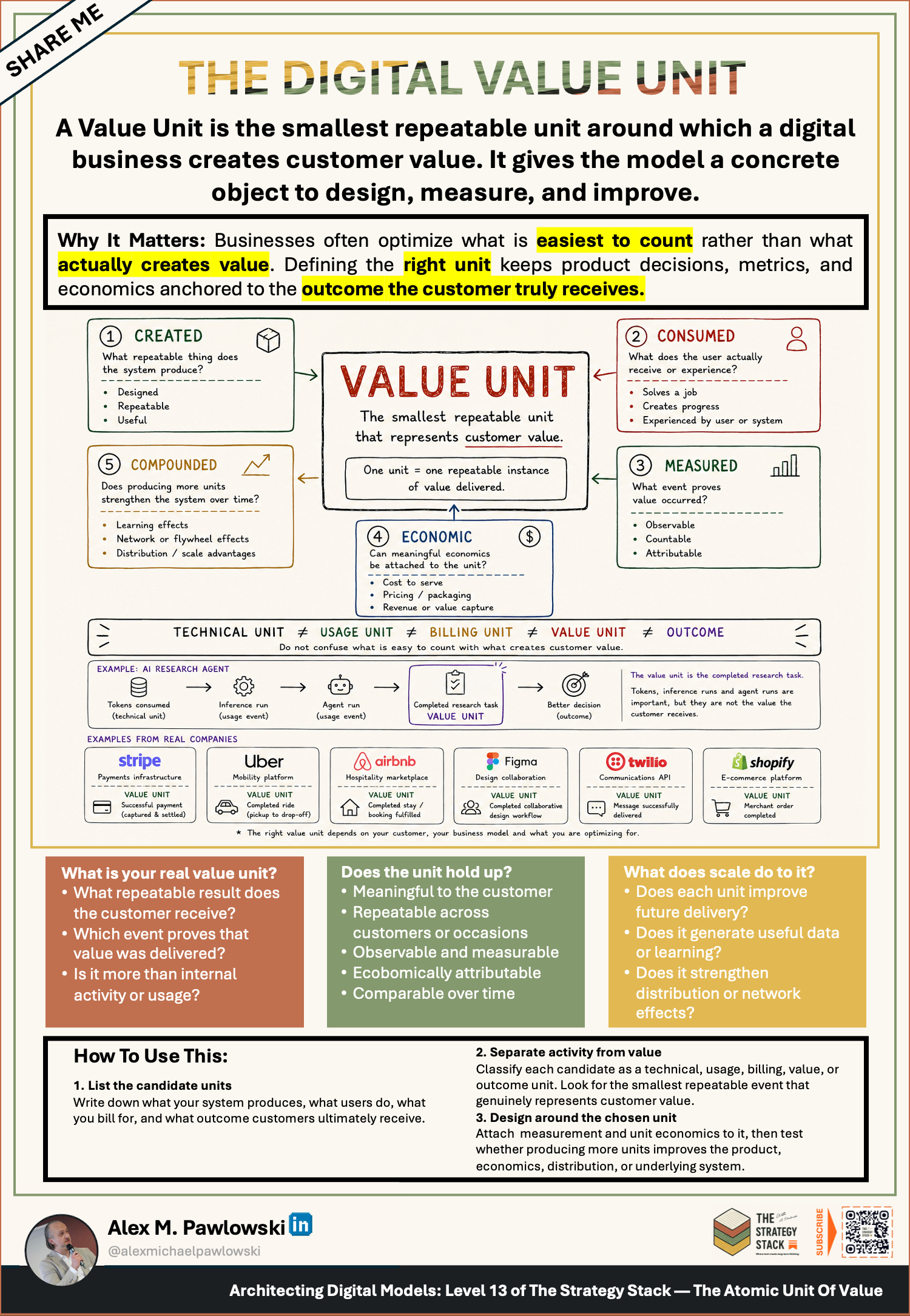
Most digital businesses are optimized around what is easy to count.
Tokens consumed. Seats sold. Sessions logged. API calls made.
Those are activity signals — useful for operations, but poor proxies for customer value. A seat can be occupied without a job getting done. A session can run without progress made.
The value unit is the smallest repeatable event around which a digital business creates customer value: the atomic outcome you design, measure, price, and improve. Get it wrong and product metrics, unit economics, and pricing all drift away from what customers actually pay for.
The Hierarchy Most Teams Skip
Teams routinely confuse four different layers:
Technical unit — what the system processes (tokens, rows, requests)
Usage unit — what the user does (a session, a run, a click)
Billing unit — what you charge for (a seat, a credit, a tier)
Value unit — what the customer receives (a completed outcome)
Technical unit ≠ Usage unit ≠ Billing unit ≠ Value unit ≠ Outcome
Outcome is what changes in the customer’s world - a better decision, a faster sale, reduced risk.
Value unit is the smallest repeatable event that reliably produces that outcome. Everything else is instrumentation.
An AI research agent might bill on tokens, measure agent runs, and deliver value only when a completed research task produces a decision the user trusts. Optimizing for tokens produces longer outputs. Optimizing for completed tasks produces better decisions.
Stripe’s value unit is not “API call.” It is a successful payment captured and settled. Uber’s is not “app open.” It is a completed ride. Shopify’s is not “store created.” It is a merchant order completed.
The Model: Five Dimensions
A defensible value unit holds up across five dimensions:
Created — What repeatable thing does the system produce?
Consumed — What does the user experience as progress toward their job?
Measured — What event proves value occurred — observable, countable, attributable?
Economic — Can cost to serve, pricing, and revenue capture map to this unit?
Compounded — Does producing more units strengthen the system through learning, network effects, or scale?
If any dimension is weak, you are probably measuring activity — not value.
The Test: What Breaks When the Unit Is Wrong
When the value unit is misidentified, failure shows up in predictable places:
Pricing rewards volume instead of outcomes
Product metrics look healthy while retention decays
AI products optimize inference cost while user trust erodes
Investor narratives cite usage growth without evidence of value delivery
The business gets busier. The model does not get stronger. That is the diagnostic: if scale increases activity but not outcome quality, revisit the unit.
How to Use This Framework
1. List candidate units
Everything the system produces, everything users do, everything you bill, and the outcomes customers describe in their own words.
2. Separate activity from value
Classify each candidate against the hierarchy above. Find the smallest event that represents true customer value.
3. Design around the chosen unit
Attach measurement, economics, and product decisions to that unit. Ask whether producing more of them actually improves the system.
Diagnostic questions:
What is your real value unit — not your billing unit?
Is it meaningful, repeatable, measurable, and comparable over time?
What does scale do to it?
👉 Unlock the Strategy Stack
…and access the Business Model Series, advanced Cheat Sheets, the Operator Vault, and various essays at the intersection of strategy and technology.
In this series →

Read next →

Go deeper →

This looks very tasty