
Ecosystem Strategy & Embedded Distribution
#143: 8. Ecosystem Strategy & Embedded Distribution - 8.1 Building Ecosystems, Not Just Products

Learning lets a firm improve itself.
Ecosystems determine whether improvement travels.
Most strategy conversations about ecosystems start in the wrong place. They talk about platforms, APIs, partnerships, or network effects—as if ecosystems were something you attach to a product once it’s “working.”
They aren’t.
An ecosystem is not an add-on. It is what happens when a product’s intelligence layer becomes useful outside the firm—and when the firm is willing to let that usefulness reshape control, boundaries, and distribution.
In the AI era, ecosystems are no longer primarily about reach.
They are about where decisions get made—and who is allowed to participate in them.
1. Ecosystems Are Decision Surfaces at a Larger Scale
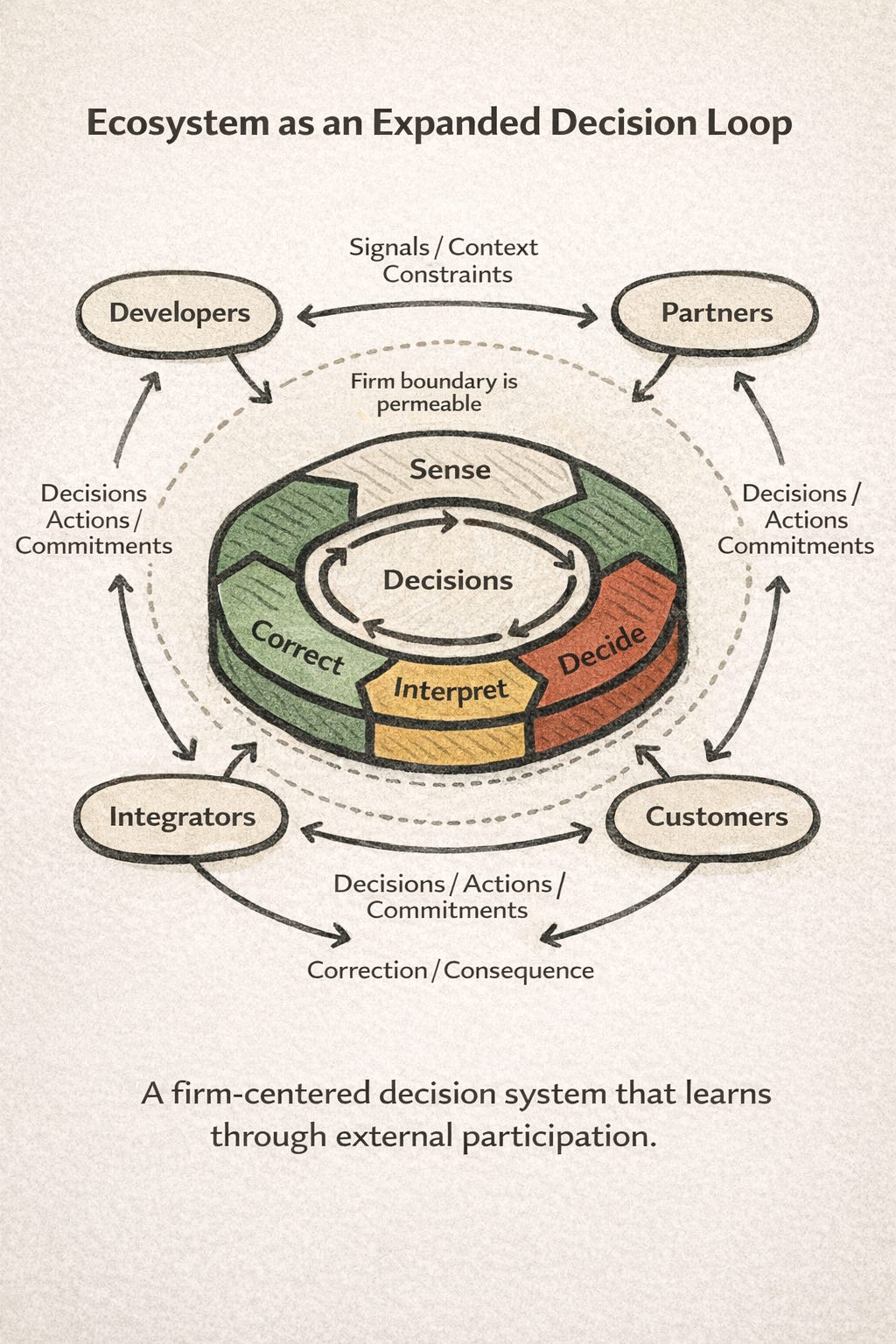
A product with an intelligence layer already behaves like a decision system. It senses, interprets, decides, executes, and corrects.
An ecosystem emerges when that loop is no longer closed inside a single organization.
The defining shift is simple but destabilizing:
The firm stops being the sole author of outcomes.
External developers, partners, customers, operators, integrators—even adjacent competitors—begin to shape how signals are generated, how decisions are framed, and how actions propagate.
This is why ecosystems feel threatening to traditional organizations. They introduce ambiguity. They reduce centralized control. They force assumptions into the open.
But that ambiguity is not a failure mode.
It is the condition under which scale becomes adaptive instead of brittle.
2. Why Products Plateau—and Ecosystems Don’t
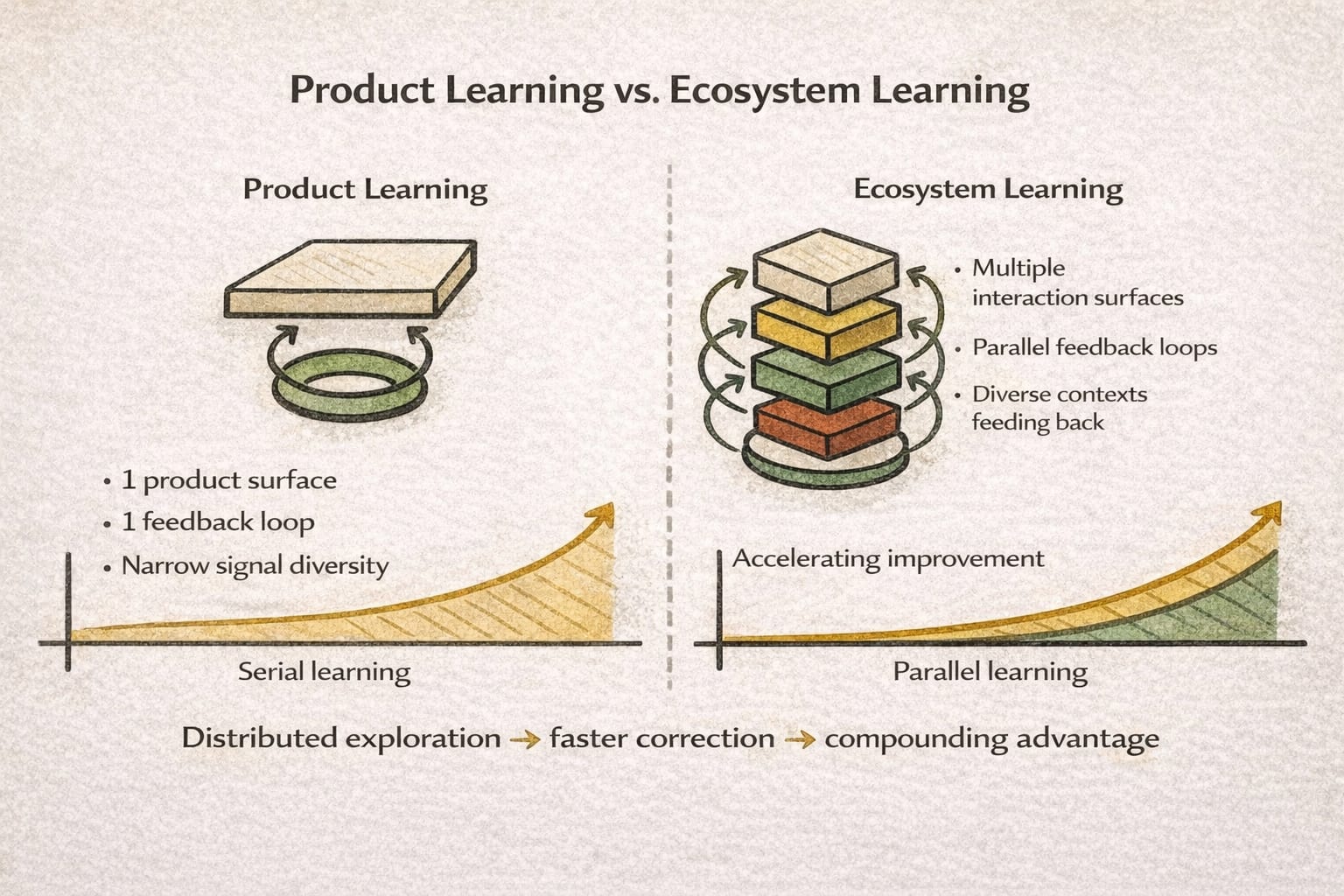
Products improve by learning faster than competitors.
Ecosystems improve by learning in parallel.
A single firm can only experience the world through the interactions it directly mediates. An ecosystem experiences the world through many interaction surfaces simultaneously—often in environments the original product team never anticipated.
This matters because intelligence layers only compound when they encounter diverse reality.
Models trained on narrow usage patterns overfit.
Decision logic optimized for one context becomes fragile.
Feedback loops tuned for internal users miss external stress.
Ecosystems introduce heterogeneity by default. Different actors push the system in different directions, surface edge cases early, and reveal second-order effects while correction is still cheap.
The strategic mistake is treating this as distraction rather than what it actually is:
distributed exploration at system scale.

