
How companies that learn faster out-compete through continuous feedback infrastructures
#134: 7.2 Learning-Driven Businesses

If data determines what a system can learn, learning determines how fast it can adapt.
That difference increasingly separates winners from everyone else.
In the AI economy, competitive advantage no longer comes primarily from scale, brand, or even technology access. Those inputs matter, but they are no longer decisive. What decides outcomes is whether an organization can convert experience into improved decisions faster than rivals — repeatedly, reliably, and under real-world conditions.
This is the shift from data-driven businesses to learning-driven ones.
Many organizations still believe they compete on assets: proprietary data, superior models, exclusive partnerships, distribution reach. In practice, these advantages erode faster than expected. Models commoditize. Data diffuses. Interfaces copy. Distribution fragments.
Learning, by contrast, compounds.
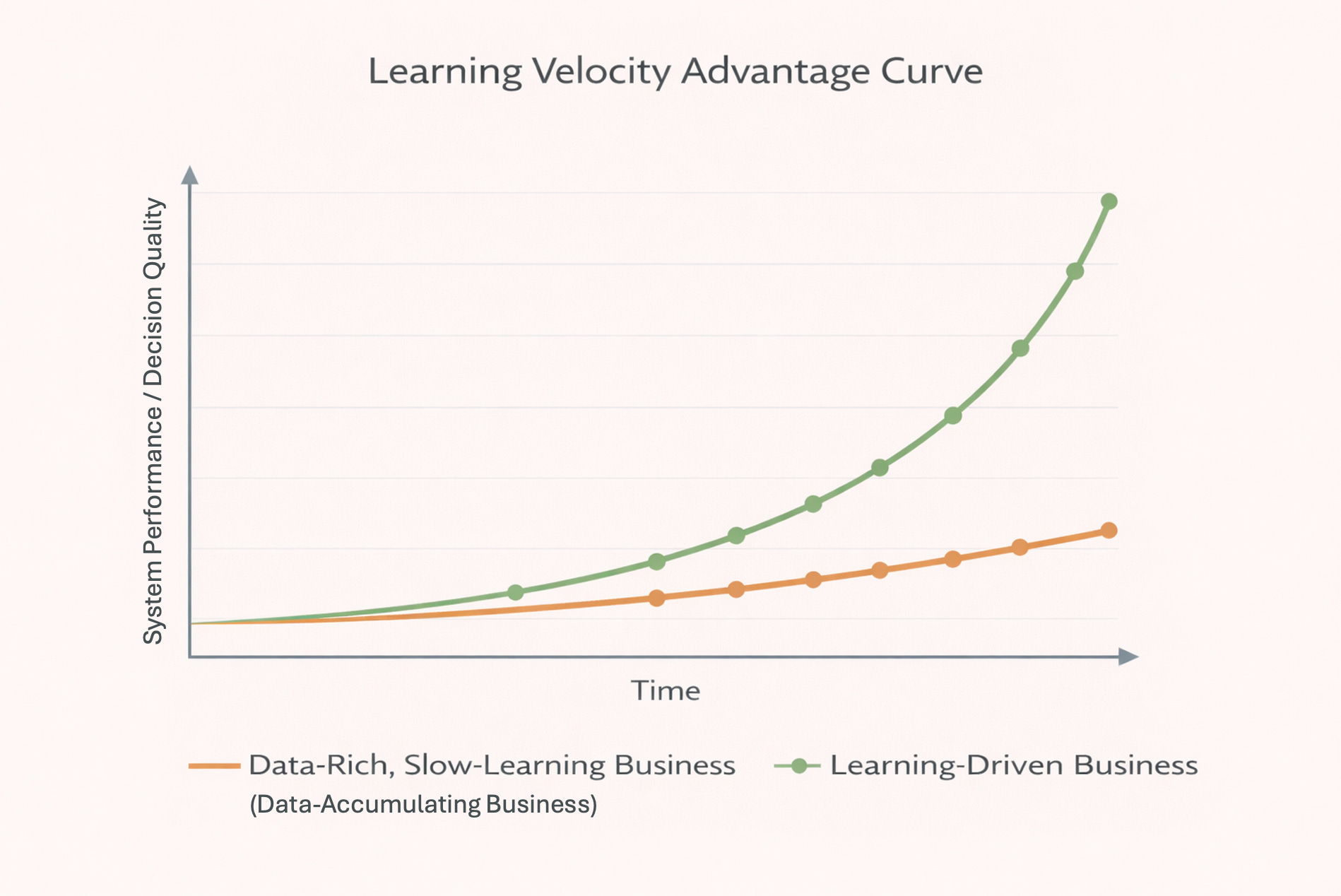
Learning-driven businesses do not just react faster. They change the system itself faster — updating assumptions, reallocating attention, and correcting errors before competitors even detect them.
This chapter explores what distinguishes learning-driven businesses from data-rich but slow organizations, why learning velocity has become the dominant competitive variable, and how continuous feedback infrastructures quietly replace traditional strategy as the engine of advantage.
TL;DR — Learning Is the New Competitive Primitive
Companies that learn faster out-compete others because they close feedback loops more tightly, translate signals into decisions more quickly, and adapt system behavior before rivals can copy surface-level features. In the AI era, advantage comes less from what you build and more from how fast your system improves itself.
Table of Contents
Why Learning Speed Now Beats Scale
From Data-Driven to Learning-Driven Organizations
Learning Velocity as a Strategic Variable
Feedback Infrastructure as Competitive Advantage
Case Patterns: Who Learns Fast — and Why
When Organizations Stop Learning
Designing for Continuous Learning
Closing Thought — Strategy as Adaptive Capacity
1. Why Learning Speed Now Beats Scale
For much of the platform era, scale created durable advantage. Larger networks generated more data, more liquidity, and stronger feedback loops. Learning was implicit and often slow, mediated through quarterly reviews, dashboards, and human interpretation.
AI collapses that timeline.
When decisions are increasingly automated, and models continuously adapt, the limiting factor is no longer data availability. It is how quickly the organization can detect signal, decide, and act.
Two companies may see the same information. One adjusts in days. The other takes months. Over time, that delta compounds more powerfully than any single product innovation.
This is why learning speed now dominates scale as a source of advantage. The market no longer rewards size alone. It rewards adaptive capacity.
2. From Data-Driven to Learning-Driven Organizations
Most organizations today describe themselves as data-driven. Far fewer are learning-driven.
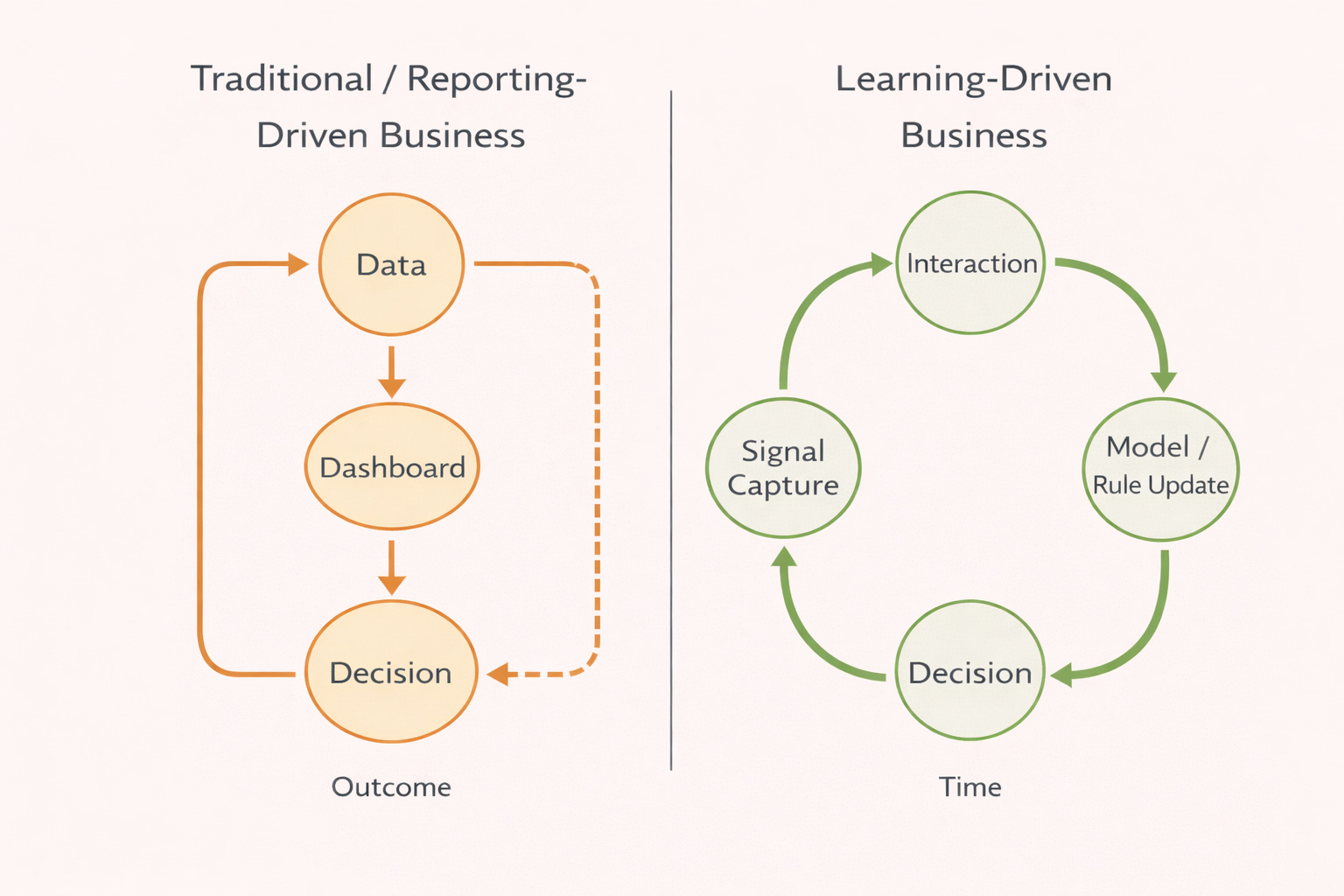
The distinction is subtle but critical.
Data-driven organizations emphasize collection, reporting, and analysis. They invest heavily in pipelines, dashboards, and analytics teams. Insights are produced, reviewed, and debated. Action follows — often slowly.
Learning-driven organizations invert this sequence.
They design systems where data is captured explicitly to improve future behavior, not merely to explain past outcomes. Feedback is operational, not retrospective. Learning happens continuously, not episodically.
In these systems:
Signals are captured at the point of interaction
Feedback is routed directly into decision logic
Improvements are deployed incrementally and observed immediately
Learning is not a project. It is the system’s default mode.

What follows explains how learning velocity is built, why it compounds inside feedback infrastructure, and how organizations quietly lose it long before metrics reveal the damage.
