
How Scale Can Erode UX, Trust And Relevance
#129: 6.3 — Network Effects Decay & Inversion

If network effects create power, they also create gravity.
The same forces that compound value at early scale can, beyond a threshold, begin to degrade user experience, distort incentives, and invert trust. In 2025, this is no longer an edge case — it’s a defining failure mode of mature platforms and AI-powered aggregators alike.
The uncomfortable truth:
Network effects do not grow indefinitely.
They decay. And if unmanaged, they invert.
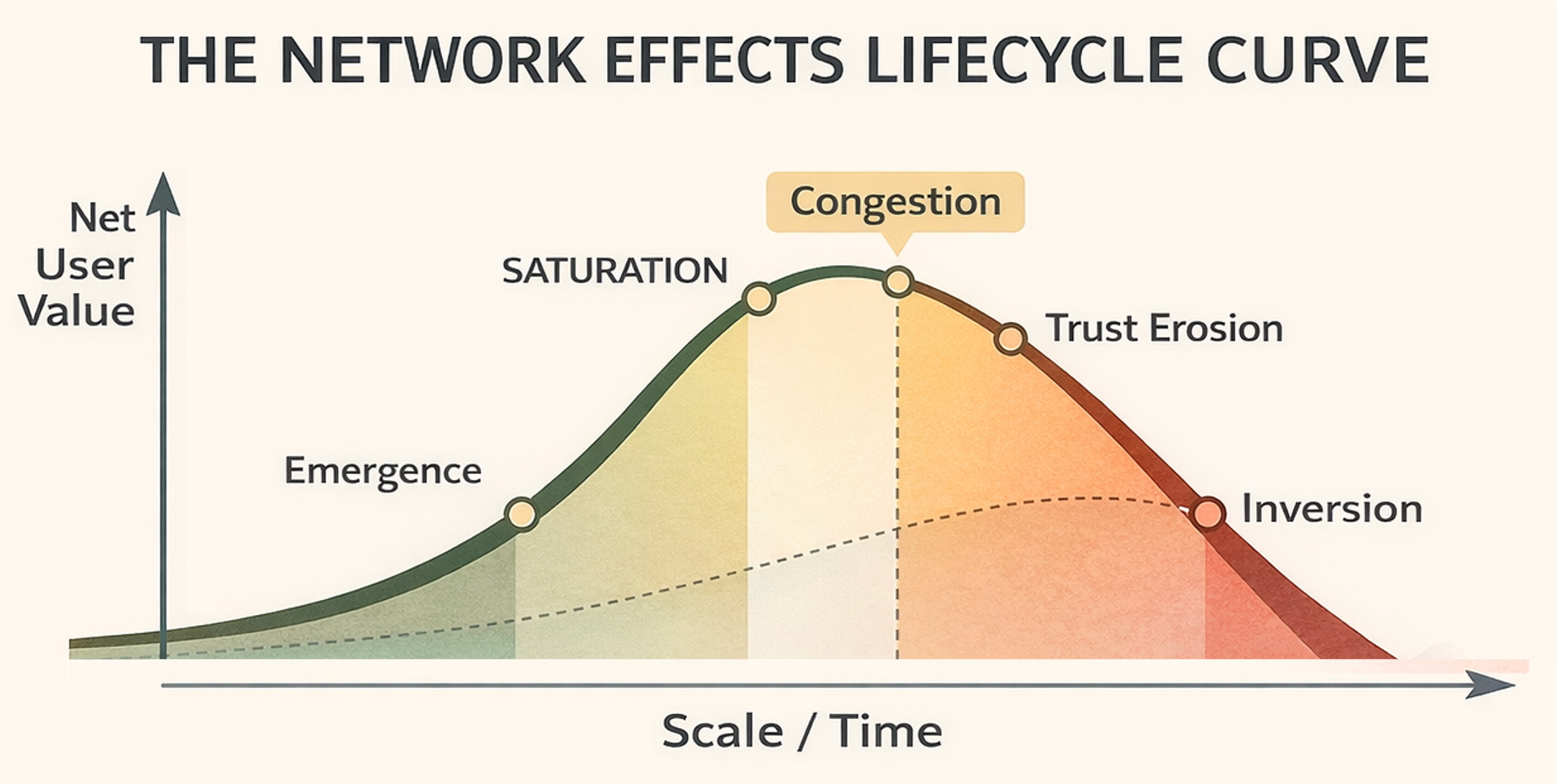
This chapter explores how and why that happens — and what strategists should learn from the platforms already living through it.
TL;DR: Network Effects Decay when scale outpaces relevance, trust, and governance.
They invert when the system starts optimizing for itself rather than for users.
Table of Contents
The Myth of Perpetual Network Effects
From Compounding to Congestion
Network Effects Inversion: When Scale Turns Against the User
Caselets: Netflix, Facebook, Uber
Early Warning Signals of Network Decay
Strategic Guidance: Designing for Graceful Degradation
Closing Thought — From Scale Obsession to System Stewardship
1. The Myth of Perpetual Network Effects
Classic platform theory taught us a simple arc:
More users → more value → more users.
That logic held when networks were:
relatively simple
lightly regulated
limited in scope
and aligned with user incentives
But modern platforms — especially AI-powered ones — are multi-loop systems. They coordinate users, data, models, tools, advertisers, regulators, and developers simultaneously.
At this level of complexity, scale stops being linear.
Instead, networks face a new question:
Does additional scale still increase value — or does it dilute it?
This is where network effects decay begins.
2. From Compounding to Congestion
Network effects decay when marginal participants add less value than friction.
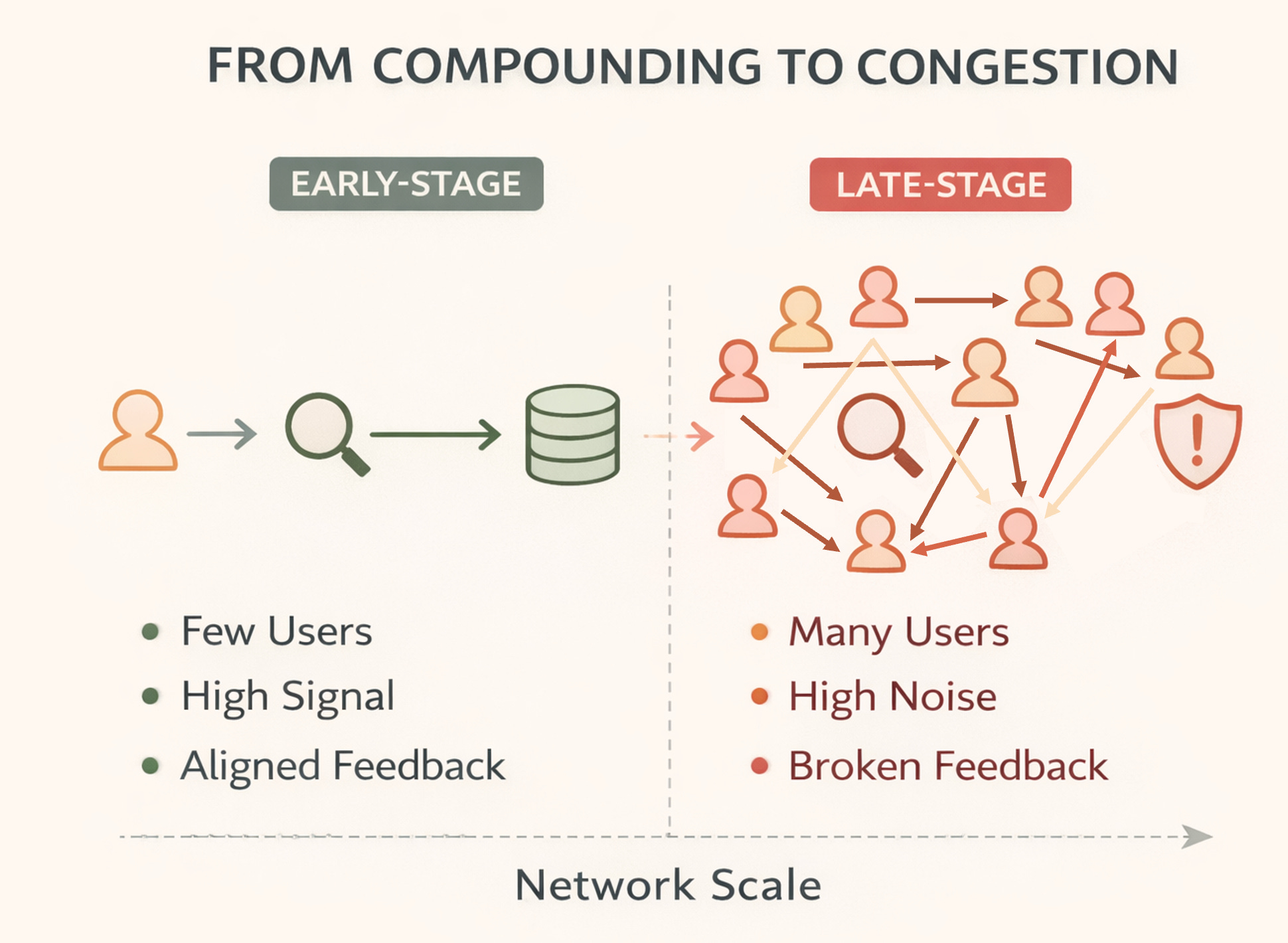
At early stages:
each new user improves discovery
data quality rises
matching improves
trust compounds
At later stages:
attention fragments
incentives misalign
moderation costs rise
signal-to-noise collapses
The system doesn’t break suddenly.
It slows, clogs, and dulls.
This is congestion — not technical, but cognitive, economic, and institutional.
In AI-mediated systems, congestion often shows up as:
worse recommendations
irrelevant personalization
tool overload
declining perceived quality despite “better” models
Scale continues. Value does not.

