


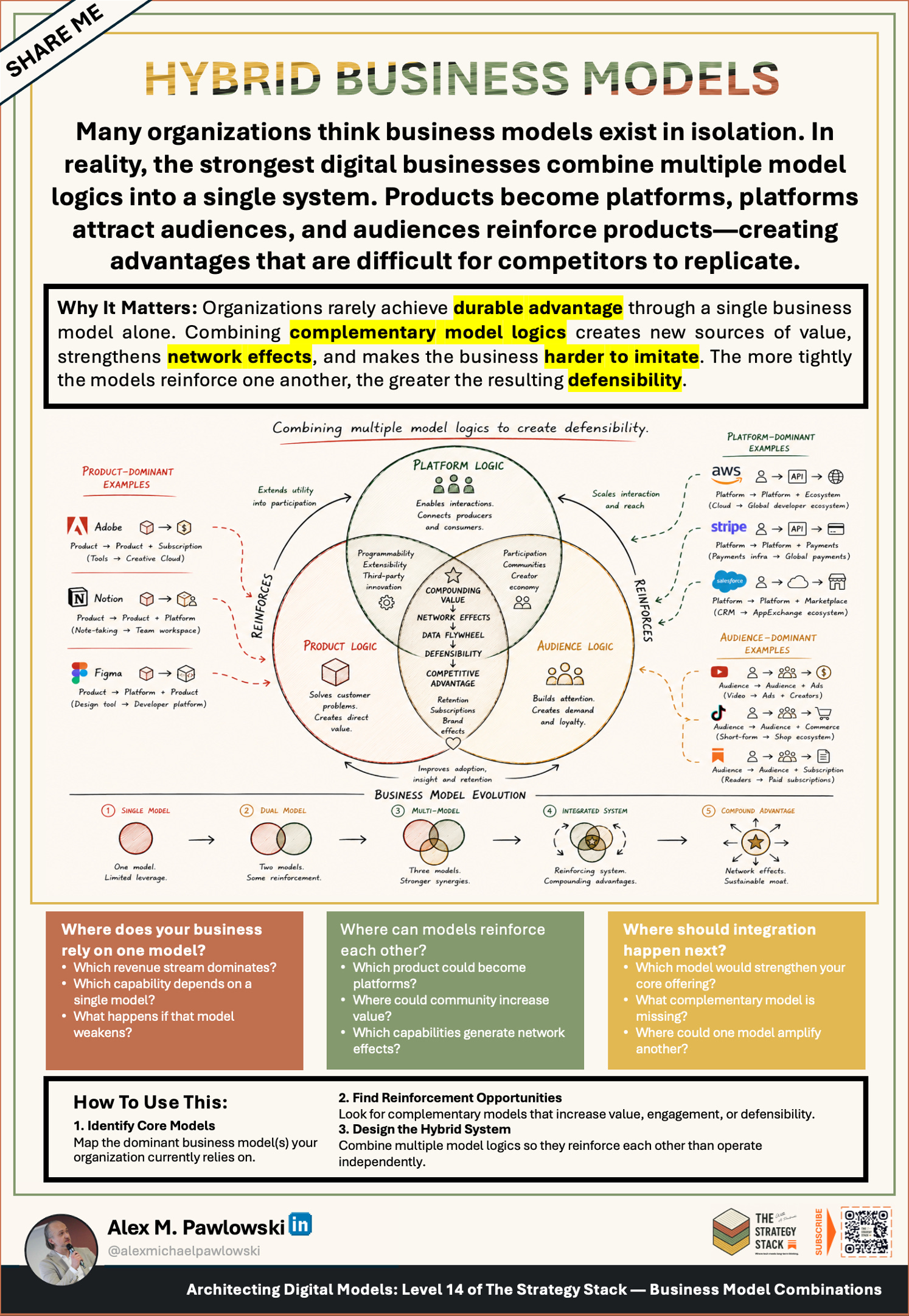
Many durable digital businesses run on more than one model logic at once.
Product logic → solves a customer problem directly.
Platform logic → enables interactions between participants.
Audience logic → builds attention, demand, and loyalty over time.
A business can be strong in one logic and still hit a ceiling. Product-only firms scale with the roadmap — and lose ground when features are copied. Platform-only firms face cold-start problems. Audience-only firms monetize attention they do not fully control.
Hybrids matter when a second or third logic reinforces the first — not when it is bolted on for diversification’s sake.
The Model: Three Logics, One System
Each logic creates value differently:
Product → direct utility, retention through solving jobs
Platform → extensibility, third-party innovation, network participation
Audience → demand, insight, brand, community effects
Where logics overlap, reinforcement appears:
Product + Platform → programmability, APIs, ecosystem extensions
Platform + Audience → participation, creator economies, community-driven supply
Product + Audience → subscriptions, brand loyalty, feedback loops that improve the product
The strategic question is not “which model are we?” but which logic should we add next - and how will it strengthen what we already have?
Evidence: When the Additional Logic Is Unmistakable
Not every product evolution is a hybrid. Subscription packaging or team features can strengthen a single logic without adding a new one. Useful examples show distinct logics operating together:
Shopify — commerce product and infrastructure (product) + app store and developer ecosystem (platform) + merchant community and partner network (audience). Merchants stay for the product; the platform extends capability; the ecosystem creates discovery and retention Shopify could not build alone.
Apple — devices and services (product) + App Store and developer standards (platform) + installed base, direct customer relationships, and brand/community effects. Each logic reinforces the others; removing one weakens the whole.
YouTube — combines a multi-sided platform with enormous audience demand and monetization/product layers for advertisers and creators. The hybrid is the business; reducing it to a single logic would describe a different company.
Contrast with a tools vendor moving from perpetual licenses to subscription: that is primarily a monetization and delivery change within product logic — valuable, but not the same as integrating platform or audience mechanics.
The Failure Pattern
Hybrids fail when logics compete rather than reinforce:
Platform APIs added to a product never designed for extensibility
Audience monetization that erodes product trust
Platform governance that starves the core experience
“Ecosystem strategy” announced before the core value unit is durable
Integration without alignment adds complexity without advantage.
How to Use This Framework
1. Identify which logics you actually run today
Revenue streams and capabilities, not aspiration slides.
2. Find where you are single-logic fragile
What breaks if competitors copy your feature set, or if a platform changes terms?
3. Design the next integration deliberately
Which logic would strengthen the value unit — and what must be true in the core before you add it?
Diagnostic questions:
Where does the business rely on one logic?
Where can a second logic reinforce the first without diluting it?
What would “hybrid” mean in operational terms — not just in a pitch deck?
👉 Unlock the Strategy Stack
…and access the Business Model Series, advanced Cheat Sheets, the Operator Vault, and various essays at the intersection of strategy and technology.
In this series →

Read next →

Go deeper →
