
JTBD for Digital Founders: Why Users Adopt Anything at All
#135: Why users switch only when progress stalls — and how demand actually enters digital systems

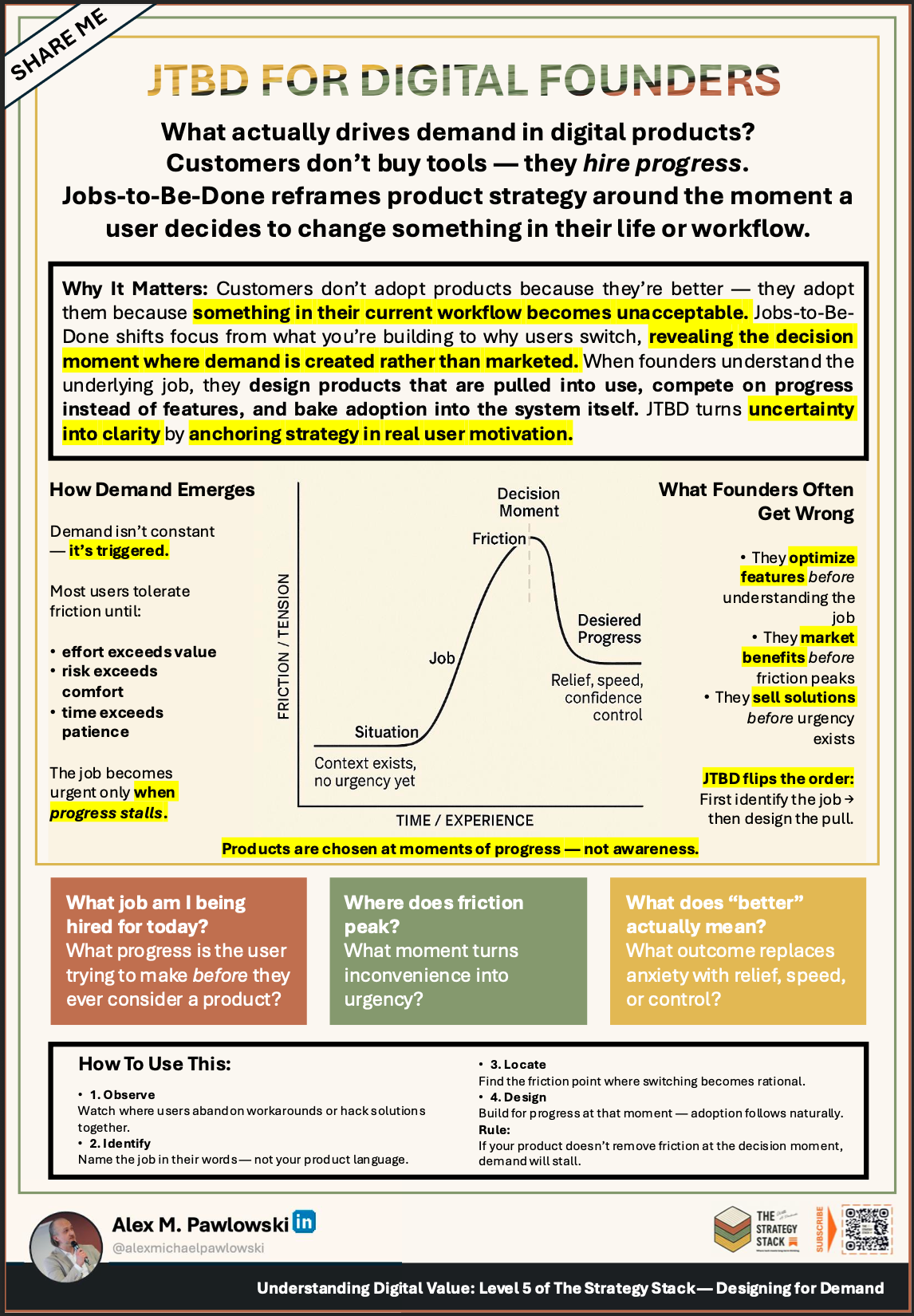
Most founders think demand is something you generate.
Through marketing.
Through awareness.
Through better features.
That’s not how adoption actually works.
Users don’t adopt products because they’re better.
They adopt because something in their current workflow becomes unacceptable.
Demand doesn’t grow gradually.
It’s triggered.
Until you understand when and why that trigger happens, you’ll keep optimizing the wrong thing.
Why This Matters
Most product strategy starts too late.
Founders ask:
How do we position this?
Which features should we build?
How do we differentiate?
But users ask a different question entirely:
“Is it worth switching right now?”
Jobs-to-Be-Done (JTBD) shifts the focus from what you’re building to why users switch.
It reframes demand around a decision moment — not awareness, not preference, not satisfaction.
This matters because:
Users tolerate friction longer than founders expect
Adoption only happens when progress stalls
Most products are evaluated after the decision is already made
If you miss the switching moment, demand never materializes — no matter how good the product is.
The Core Shift: From Features to Progress
Customers don’t buy tools.
They hire products to make progress.
That progress might be:
Reducing anxiety
Saving time
Gaining control
Avoiding risk
Restoring confidence
JTBD asks one question above all others:
What progress is the user trying to make — and what makes the current situation intolerable?
Demand emerges when the cost of staying exceeds the cost of switching.
Not when a feature is announced.
Not when a benefit is explained.
Not when awareness increases.
How Demand Actually Forms
Demand isn’t constant.
It’s triggered.
Most users tolerate friction until:
Effort exceeds value
Risk exceeds comfort
Time exceeds patience
Before that point, the job exists — but it isn’t urgent.
The critical moment is when:
Progress stalls.
That’s when switching becomes rational.
JTBD focuses on identifying that decision moment, not persuading users earlier.
This is why so many products feel invisible until suddenly they’re essential.
What Founders Often Get Wrong
Most teams invert the sequence.
They:
Optimize features before understanding the job
Market benefits before friction peaks
Sell solutions before urgency exists
This creates a familiar failure mode:
Strong messaging.
Weak adoption.
Confusing churn.
JTBD flips the order:
Identify the job
Locate the friction peak
Design for progress at that moment
When the product removes friction at the decision point, adoption follows naturally.
What a Healthy Demand System Looks Like
Products designed around jobs behave differently:
Adoption feels obvious, not forced
Users pull the product into their workflow
Marketing clarifies — it doesn’t convince
Switching feels inevitable, not risky
The product doesn’t compete on features.
It competes on progress.
And progress is evaluated in moments — not roadmaps.
The Questions That Matter
If you want to apply JTBD honestly, start here:
What job is the user trying to get done before they consider a product?
Where does friction peak?
What turns inconvenience into urgency?
What outcome replaces anxiety with relief, speed, or control?
If the product disappeared, what workaround would users immediately rebuild?
If you can’t answer these clearly, demand hasn’t entered the system yet.
About the Cheat Sheet (And Why Some Depth Is Gated)
The JTBD for Digital Founders Cheat Sheet helps you:
See how demand actually forms
Identify real switching moments
Design for progress instead of features
Anchor strategy in user motivation
It shows you the structure.
When you start asking:
“Which job should we prioritize?”
“Where exactly does switching become rational?”
“What breaks if we scale this job?”
That’s where the paid layer begins.
Because once demand is real, decisions carry consequences.
Which Tier Is Right for You?
Choose Free if you:
Want to understand why users switch
Are learning how demand really forms
Prefer clarity over execution depth
Choose Paid if you:
Design products or platforms
Make decisions under uncertainty
Want frameworks that guide real trade-offs
If adoption matters — paid pays for itself.
Why This Exists
Most strategy fails at the moment it should help most —
when decisions must be made under uncertainty.
Frameworks explain the world.
They rarely tell you what to do inside it.
The Strategy Stack exists to close that gap:
from understanding → judgment
from insight → decision
from theory → execution
Every layer exists for a reason.
Every upgrade moves you closer to usable strategy.
👉 Unlock the Strategy Stack
…and access the Business Model Series, advanced Cheat Sheets, the S-Vault, and various essays at the intersection of strategy and technology.

Hit subscribe to get it in your inbox. And if this spoke to you:
➡️ Forward this to a strategy peer who’s feeling the same shift. We’re building a smarter, tech-equipped strategy community—one layer at a time.
Let’s stack it up.
A. Pawlowski | The Strategy Stack
When using building anything you need a strategy.
This is a really good business approach for AI. 🙏🏾