


When we talk about network effects, most people jump to the obvious:
“The more users join, the more valuable it becomes.”
That’s true — but it’s also shallow.
In 2025, the real challenge isn’t just growing a network. It’s making it resilient:
Can it scale without breaking?
Can it govern without slowing?
Can it adapt without losing trust?
Today’s drop takes a strategy-first look at network design — using the metaphor of a modern city to unpack what really makes ecosystems thrive. It’s not just about what’s built. It’s about how it all connects.
Why Think of Networks Like Cities?
Cities don’t grow because one building goes up.
They grow because roads, governance, utilities, rules, and people scale together.
Digital ecosystems — whether in Web3, AI platforms, or SaaS marketplaces — behave the same way.
If you want long-term value, you need to design for:
Growth
Governance
Coordination
Incentive alignment
Risk containment
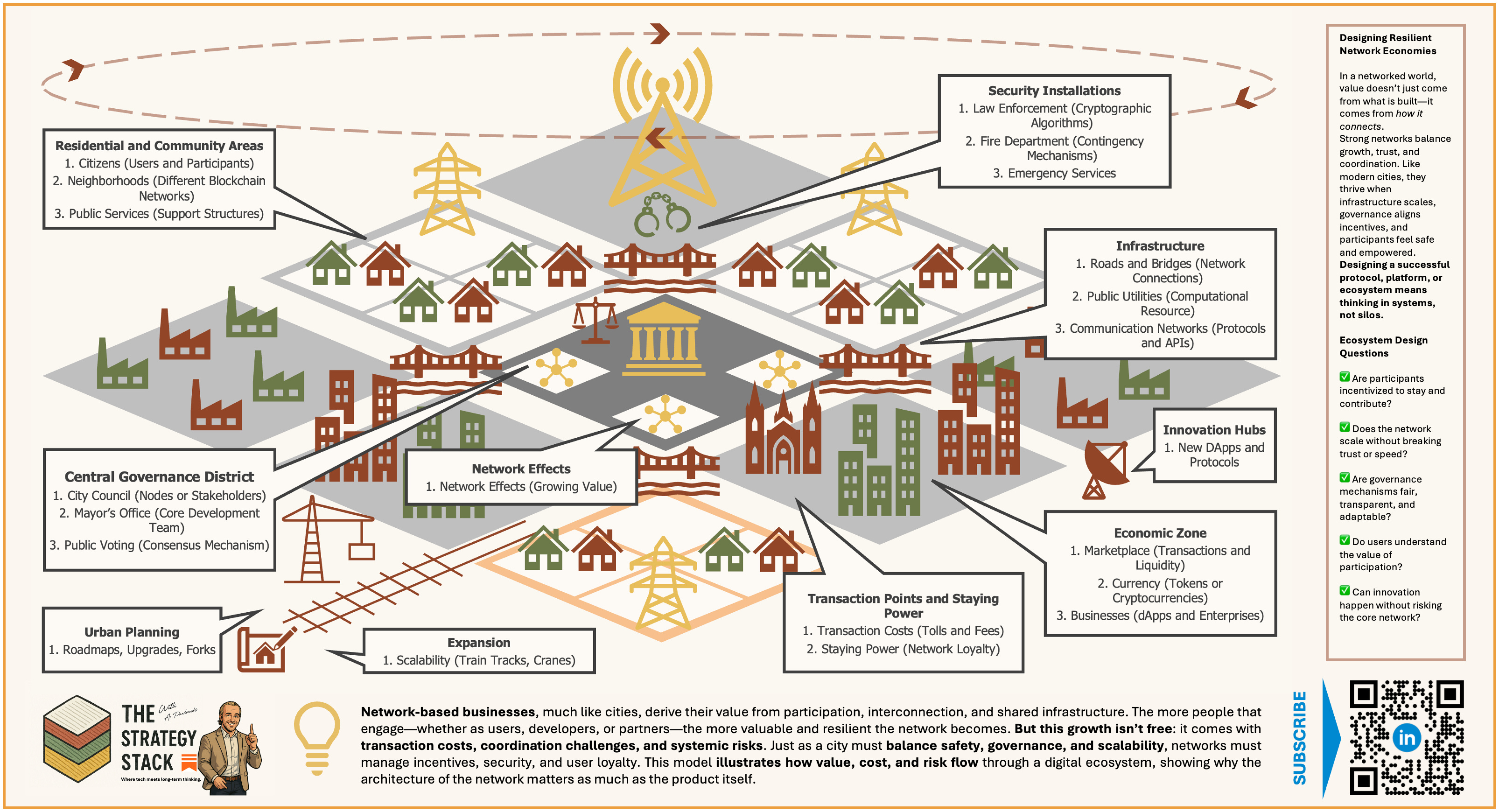
The visual you see above is built on that metaphor: a cityscape that maps how value, cost, and trust flow through a well-architected digital network.
Strategic Takeaway: Network Effects ≠ Viral Loops
Let’s redefine it.
Network effects = Value increases as participation increases — only if the infrastructure, incentives, and feedback loops scale in sync.
It’s not enough to get people in.
You have to give them a reason to stay, contribute, govern, and trust.
Let’s explore the city.
1. The Central Governance District
(How coordination and rules are made)
Nodes = Stakeholders
Mayor’s Office = Core dev team
Voting = Consensus mechanism (on-chain or off)
This is the part of your ecosystem that sets direction, manages change, and protects integrity. If this fails? You lose trust, clarity, and speed.
📌 Ask yourself:
Who owns change?
How does the network evolve without splintering?
2. Residential + Community Zones
(Where users and devs “live”)
Participants = Users, contributors, partners
Neighborhoods = Subnetworks or product layers
Public Services = Support systems, docs, forums
This is where real value is created.
Strong networks invest in public goods — onboarding, support, education, open APIs — because that’s what keeps neighborhoods livable.
📌 Ask yourself:
Are participants empowered or extractively managed?
Are public goods strong enough to lower activation friction?
3. Infrastructure Layer
(How your ecosystem runs under the hood)
Roads = Network connectivity
Utilities = Compute power, storage, bandwidth
Protocols = APIs, permissions, smart contracts
No infrastructure = no throughput = no network.
It must scale with growth — without introducing fragility.
📌 Ask yourself:
Can the network survive 10x demand?
Can infrastructure adapt without breaking trust?
4. Economic Zone
(Where value flows, trades, and accumulates)
Marketplaces = Where liquidity lives
Tokens = Currency
Businesses = dApps, SaaS providers, creators
No economy = no sustainability.
This zone enables transactions — but also anchors loyalty. If incentives don’t match participation value, you get churn.
📌 Ask yourself:
Is the value distribution fair?
Can new builders and participants create wealth here?
5. Security + Risk Zones
(What happens when things go wrong)
Law enforcement = Cryptography, audit layers
Fire department = Incident response
Emergency services = Contingency protocols
Great networks bake in resilience. They assume failure — and design graceful recovery into the architecture.
📌 Ask yourself:
Are risks predictable, patchable, and shared?
Who responds when something breaks?
Strategy Application: Ecosystem Design Questions
When you assess a platform, protocol, or ecosystem, don’t just look at features.
Ask: Is this a healthy city — or a shiny facade with no roads?
Are participants incentivized to stay and contribute?
Does the network scale without breaking trust or speed?
Are governance mechanisms fair, transparent, and adaptable?
Do users understand the value of participation?
Can innovation happen without risking the core?
These aren’t theoretical.
They’re the playbook for designing modern, resilient, strategy-proof ecosystems — whether you're building a product, a platform, or an org.
Final Thought: Network Strategy Is System Design
A product can be viral.
A feature can be clever.
But a resilient network? That’s system-level work.
It requires urban planning, not just growth hacking.
And it’s what separates fleeting buzz from enduring scale.
Knowing the urban-planning metaphor is step one. The strategic question is how ecosystems compound — and what you build on top of network effects.
Paid subscribers get Platform Strategy 2026 — how living economies actually work — and Why AI Features Don’t Compound — when network scale turns into durable advantage. For the operating model layer, add The Agentic Operating Model.

Hit subscribe to get it in your inbox. And if this spoke to you:
➡️ Forward this to a strategy peer who’s feeling the same shift. We’re building a smarter, tech-equipped strategy community—one layer at a time.
Let’s stack it up.
A. Pawlowski | The Strategy Stack
Great breakdown!