
Optionality & Strategic Flexibility
Strategic optionality — how to design businesses that evolve into platforms, spin-offs, and ecosystem nodes.


Over the past few months, I’ve found myself noticing the same pattern in companies that, on the surface, have very little in common.
OpenAI began as a research lab before becoming a developer platform. Amazon built cloud infrastructure to solve an internal problem, only to discover it had created one of the most valuable businesses in history. Shopify started by helping merchants build online stores and gradually evolved into a financial infrastructure company powering payments, lending, logistics, and an ecosystem of third-party developers.
None of these organizations followed the path they originally set out to pursue.
Their products changed.
Their customers expanded.
Their revenue models evolved.
In some cases, their role within the broader economy changed entirely.
What remained surprisingly consistent were the underlying capabilities they had spent years developing. The knowledge accumulated inside the organization continued to solve increasingly different problems, often in markets that barely existed when those capabilities were first created.
That observation has made me rethink something we rarely question in strategy.
We often speak about business models as though they represent relatively stable destinations. Companies choose one, optimize it, defend it, and eventually replace it when markets change.
Increasingly, that no longer reflects how many of today’s most successful organizations actually evolve.
Digital businesses rarely move through a sequence of disconnected business models. More often, they grow by expressing the same capability architecture in different ways over time. A capability that initially supports one product gradually becomes useful elsewhere. An internal service becomes a commercial offering. A customer-facing application evolves into infrastructure that thousands of other businesses build upon. Sometimes the company becomes the platform. Sometimes it becomes an indispensable participant within someone else’s ecosystem. Occasionally, an entirely new company emerges from capabilities that originally existed only to support the first.
The interesting question is no longer whether businesses should adapt.
Adaptation has always been part of competition.
The more interesting question is why some organizations seem capable of repeatedly discovering entirely new futures while others struggle to move beyond the products that originally made them successful.
The previous article argued that capabilities are gradually replacing departments as the fundamental building blocks of the modern firm. If organizations are increasingly understood as networks of capabilities rather than collections of functions, another implication follows naturally.
The architecture of those capabilities does more than determine what a company can do today.
It determines what the company can become tomorrow.
That is where optionality enters the discussion.
Optionality is often treated as a financial concept associated with investment portfolios, venture capital, or risk management. While those interpretations remain valuable, they capture only part of its strategic significance.
In an economy where knowledge, software, artificial intelligence, and digital infrastructure can be recombined at unprecedented speed, optionality increasingly becomes an architectural property of the organization itself. It reflects how many credible future business models the firm’s existing capabilities can support without requiring the company to reinvent itself from scratch.
Some organizations unintentionally design themselves into strategic dead ends.
Others quietly preserve multiple paths forward.
The difference is rarely visible in this quarter’s earnings.
It becomes obvious over the following decade.
This article explores how organizations can deliberately preserve that freedom. Rather than treating platforms, spin-offs, and ecosystem participation as independent strategic choices, I argue that they are often different evolutionary paths emerging from the same underlying capability architecture. Strategic flexibility, in other words, is less about keeping every option open than about designing the organization so that valuable new options continue to emerge.
TL;DR — The Strategic Essence
Business models are becoming increasingly fluid. As capabilities detach from individual products and become reusable across multiple contexts, organizations gain the ability to evolve into entirely different forms without abandoning the knowledge they have accumulated. Some capabilities become platforms that enable others to build. Others mature into independent businesses through spin-offs. Many create greater value by becoming indispensable ecosystem nodes inside larger networks rather than by owning the ecosystem themselves.
Strategic optionality is therefore no longer best understood as a financial concept. It is an architectural characteristic of the firm that reflects how easily capabilities can be recombined into future products, services, and business models. Organizations that deliberately preserve this flexibility are better positioned to adapt as technologies mature, industries converge, and new opportunities emerge. In an environment where competitive advantages decay more quickly than ever before, designing for evolution increasingly becomes as important as optimizing for execution.
Table of Contents
From Business Models to Business Model Evolution
Understanding Strategic Optionality
Three Evolutionary Paths
Designing Organizations That Can Evolve
Closing Thought — Preserving Futures
1. From Business Models to Business Model Evolution
One of the most enduring assumptions in strategy is that organizations compete through business models.
Companies choose how they create value, how they capture value, and which customers they serve. They refine that model over time, defend it against competitors, and occasionally reinvent it when markets shift. Entire management disciplines have emerged around designing, optimizing, and scaling business models more effectively.
That perspective has served organizations remarkably well.
It has also encouraged us to think about business models as relatively stable destinations.
Once the right model has been identified, the strategic challenge becomes execution.
History tells a more complicated story.
Very few of the world’s most influential companies look today the way they did when they first achieved success. Amazon began as an online bookstore before expanding into retail infrastructure, cloud computing, digital advertising, logistics, entertainment, and artificial intelligence. Shopify initially helped entrepreneurs build simple online stores before evolving into a broader commerce infrastructure that today encompasses payments, financing, fulfillment, identity, and one of the largest developer ecosystems in commerce. NVIDIA spent much of its history selling graphics processors before its accumulated expertise in parallel computing unexpectedly became foundational infrastructure for modern artificial intelligence.
Looking backwards, these transitions often appear inevitable.
Looking forwards, they rarely were.
None of these companies published a master plan describing every stage of their evolution twenty years in advance. They responded to opportunities that became visible only after their existing capabilities reached sufficient maturity. Their future business models were discovered through the capabilities they had already developed rather than designed independently from them.
That distinction matters because it changes where strategy begins.
Traditional strategic planning often follows a relatively linear sequence. Organizations identify an attractive market, define a product or service, build the capabilities necessary to support it, and then optimize execution. Capabilities exist largely in service of the chosen business model.
Increasingly, the relationship appears to be reversing.
Capabilities themselves become the primary strategic asset, while business models become temporary expressions of what those capabilities make possible at a particular point in time.
This perspective does not diminish the importance of business models. Products still need customers. Revenue models still determine economic viability. Organizations still require strategic focus.
It simply suggests that the business model visible today represents only one possible expression of a deeper organizational architecture.
The capability remains.
Its application evolves.
This becomes easier to understand when viewed through the lens developed in the previous chapter.
Capabilities accumulate knowledge rather than simply performing tasks. They improve through repeated use, generate increasingly valuable data, become more efficient over time, and frequently discover applications beyond the problem they were originally designed to solve. A payment capability built to simplify online checkout gradually becomes useful for fraud detection, merchant financing, treasury management, identity verification, and international settlement. The underlying capability continues learning even as the surrounding business evolves.
Products, by contrast, rarely enjoy that kind of longevity.
They emerge.
They mature.
Eventually they become less relevant as technologies, customer expectations, or competitive conditions change.
Capabilities often survive every one of those transitions.
Perhaps strategy has been looking at organizations from the wrong altitude.
Instead of asking which business model a company should pursue, leaders may increasingly benefit from asking what their capability architecture makes possible over the next decade. The answer will rarely be limited to a single product, market, or revenue stream.
It is increasingly a portfolio of plausible futures.
This is one of the reasons the language surrounding “pivots” often feels unsatisfactory.
The word implies a dramatic change in direction, almost as though successful organizations periodically abandon one identity in favor of another. Certainly, there are examples where that description fits. Slack emerged from the remnants of a failed gaming company. Netflix moved from DVD rentals into streaming before becoming a global content producer. Adobe fundamentally reshaped its economics through the transition to subscription software.
Yet many of the most successful strategic transformations look less like pivots than evolutions.
The organization does not suddenly become something different.
It gradually discovers additional expressions of capabilities it already possesses.
The transition appears dramatic only when viewed through the products being sold.
Viewed through the capabilities being developed, the path often looks remarkably continuous.
That observation suggests a useful distinction.
Products evolve through life cycles.
Capabilities evolve through learning curves.
Business models evolve through recombination.
The future rarely arrives by replacing everything an organization already knows. More often, it emerges from rearranging that knowledge into forms that create value under new technological and economic conditions.
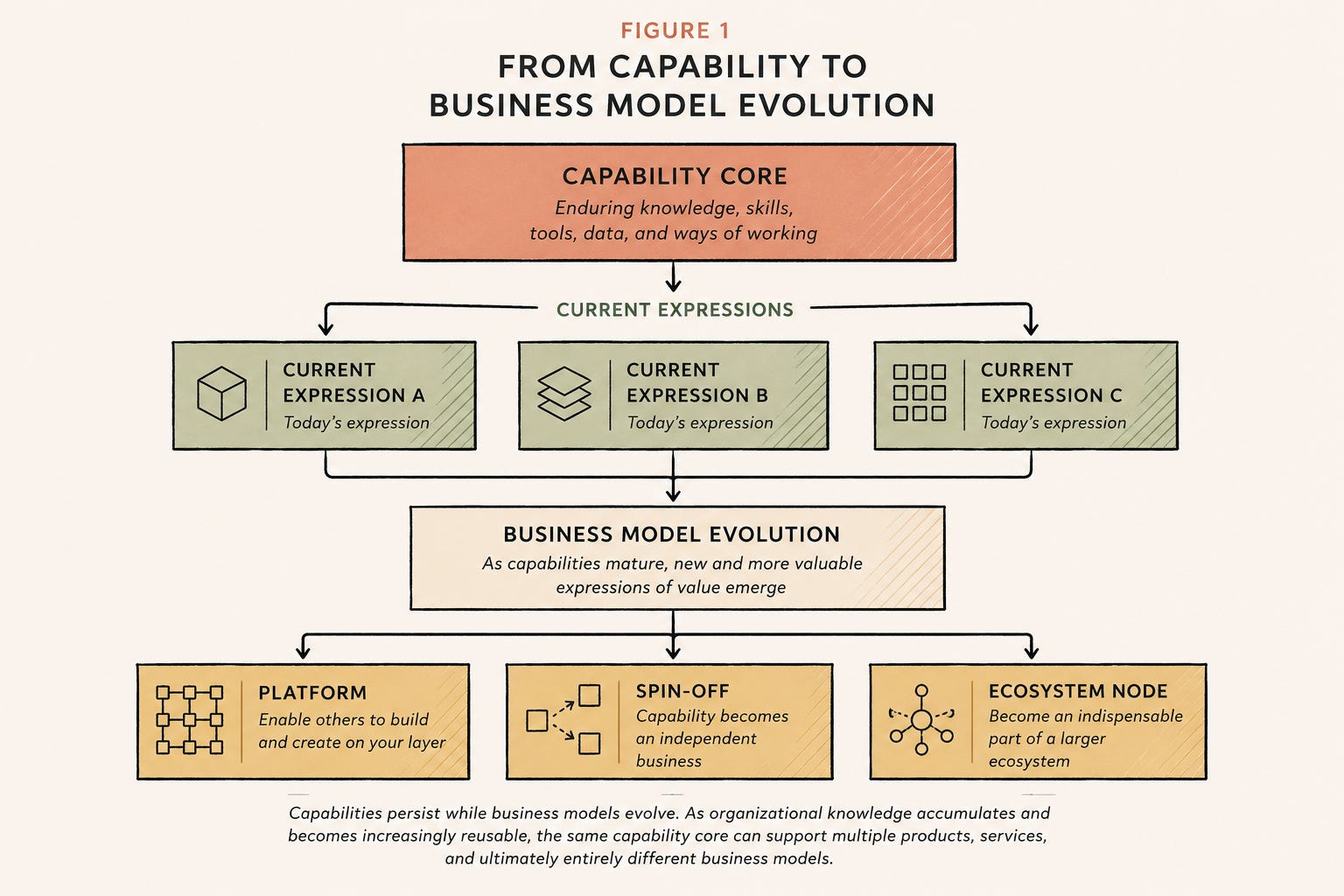
If capabilities increasingly represent the enduring layer of the firm, business models become something more fluid than strategy has traditionally assumed.
They become temporary organizational configurations rather than permanent strategic identities.
That idea naturally raises another question.
If business models are becoming increasingly fluid, what determines how many different futures an organization can realistically pursue?
The answer lies in strategic optionality.
2. Understanding Strategic Optionality
The word optionality has become increasingly popular in business discussions, yet it often remains surprisingly vague.
Sometimes it refers to maintaining flexibility.
Sometimes it describes diversification.
Sometimes it simply means avoiding commitment.
None of these interpretations fully capture why optionality has become strategically important.
The concept originally emerged from finance. An option derives value from preserving the right—but not the obligation—to pursue a future course of action. Investors purchase options because uncertainty creates opportunities that cannot always be predicted in advance. The value lies less in making a decision today than in preserving the ability to make a better decision tomorrow as new information becomes available.
Organizations face a remarkably similar challenge.
Markets evolve continuously. Technologies mature at uneven speeds. Regulation shifts. Customer expectations change. Entire industries increasingly converge as software, artificial intelligence, cloud infrastructure, and digital platforms dissolve historical boundaries between sectors.
The future therefore becomes progressively harder to forecast with confidence.
Traditional strategic planning often responds by attempting to improve forecasting.
An equally important response is to improve adaptability.
These approaches are fundamentally different.
One assumes uncertainty can largely be reduced through better prediction.
The other assumes uncertainty will remain an enduring characteristic of modern competition and therefore asks a different question: how should organizations be designed if the future cannot be fully anticipated?
This is where optionality becomes an architectural concept rather than merely a financial one.
Strategic optionality describes the organization’s capacity to pursue credible future business models without fundamentally rebuilding itself.
The emphasis deserves attention.
Not every imaginable future.
Credible futures.
Futures that naturally emerge from capabilities the organization has already accumulated, relationships it has already established, and knowledge it continues to strengthen through daily operation.
That distinction separates optionality from unfocused diversification.
Organizations do not create optionality by entering unrelated markets simply because opportunities appear attractive. They create optionality by deliberately investing in capabilities that remain valuable across multiple potential futures.
The underlying architecture determines whether adjacent opportunities become accessible or prohibitively expensive.
This also explains why some companies appear unusually resilient during periods of technological disruption.
When artificial intelligence accelerated over the past several years, NVIDIA benefited not because it had predicted every downstream application of generative AI, but because decades of investment in programmable parallel computing had produced capabilities that suddenly became relevant across an expanding range of industries. Microsoft’s cloud infrastructure, developer ecosystem, and enterprise distribution allowed it to integrate generative AI into products spanning productivity software, cybersecurity, software development, and enterprise search with remarkable speed. Meanwhile, companies whose core capabilities remained tightly coupled to a single product category often found themselves struggling to respond despite recognizing the same technological shift.
The difference was not awareness.
It was architecture.
Strategic optionality therefore should not be confused with indecision. Quite the opposite. Organizations with the greatest optionality often exhibit extraordinary discipline. They invest deeply in a relatively small number of capabilities, knowing that those capabilities can support many different expressions over time. Focus and flexibility are not opposing forces. At the architectural level, they frequently reinforce one another.
Perhaps the most valuable strategic question leaders can ask is therefore not “What business should we become?”
It is “What capabilities are we building today that future versions of our business will thank us for?”
That question shifts strategy away from predicting a single destination and toward deliberately expanding the organization’s future opportunity space.
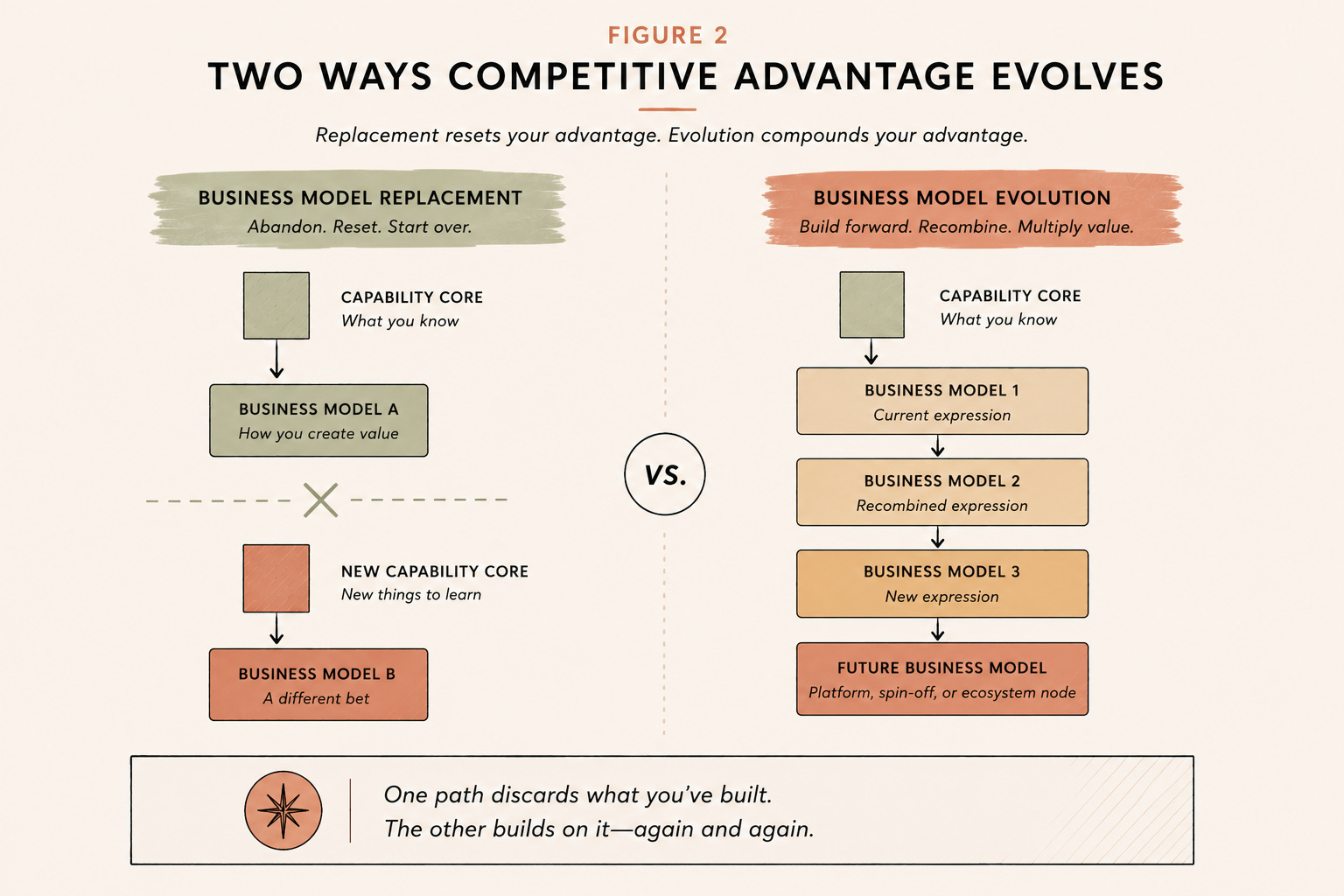
And once organizations begin thinking this way, another realization follows.
Optionality rarely produces the same destination twice.
It tends to express itself through a small number of recurring evolutionary paths. Those paths—becoming a platform, creating a spin-off, or positioning the organization as an indispensable ecosystem node—form the foundation of the next section.

