


The hardest part of building a product is choosing the right problem to solve.
Teams often invest months in interviews, workshops, and research, only to realize they’ve validated the wrong problem. The failure isn’t effort; it’s structure. Without a clear way to frame assumptions, signals, and constraints, problem discovery becomes slow, noisy, and biased.
The Problem Discovery Canvas is a lightweight framework designed to fix that. It helps teams quickly map what they believe, what they know, and what they still need to learn — before committing to solutions. Instead of replacing qualitative research, it sharpens it by making uncertainty explicit.
In this article, I’ll explain what the Problem Discovery Canvas is, when to use it, and why it’s often faster and more reliable than traditional discovery methods when you’re deciding what to build next.
Why This Matters
Most teams chase interesting ideas instead of unavoidable problems.
Which sounds harmless — until you realize what it creates:
endless pivots
weak retention
“we need better marketing” symptoms
demand that always feels forced
The truth is simple:
Value isn’t created by novelty.
It’s created by removing meaningful friction from people’s lives.
That’s why problem discovery is not a creative activity.
It’s a diagnostic process.
The Core Shift: From “What Should We Build?” to “What Is Already Pulling?”
Most founders start here:
“What could we build that’s useful?”
But useful doesn’t win.
Urgent wins.
The Problem Discovery Canvas reframes the entire question:
Instead of asking “Is this a good idea?”
You ask:
Is this pain unavoidable — and solvable right now?
Because the best products don’t convince people.
They remove the need for convincing.
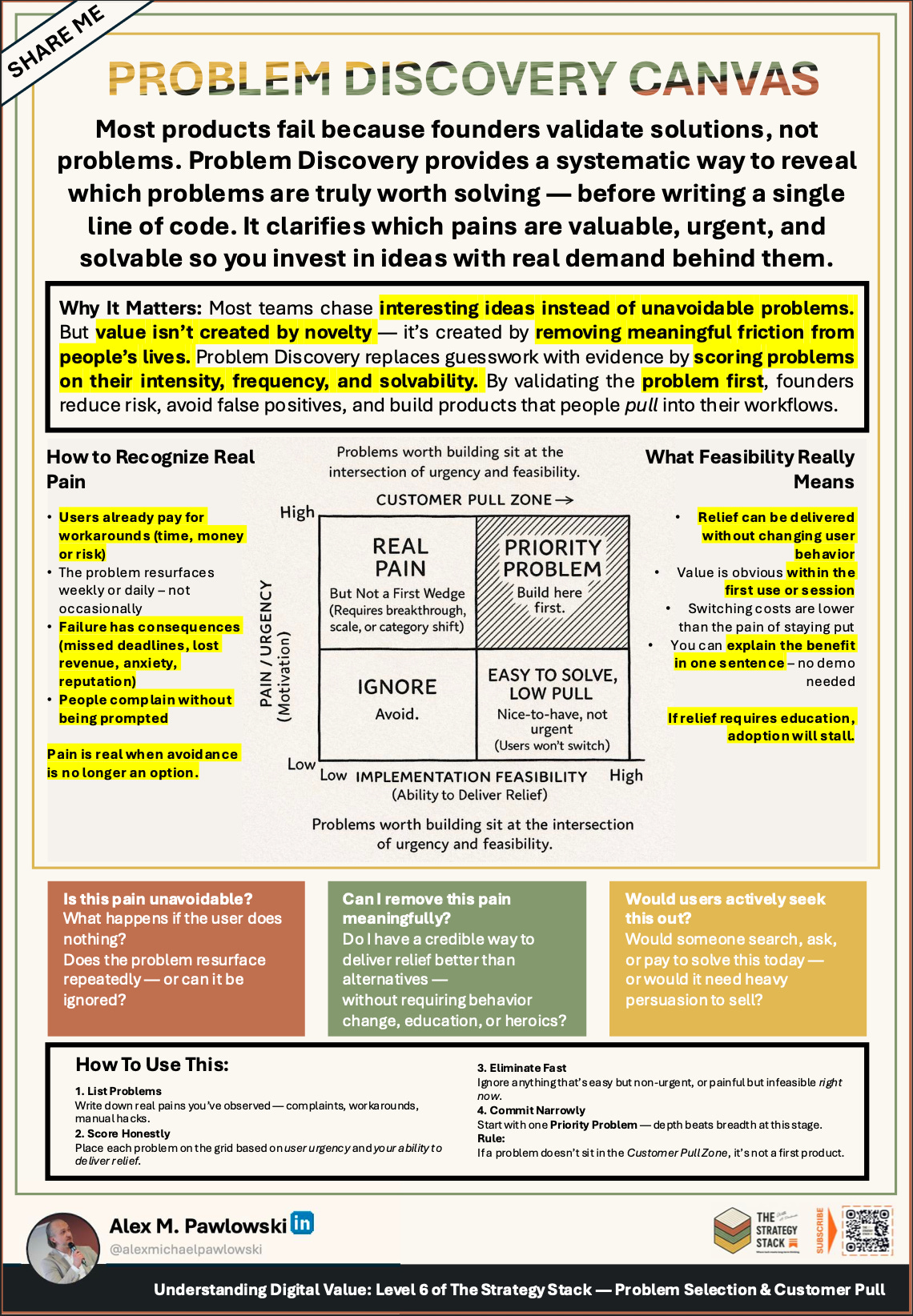
The Problem Discovery Grid
The cheat sheet scores every problem on two forces:
1) Pain / Urgency (Motivation)
How bad is the problem today?
2) Implementation Feasibility
Can you deliver meaningful relief without requiring heroic adoption?
When you combine them, you get four zones:
Priority Problem (Build Here First)
High urgency + high feasibility
This is where “customer pull” lives.
Real Pain (But Not a First Wedge)
High urgency + low feasibility
Requires breakthrough tech, a category shift, or scale you don’t have yet.
Easy to Solve, Low Pull
Low urgency + high feasibility
Nice-to-have. Users won’t switch for it.
Ignore
Low urgency + low feasibility
Not worth your time.
Your first product should live in the Customer Pull Zone — everything else is a distraction.
The entire purpose is to stop guessing.
It forces you to choose problems with gravitational force.
How to Recognize Real Pain (Before You Write a Single Line of Code)
Real pain has signals. And they’re observable.
It’s usually present when:
users already pay for workarounds (time, money, or risk)
the problem resurfaces weekly or daily (not “someday”)
failure has consequences (lost revenue, anxiety, missed deadlines)
people complain without being prompted
they’ve already built manual hacks to avoid the pain
The simplest rule is brutal:
Pain is real when avoidance is no longer an option.
If the user can ignore it indefinitely, the product is optional.
What Feasibility Actually Means (And Why Teams Misjudge It)
Feasibility is not “can we build it.”
Feasibility is:
Can relief be delivered without changing user behavior?
A problem is feasible when:
the value is obvious within the first use or session
switching costs are lower than staying stuck
you can explain the benefit in one sentence
users don’t require education just to feel progress
The key constraint:
If relief requires education, adoption will stall.
The Only Zone That Matters Early: Customer Pull
The best early products sit here:
Urgency intersects Feasibility = Pull
That’s the “first wedge” zone.
Not because the problem is the biggest in the world.
But because it’s:
intense enough to trigger action
solvable enough to show immediate relief
simple enough to spread without persuasion
This is the zone where marketing becomes easier — because the pain does the selling.
What Founders Often Get Wrong
Most founders validate the wrong thing:
They validate that people like the idea
Instead of validating that people need relief now
They confuse:
compliments with switching
interest with urgency
“would use” with “will pay today”
problem awareness with pain intensity
The result is predictable:
Good product.
Weak pull.
Then a slow death by “growth strategy.”
The Questions That Matter
Use the canvas to pressure-test your next idea:
Is this pain unavoidable?
What happens if the user does nothing?Can I remove this pain meaningfully?
Do I have a credible relief mechanism without behavior change?Would users actively seek this out?
Would they search, ask, or pay to solve it today?
If the answer is no, you don’t have a product problem.
You have a pull problem.
About the Cheat Sheet (And Why This Layer Matters)
The Problem Discovery Canvas is designed to do one thing:
Turn product selection into a system — not a vibe.
It helps founders:
score problems before building
avoid false positives
find wedge opportunities with pull
stop wasting cycles on “interesting but optional”
Most product failures don’t come from weak execution.
They come from choosing problems that weren’t urgent in the first place.
How to Use It
Use it as a 20-minute discipline:
1. List Problems
Write down real pains you’ve observed: complaints, workarounds, manual hacks.
2. Score Honestly
Place each on the grid: urgency vs your ability to deliver relief.
3. Eliminate Fast
Ignore anything easy-but-not-urgent, or painful-but-infeasible right now.
4. Commit Narrowly
Pick one Priority Problem and go deep.
Rule:
If there’s no pull, it’s not a first product.
Why This Exists
Most founders don’t need more execution advice.
They need better filters.
Because the game isn’t:
“Build faster.”
It’s:
Choose problems where speed matters.
Where relief is obvious.
And where adoption is inevitable.
That’s what creates pull.
That’s what creates momentum.
That’s what makes the rest of strategy work.
Problem discovery is the filter. Jobs-to-be-done and the value creation loop are the engine.
Paid subscribers get Jobs-to-Be-Done for Digital Founders — why users hire your product — and The Value Creation Loop — how learning compounds into pull.
👉 Unlock the Strategy Stack
…and access the Business Model Series, advanced Cheat Sheets and various essays at the intersection of strategy and technology.

Hit subscribe to get it in your inbox. And if this spoke to you:
➡️ Forward this to a strategy peer who’s feeling the same shift. We’re building a smarter, tech-equipped strategy community—one layer at a time.
Let’s stack it up.
A. Pawlowski | The Strategy Stack