
The Agentic Operating Model: Building Enterprises That Think, Learn, And Act
The agentic operating model: a framework for designing enterprises that think, learn, and act on their own.

In short: An agentic operating model is a way of running a company where AI agents are embedded into core operations to think, learn, and act alongside people — not bolted on as features. After two years of racing to adopt AI, the firms pulling ahead are redesigning the operating model itself. This essay lays out how to build one.
Over the past two years, companies have raced to integrate AI into their operations. Billions have been spent on pilots, platforms, and AI-powered assistants. Yet for many enterprises, the promised value remains elusive. Instead of transformation, most have ended up with scattered automation projects and dashboards that still require humans to babysit decisions.
What’s missing isn’t better models or more tooling—it’s a better operating model for ai agents.
An agentic operating model is the organizational framework for running a business where AI agents don’t just execute tasks, but actively participate in decision-making: interpreting intent, coordinating work, adapting to context, and improving based on outcomes. Without this shift, AI stays stuck in “tool mode,” where every workflow ultimately escalates back to a human.
That mindset—tool-thinking—assumes humans are the brains and systems are just the hands. It worked in a world of static goals, simple interfaces, and predictable environments. But it breaks down when agents can plan, reason, collaborate, and operate continuously across systems.
A different approach—agentic thinking—moves beyond tools. In an agentic operating model, humans and agents think together. Agents suggest strategies, execute within clear constraints, and learn from feedback loops. This agentic economic shift changes how companies scale work, govern decisions, measure performance, and design accountability.
In this article, you’ll learn:
what an agentic operating model is (and what it isn’t)
the core building blocks enterprises need
common failure modes and how to avoid them
What Is an Agentic Operating Model?
An agentic operating model is the enterprise framework for running a business where AI agents can interpret intent, plan work, execute actions, and learn from outcomes—within clear governance and human decision boundaries. Unlike traditional automation, it enables distributed decision-making and continuous adaptation across teams and systems.
Why Enterprises Need an Agentic Operating Model Now
Over the last decade, digital transformation focused on digitizing legacy processes, centralizing data, and streamlining workflows through cloud platforms and automation tools. These efforts delivered operational efficiency but rarely produced lasting competitive advantage. Everyone gained access to the same systems, dashboards, and RPA bots.
The underlying model stayed the same: humans made decisions, and systems executed those decisions. Even advanced AI, such as recommendation engines or chatbots, was bolted onto existing processes without altering how the organization thought or learned.
Autonomous agents change the equation. These systems can interpret goals, adapt workflows dynamically, and act on behalf of the organization without continuous human input. With autonomy at the core, strategy no longer flows through rigid planning cycles. It evolves continuously through a network of human and machine collaborators.
This marks the shift from digital transformation to cognitive transformation. Success no longer depends on having more digital tools. The entire enterprise must learn to think in a new way. The Agentic Operating Model (AOM) provides the architecture for this evolution, distributing intelligence across the organization and enabling decisions that adapt and compound over time.
This is why companies need an AI-native operating model—not just AI features.
How the Agentic Operating Model Creates Enterprise Value
Many executives and employees share a pressing concern: if agents take on more of the work, where does value come from, and does this mean fewer jobs?
In a Level 1–3 organization, value comes primarily from human effort. Employees create outputs manually, and efficiency gains are achieved by doing the same work faster or cheaper. This often leads to automation programs focused on cost reduction, which in turn fuels fears of job loss.
A Level 4–5 organization generates a different kind of value—one that comes from cognition, not just execution. Agents continuously interpret data, identify patterns, and act on opportunities at a speed and scale no human team can match. The result is not just lower costs, but new forms of growth and innovation.
Examples of value generated by AOM:
Strategic agility: Agents detect weak signals in markets and customer behavior, enabling companies to pivot faster than competitors.
Compounding intelligence: Every interaction becomes a learning event, creating a self-improving system that gets smarter over time.
Human amplification: Employees focus on creativity, ethics, and storytelling, while agents handle complexity and repetitive decision-making.
Continuous optimization: Processes no longer run on fixed schedules—they adapt in real time, maximizing performance across the enterprise.
This type of value is additive, not merely substitutive.
Instead of replacing people, AOM frees them from lower-value tasks so they can focus on higher-value work: shaping strategy, nurturing relationships, innovating products, and designing cultures that align humans and agents.
If you push this further, you run into coordination limits—which is exactly what the AI operating model → defines
Why the Agentic Operating Model Beats Traditional Automation
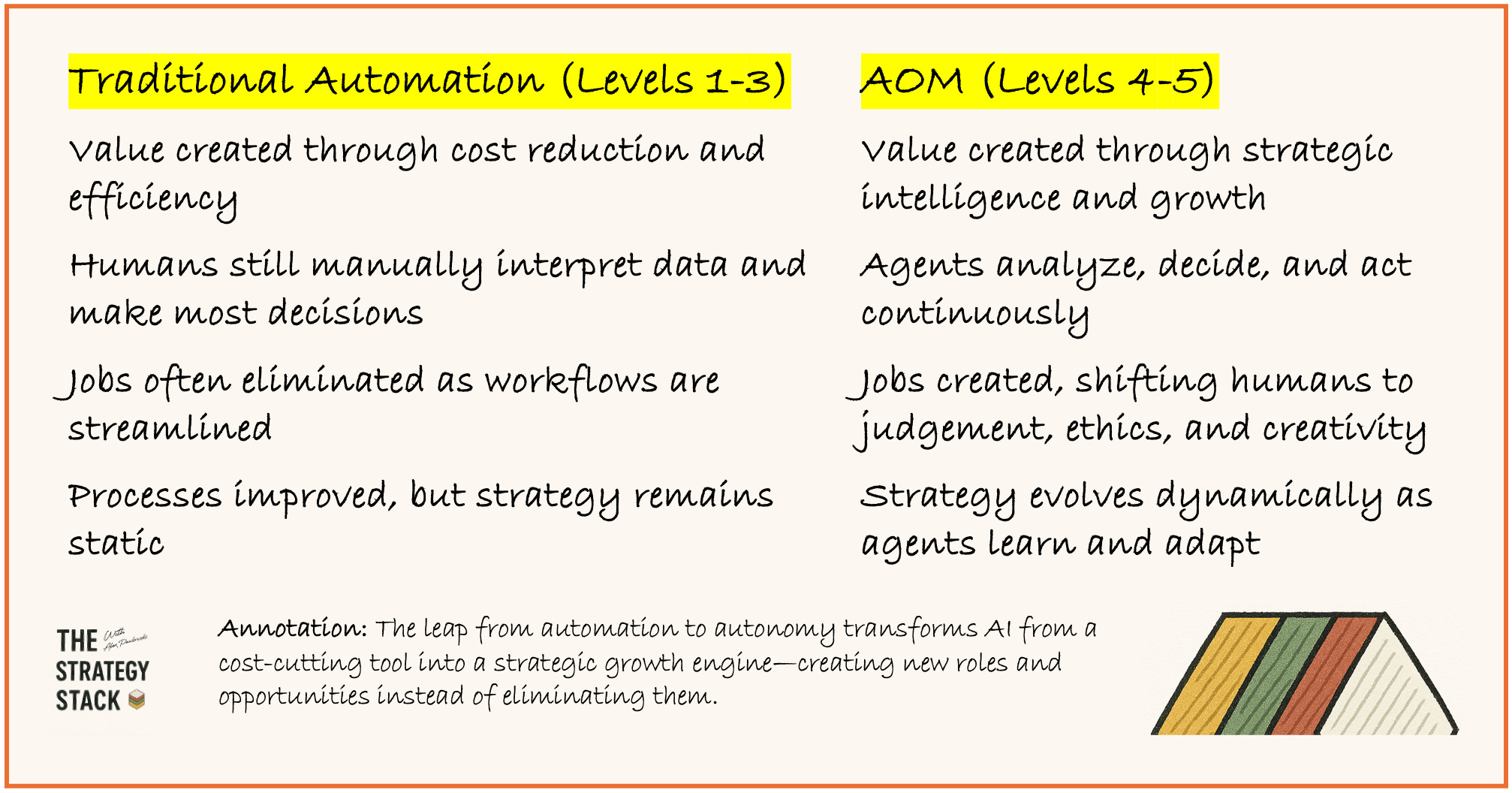
Traditional automation optimizes execution. The agentic operating model upgrades cognition.
That difference matters because it creates new leverage:
automation reduces cost per task
agents reduce decision latency
cognition compounds through feedback loops
value shifts from outputs → outcomes
In other words, AOM doesn’t simply make existing work cheaper—it creates entirely new forms of leverage.
This helps resolve the tension around job loss: when value is generated through cognition, not just execution, humans remain indispensable, but their role changes dramatically.
The difference is structural: AOM defines decision rights, governance, and feedback loops so autonomy can scale safely across the enterprise.
