


Get the slide-ready PDF + editable Leverage Progression Map (and 100+ tools in the Opertor Vault).
In every founder’s journey, there comes a point when more effort stops producing proportionally more value.
You cannot keep grinding harder, hiring around every bottleneck, or adding hours indefinitely. Eventually, the constraint is no longer motivation or execution capacity. It is the architecture of the business itself.
The founders who break through this ceiling do something different. They progressively move value creation away from themselves.
Knowledge becomes a method.
Methods become systems.
Systems begin operating at scale.
And, in some businesses, those systems eventually become ecosystems that reinforce themselves.
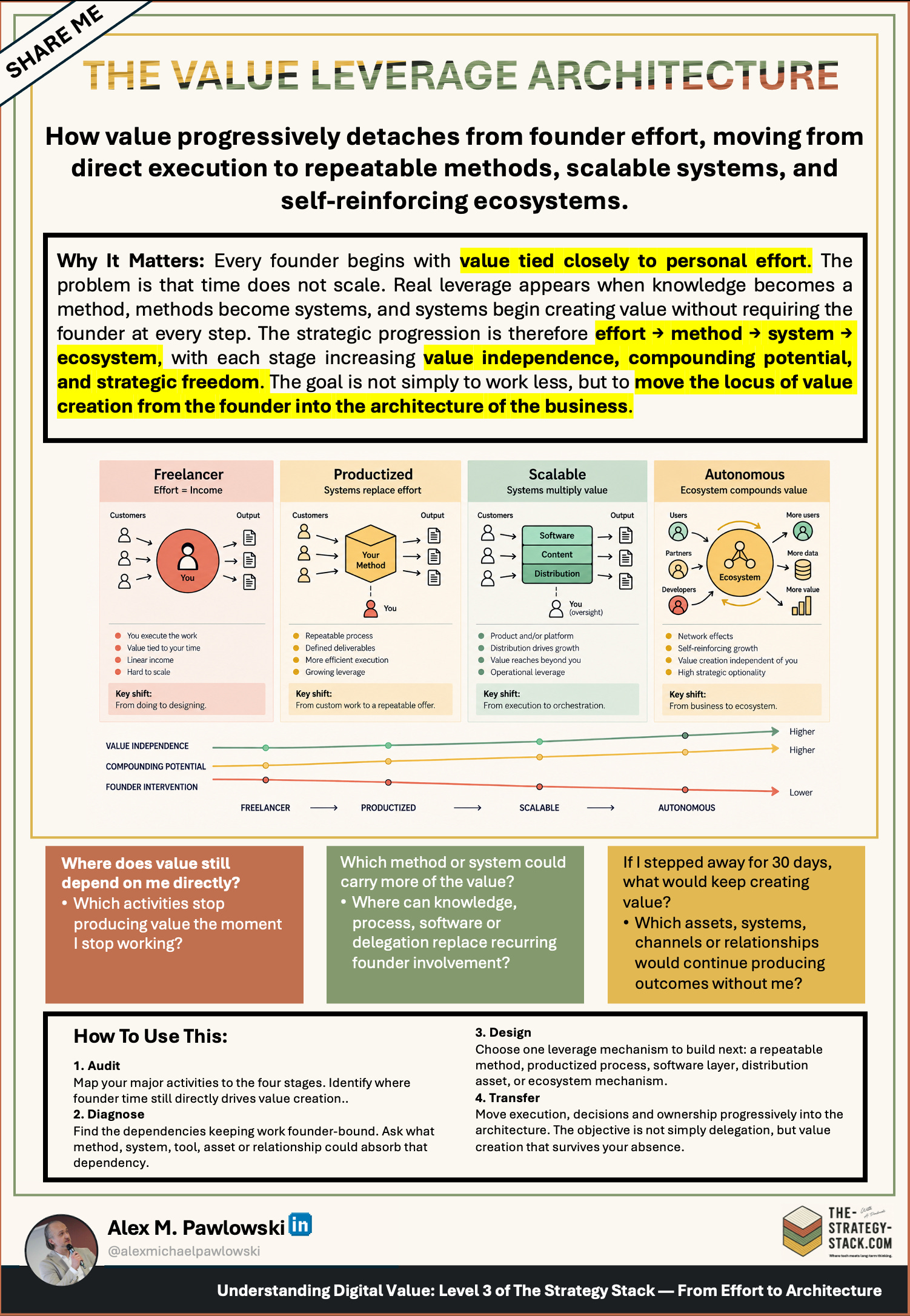
This progression is what I call The Value Leverage Architecture: a model for understanding how value moves from direct founder execution into structures capable of producing, distributing, and compounding value with decreasing founder intervention.
The objective is not simply to work less.
It is to change where value comes from.
TL;DR — The Value Leverage Ladder
Every founder begins with value closely tied to personal effort.
The progression is:
Effort → Method → System → Ecosystem
As you move through the architecture:
Value independence increases.
More value can be produced without your direct participation.
Compounding potential increases.
Each cycle can strengthen the assets, data, capabilities, relationships, and distribution behind the next.
Founder intervention decreases.
Your role moves from executing work toward designing, allocating, orchestrating, and eventually stewarding the system.
You do not scale simply by doing the same work faster.
You scale when the architecture begins carrying more of the value than you do.

The Four Architectures of Value Creation
The important distinction between the stages is not company size.
It is where the productive capacity of the business resides.
1. Freelancer: Effort = Income
At the beginning, the founder is effectively the production system.
Customers arrive, the founder performs the work, and an output is delivered.
The relationship is highly direct:
Customer → Founder → Output
This is valuable because it creates proximity to the market. You learn quickly, build expertise, and discover what customers are actually willing to pay for.
But the model contains an obvious constraint: your capacity is the capacity of the business.
Typical characteristics:
You execute the work.
Value is tied closely to your time.
Revenue is largely linear.
Increasing output usually requires increasing effort.
The important transition is not immediately to automate everything.
It is to identify what is repeatable inside the work.
Key shift: from doing to designing.
2. Productized: The Method Starts Carrying the Value
The first meaningful form of leverage appears when experience becomes explicit.
Instead of solving every problem from scratch, you begin codifying:
processes, templates, standards, workflows, methodologies, intellectual property, decision rules.
The architecture changes:
Customer → Repeatable Method → Output
The founder is still involved, but no longer needs to recreate the value mechanism every time.
This distinction matters.
A productized business is not merely a service with a nicer package. It represents the beginning of institutionalized knowledge.
Typical characteristics:
Repeatable processes
Defined deliverables
More consistent execution
Growing leverage through reuse
The method becomes an asset.
Key shift: from custom work to a repeatable offer.
3. Scalable: Systems Multiply Value
The next transition occurs when value creation begins moving beyond the method itself.
Software, automation, content, distribution, data, teams, and increasingly AI can execute or amplify parts of the system.
The architecture becomes something closer to:
Customer → System → Output
The founder increasingly sits outside the main production loop.
This is where leverage becomes structurally more powerful because the same architecture can serve substantially more demand without requiring proportional increases in founder effort.
A scalable system may combine:
software, digital products, content, automation, AI agents, data, standardized operations, channels, and distribution infrastructure.
The important point is not that everything becomes automated.
It is that direct founder presence stops being the primary unit of scale.
Typical characteristics:
Product and/or platform architecture
Distribution drives growth
Value reaches beyond founder presence
Increasing operational leverage
The founder’s job consequently changes.
Execution gives way to architecture and orchestration.
Key shift: from execution to orchestration.
4. Autonomous: The Ecosystem Begins Compounding Value
The final architecture is qualitatively different.
Value is no longer created only by the company.
Customers, partners, developers, creators, suppliers, data, integrations, and other participants can begin strengthening the system itself.
The architecture becomes:
Participants → Ecosystem → More participants, data, capabilities, and value
This is where network and ecosystem effects can emerge.
More participation can improve the system.
A better system can attract more participation.
More activity can create more data or complementary assets.
Those assets can increase the value of participating again.
The founder becomes progressively less central to the value-production mechanism.
Typical characteristics:
Network or ecosystem effects
Self-reinforcing growth loops
Value creation increasingly independent of the founder
Greater strategic optionality
This does not mean the organization becomes literally self-managing.
It means the founder’s highest-value role shifts again, from architecting the system to governing and stewarding an increasingly distributed value network.
Key shift: from business to ecosystem.
The Three Gradients Behind the Architecture
The progression becomes more useful when you stop viewing it as four company types and instead look at the three variables moving underneath them.
Value Independence ↑
Ask:
How much value can the organization create without my direct involvement?
For the freelancer, very little.
For a productized business, the method begins carrying part of the value.
For a scalable business, systems increasingly do.
For an ecosystem, value can increasingly be created by participants interacting with the architecture itself.
Compounding Potential ↑
Leverage becomes more powerful when today’s activity strengthens tomorrow’s productive capacity.
A process can improve.
Software can serve another customer.
Content can continue attracting demand.
Data can improve a decision system.
Distribution can accumulate.
Relationships can create new relationships.
Ecosystems can generate complementary innovation.
The crucial question becomes:
Does this activity merely create output, or does it strengthen the system that produces future output?
Founder Intervention ↓
The goal is not founder disappearance.
It is founder de-bottlenecking.
At lower levels of leverage, the founder is necessary for execution.
At higher levels, the founder increasingly contributes through architecture, capital allocation, strategic judgment, culture, governance, and system design.
That is a much more consequential form of leverage than simply becoming more productive.
The Strategic Progression: Effort → Method → System → Ecosystem
The architecture can be reduced to four transformations.
1. Effort proves value
Initially, you do the work yourself.
This is where you discover whether the problem matters, what customers value, and which capabilities actually produce the desired outcome.
The mistake is not starting here.
The mistake is staying here after the pattern becomes visible.
2. Method captures value
Once a pattern works repeatedly, you codify it.
Knowledge moves from your head into a process, framework, playbook, template, productized offer, or repeatable operating model.
Tacit knowledge becomes reusable architecture.
3. Systems multiply value
The method becomes embedded in products, software, automation, AI, teams, data infrastructure, or distribution.
The system can now reproduce more of the value without reproducing the founder.
4. Ecosystems compound value
Eventually, external participants may begin contributing value to one another through the architecture.
At this point, the organization is no longer simply scaling its own output.
It is enabling distributed value creation.
That is the deepest form of leverage in the model.
The AI-Era Inflection Point: Architecture Becomes More Valuable
AI changes this progression because it dramatically lowers the cost of turning knowledge into executable systems.
Processes that previously required additional headcount can increasingly be supported by software and agents.
Tacit knowledge can be encoded more quickly.
Decision support can scale.
Content and personalization can become less labor-intensive.
Workflows can become more adaptive.
But AI does not make architecture irrelevant.
It makes architecture more important.
If the underlying process is badly designed, AI can scale the dysfunction.
If incentives are wrong, AI can accelerate the wrong behavior.
If the workflow contains unnecessary dependencies, automation can simply make those dependencies operate faster.
So the competitive question is increasingly not:
“Where can we add AI?”
It is:
“What system should exist in the first place, and where can intelligence remove a dependency or increase its leverage?”
The modern entrepreneur therefore does not merely manage labor.
They design systems of human judgment, software, intelligence, distribution, and capital that can produce value at increasingly lower levels of direct intervention.
Using the Value Leverage Architecture as a Value Independence Map
The framework can also be used diagnostically.
Instead of asking only how to grow, ask where value currently depends on you.
Three questions are particularly revealing:
Where does value still depend on me directly?
Which activities stop producing value the moment I stop working?Which method or system could carry more of the value?
Where can knowledge, process, software, or delegation replace recurring founder involvement?If I stepped away for 30 days, what would keep creating value?
Which assets, systems, channels, or relationships would continue producing outcomes without me?
Then use four steps.
1. Audit
Map your major activities against the four architectures. Identify where founder time still directly drives value creation.
2. Diagnose
Find the dependencies keeping the activity founder-bound. Ask what method, system, tool, asset, or relationship could absorb that dependency.
3. Design
Choose one leverage mechanism to build next: a repeatable method, productized process, software layer, distribution asset, or ecosystem mechanism.
4. Transfer
Move execution, decisions, and ownership progressively into the architecture.
The objective is not simply delegation.
It is value creation that survives your absence.
Over time, the progression from Effort → Method → System → Ecosystem turns personal capability into institutional capability, and founder effort into compounding strategic freedom.
Unlock your leverage portfolio tools 👇
Get the slide-ready PDF + editable Value Independence Map and 100+ AI-era strategy tools in the Operator Vault.
The Takeaway: Move Value Into the Architecture
Founder leverage is often described as doing more with less.
That is only part of it.
The deeper transformation is moving the source of value away from direct founder execution and into an architecture that can persist, scale, learn, and eventually compound.
Effort creates the first proof.
Methods make that proof repeatable.
Systems make it scalable.
Ecosystems can make it self-reinforcing.
The objective is not to eliminate the founder.
It is to ensure the founder is no longer the bottleneck through which all value must pass.
Execution creates value. Architecture determines how far that value can travel without you.

Hit subscribe to get it in your inbox. And if this spoke to you:
➡️ Forward this to a strategy peer who’s feeling the same shift. We’re building a smarter, tech-equipped strategy community—one layer at a time.
Let’s stack it up.
A. Pawlowski | The Strategy Stack