
Three Assets of Digital Independence: What Actually Creates Leverage in Digital Businesses
#133: Why digital advantage compounds differently than industrial advantage

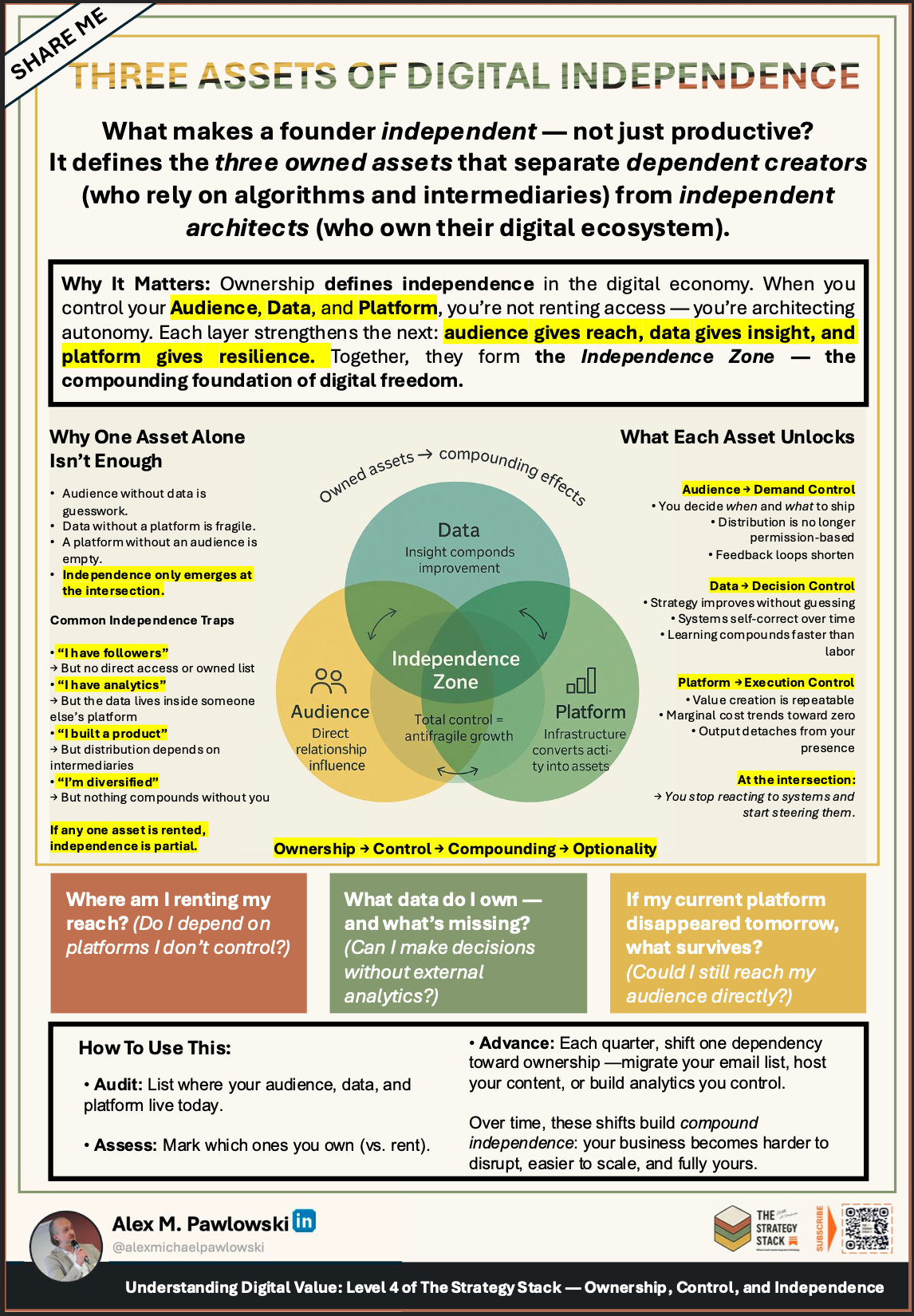
Most people think digital businesses scale because they’re faster, cheaper, or more efficient.
That’s not why they win.
They win because digital systems are built on fundamentally different assets — assets that don’t behave like factories, inventory, or headcount.
In industrial logic, value scales by owning more.
In digital logic, value scales by removing limits.
This distinction is subtle — and it breaks most strategic thinking before it even starts.
If you don’t reset your mental model here, everything that follows — product strategy, growth, monetization, AI — will be distorted.
Why This Matters
Most founders apply industrial intuition to digital systems.
They optimize cost.
They optimize efficiency.
They optimize output.
But digital leverage doesn’t come from doing the same work better.
It comes from building assets that grow stronger the more they’re used — without proportional effort.
That’s why some products improve as usage increases.
Why some companies scale without adding people.
Why some advantages compound — while others quietly decay.
The difference isn’t execution quality.
It’s asset structure.
Until you understand what kind of assets you’re actually building, you can’t reason clearly about scale, defensibility, or long-term advantage.
The Core Shift: Rival vs. Non-Rival Assets
Industrial assets are rival.
If one person uses them, another can’t — or it costs more.
Factories.
Trucks.
Inventory.
Office space.
Human time.
They scale linearly.
More output requires more input.
Digital assets are non-rival.
Once created, they can be reused endlessly at near-zero marginal cost.
Software.
Data.
Algorithms.
Content.
Networks.
One user doesn’t diminish value for another.
In many cases, usage increases value.
This single distinction explains most modern power asymmetries.
The Three Assets of Digital Independence
Digital leverage concentrates around three asset types.
They behave differently — but they reinforce each other.
1. Code (Automation of Work)
Code replaces repeated human effort with systems.
Once built, it runs continuously.
It doesn’t get tired.
It doesn’t renegotiate.
It scales instantly.
This isn’t about productivity.
It’s about removing labor from the growth equation.
Every task that can be automated becomes an asset instead of a cost.
2. Content & Distribution (Automation of Reach)
Content separates effort from exposure.
A single insight can educate thousands, onboard users, create trust, and shape demand — without repeating the work.
Distribution compounds when reach doesn’t reset to zero every day.
This is why owned channels outperform rented attention over time.
Effort decouples from impact.
3. Capital & Networks (Amplification of Results)
Capital doesn’t just fund growth — it amplifies systems that already work.
In digital contexts:
Data improves algorithms.
Usage improves models.
Participation improves networks.
The asset isn’t money itself.
It’s what money accelerates once loops exist.
Without loops, capital burns.
With loops, capital compounds.
What Most Teams Get Wrong
Teams fail when they mistake tools for assets.
They hire more people instead of removing work.
They ship features instead of improving reuse.
They buy ads instead of building distribution.
They raise capital before creating compounding loops.
These choices feel productive.
They are often impressive.
They are rarely independent.
If growth collapses when effort stops, you don’t own leverage — you rent momentum.
What Digital Independence Actually Looks Like
Independent systems behave differently.
Marginal cost trends toward zero.
Output grows faster than input.
Quality improves with use.
Learning compounds.
Scale doesn’t require permission.
This doesn’t mean “no people.”
It means people are applied to design systems, not to prop them up.
Independence isn’t autonomy from customers.
It’s autonomy from linear effort.
The Questions That Matter
If you want to apply this honestly, start here:
What work am I still doing manually that should be automated?
What value disappears if I stop paying for reach?
What improves because more people use it?
What asset grows stronger without additional effort?
Where does effort still scale linearly?
If these answers are uncomfortable, that’s the point.
About the Cheat Sheet (And Why Some Depth Is Gated)
The Three Assets of Digital Independence cheat sheet helps you:
Identify which assets you’re actually building
Separate leverage from activity
See why some systems compound and others stall
Reset industrial assumptions before they infect strategy
It shows you the structure.
When you start asking:
Which asset should I prioritize right now?
What breaks if this scales?
Where does leverage actually come from in my model?
That’s where the paid layer begins.
Because leverage isn’t abstract once decisions are real.
Which Tier Is Right for You?
Choose Free if you:
Want to sharpen strategic intuition
Are learning how digital systems differ from industrial ones
Prefer clarity over execution depth
Choose Paid if you:
Design products, platforms, or business models
Make decisions under uncertainty
Want frameworks that guide real trade-offs
If your work compounds — paid pays for itself.
Why This Exists
Most strategic thinking breaks at the moment it matters most —
when decisions must be made under uncertainty.
Frameworks explain the world.
They rarely tell you what to do inside it.
The Strategy Stack exists to close that gap:
from understanding → judgment
from insight → decision
from theory → execution
Every layer exists for a reason.
Every upgrade moves you closer to usable strategy.
👉 Unlock the Strategy Stack
…and access the Business Model Series, advanced Cheat Sheets, the S-Vault, and various essays at the intersection of strategy and technology.

Hit subscribe to get it in your inbox. And if this spoke to you:
➡️ Forward this to a strategy peer who’s feeling the same shift. We’re building a smarter, tech-equipped strategy community—one layer at a time.
Let’s stack it up.
A. Pawlowski | The Strategy Stack