
Data Center Boom: How AI Is Reshaping America's Construction Landscape
#82: US Data Center Construction Soars 190% Since ChatGPT Launch – Will It Surpass Office Spending?

Are We Witnessing a Fundamental Shift in How America Builds Its Future?
How often do you see a sector go from niche to nearly overtaking a cornerstone of modern infrastructure within just a few years?
That’s exactly what’s happening in the world of data center construction, as shown by new data released by economist Joseph Politano. In two recent posts, Politano visualizes a dramatic transformation underway in the U.S. construction industry – a transformation led by the AI revolution.
These two critical questions now emerge:
Are we approaching the end of the office-dominated construction era?
What does it mean when data centers become the centerpiece of physical infrastructure investment in the AI age?
Let’s break down what’s happening.
The Numbers Don’t Lie: Data Center Construction Has Exploded Since ChatGPT's Launch
In the first chart, Politano highlights how US data center construction spending hit a record high in June 2025, exceeding $40 billion (annualized) for the first time ever. That’s a 28% increase year-over-year, and a stunning 190% increase since ChatGPT was launched in late 2022.
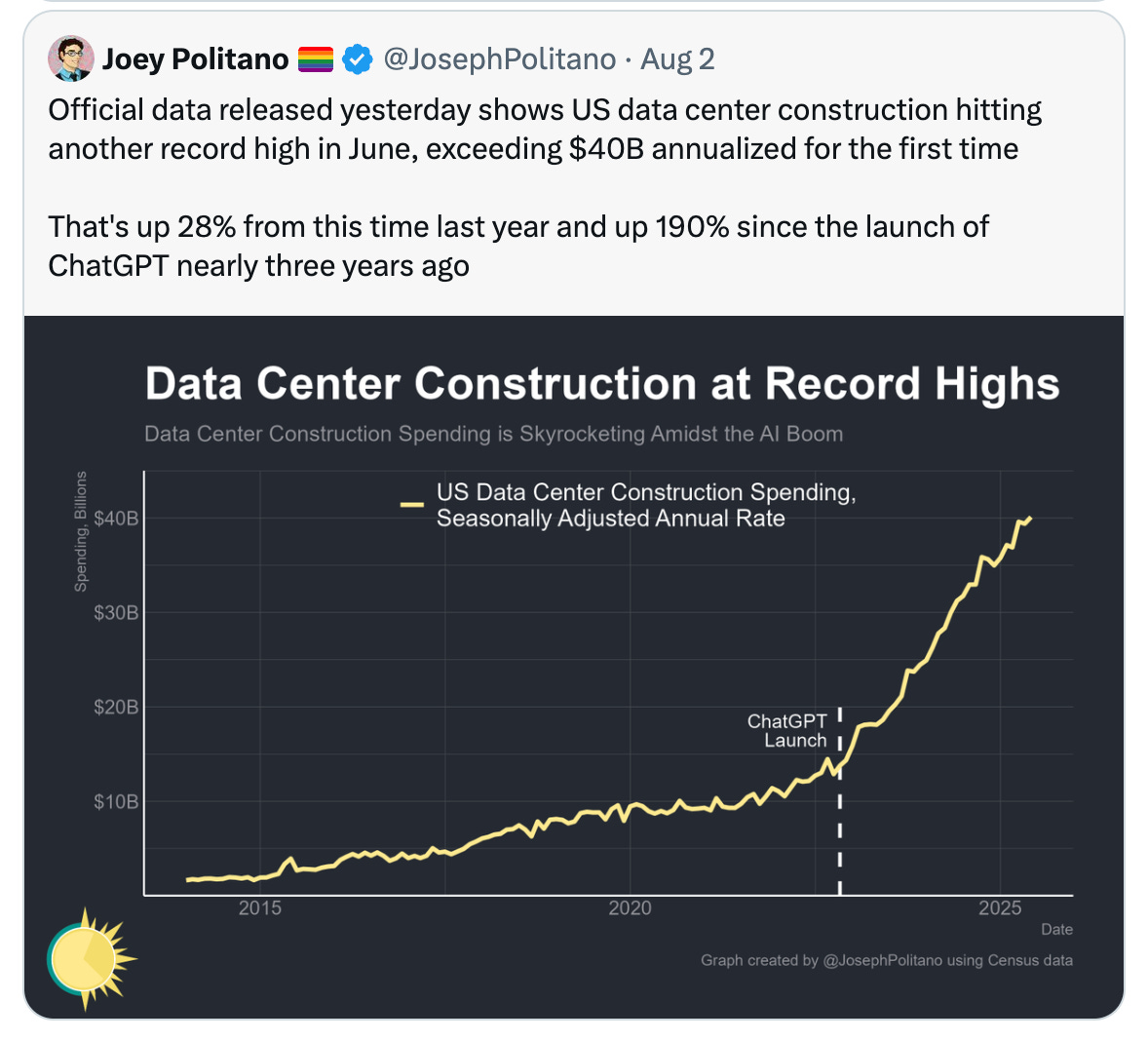
From 2015 to 2020, spending hovered relatively flat, averaging under $15 billion. After the launch of ChatGPT, however, a sharp and sustained acceleration began — turning a once-steady line into a near-vertical growth trajectory.
Why the sudden spike?
Two key factors:
Explosive demand for AI infrastructure: Large Language Models (LLMs) and other AI workloads require massive computational resources. This means more GPUs, more servers, and more power — all housed in modern, specialized data centers.
Cloud computing dominance: As more businesses move operations to the cloud, tech companies are scaling up their physical backbones to support this shift.
Data Centers Are Catching Up to Office Construction
In Politano’s second chart, the broader context comes into view.
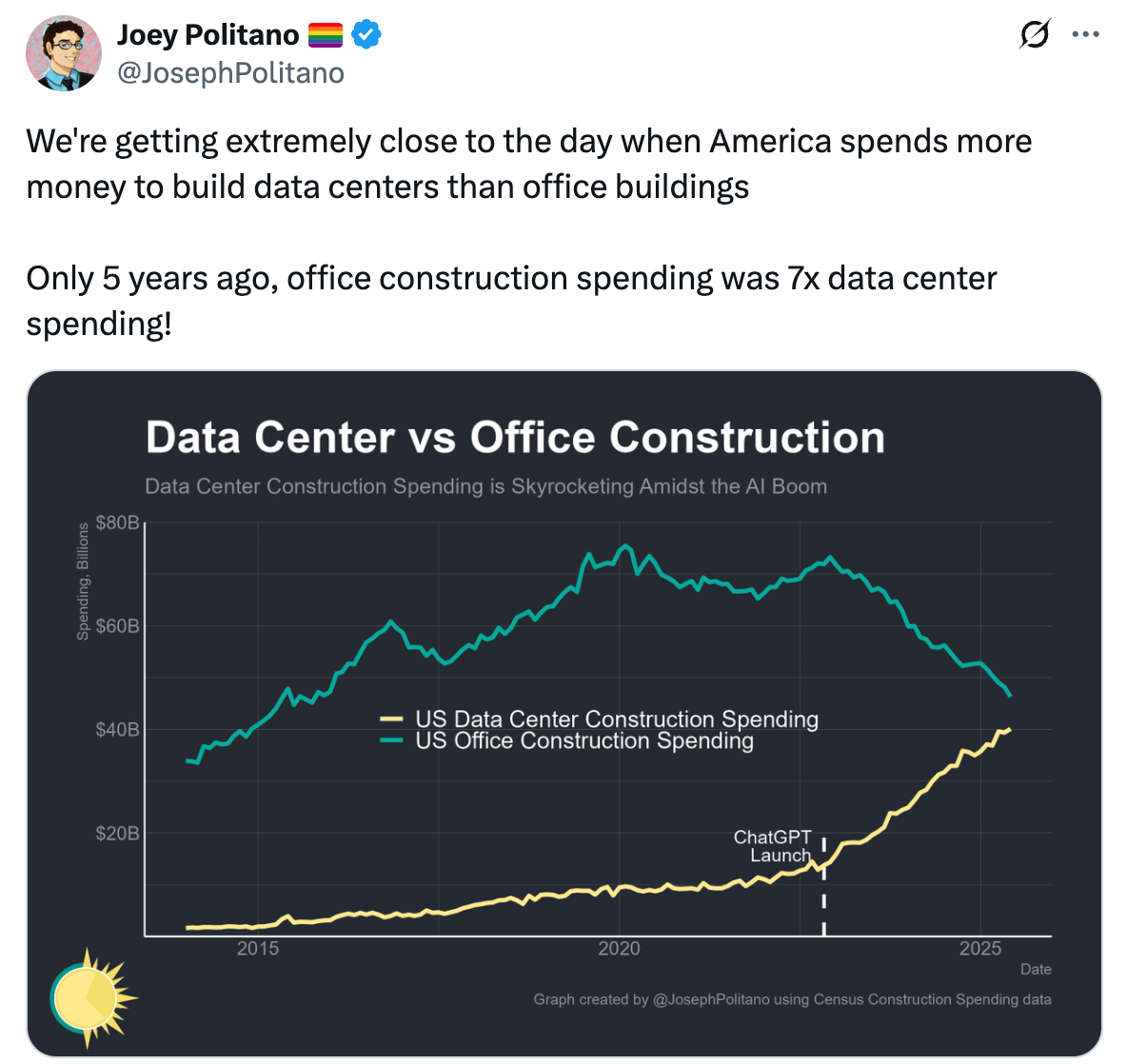
Just five years ago, office construction spending was 7x larger than data center spending. Office construction peaked around $75 billion, while data centers were below $10 billion.
But look at the crossover trend:
Office construction is in decline, particularly post-COVID, as remote work has reduced the need for commercial real estate.
Meanwhile, data center construction is in liftoff mode, closing in on parity with office construction as of mid-2025.
We're now reaching an inflection point: data center construction may soon surpass office construction in total value — something unimaginable just a few years ago.
What Does This Shift Mean for the Future?
This isn’t just a story about construction budgets — it’s a broader reflection of how America is redefining the future of work, productivity, and infrastructure.
Key Implications:
AI infrastructure is becoming a national priority: Data centers are now treated as critical assets, akin to highways or utilities, enabling AI-driven growth across sectors like healthcare, education, and manufacturing.
Commercial real estate is being reimagined: With office demand falling, cities may need to rethink zoning, tax structures, and urban planning.
Energy demands will skyrocket: Data centers are extremely power-hungry. Expect more discussion around sustainable energy, grid capacity, and environmental regulation.
Geopolitical and security considerations: Control over AI infrastructure is now a strategic concern. Where these data centers are built — and who controls them — will matter more than ever.
So What’s Next?
As AI continues to embed itself deeper into our lives, data centers will be the backbone of this new era — and the current construction boom is just the beginning.
The big question now is:
Will we see a world where data center spending not only eclipses office construction — but becomes the dominant category of all non-residential infrastructure investment?
We’re not far off.

Hit subscribe to get it in your inbox. And if this spoke to you:
➡️ Forward this to a strategy peer who’s feeling the same shift. We’re building a smarter, tech-equipped strategy community—one layer at a time.
Let’s stack it up.
A. Pawlowski | The Strategy Stack
Very interesting point. I always saw data centers as a crucial part of national sovereignty, but the lens of construction is a nice one. Makes me think about the impacts on architecture and urbanism too.