
How Companies Turn Capabilities Into Billion-Dollar Businesses
#155: The strategic logic behind Stripe, Plaid, Glean and the next generation of AI companies


Some of the most valuable companies in the modern economy are almost invisible to the people who benefit from them.
Stripe rarely owns the commerce experience.
Plaid rarely owns the banking experience.
Glean rarely owns the systems employees spend their day inside.
Yet all three have become extraordinarily valuable.
At first glance, this appears counterintuitive.
For decades, strategy pushed organizations in the opposite direction. Own the customer relationship. Control the experience. Build direct channels. Reduce intermediaries. The closer a company moved toward the end customer, the stronger its position appeared to become.
Yet many of today’s most successful businesses have done precisely the reverse.
Rather than competing for attention, they compete for dependence.
Rather than owning the visible experience, they provide capabilities that operate underneath it.
When a company integrates Stripe, it is not primarily purchasing a payment interface. It is acquiring the capability to process payments globally without building the underlying infrastructure itself. When a company uses Plaid, it is not purchasing a dashboard. It is acquiring the ability to connect financial accounts. When an enterprise deploys Glean, it is not merely implementing search. It is acquiring the ability to retrieve knowledge across fragmented systems.
The interface matters.
The capability matters more.
Historically, products and capabilities were bundled together. If an organization wanted a capability, it typically purchased the entire system that delivered it. As digital architectures became more modular, capabilities became separable from products. Once extracted, they could be distributed, embedded, and reused across thousands of organizations simultaneously.
This shift transformed capabilities into businesses of their own.
As capabilities mature, they accumulate complexity in ways that are often invisible from the outside. Payment processing sounds straightforward until global payment methods, fraud prevention, subscription management, chargebacks, taxation, settlement, reconciliation, and regulatory requirements enter the picture.
Enterprise search sounds straightforward until permissions, security models, context retrieval, semantic ranking, governance, and organizational knowledge fragmentation become part of the equation.
The visible feature remains simple.
The operational burden grows exponentially.
This creates an opportunity for specialization.
Embedded businesses succeed because they absorb complexity on behalf of others. Every new customer contributes additional edge cases, operational knowledge, and learning opportunities. Over time, the provider develops a depth of capability that becomes increasingly difficult for any individual customer to replicate internally.
What appears to be a software product is often a complexity-management system in disguise.
This creates an interesting question.
Why has it become so valuable to sit underneath someone else’s business?
The answer reveals an increasingly important business model pattern. As digital systems become more complex, organizations are discovering that competitive advantage no longer comes solely from owning products, platforms, or customer relationships. Increasingly, it comes from owning capabilities that other businesses depend upon.
The result is what I would describe as embedded business models: a model in which value is created not by owning the visible experience, but by becoming part of the infrastructure that makes the experience possible.
TL;DR — The Stack Layer, Condensed
With software systems becoming more interconnected, companies are increasingly assembling products from specialized capabilities rather than building everything themselves. Embedded business models emerge when a company provides a critical capability that becomes integrated into another company’s workflow, product, or operating model. The strongest embedded businesses do more than provide functionality. They absorb complexity, accumulate context, and become woven into how other organizations operate. The strategic challenge is no longer deciding what to build, but understanding which capabilities should be owned, embedded, exposed, or orchestrated.
Table of Contents
From Products to Capabilities
Why Complexity Creates Opportunity
The Hidden Architecture of Modern Businesses
The Embedded Advantage
Where This Shows Up
The Evolution Toward Embedded Intelligence
Designing Your Own Embedded Strategy
Closing Thought — The Future Belongs to Capabilities
1. From Products to Capabilities
Many business model shifts can be understood by examining what exactly companies sell.
Industrial firms sold products. Service firms sold expertise. Software firms sold applications. Platform businesses connected participants and facilitated interactions.
Embedded businesses are different.
What they sell is not necessarily visible to the customer at all.
Instead, they sell capabilities.
This distinction may appear semantic, but it fundamentally changes where value accumulates.
When a company integrates Stripe, it is not primarily purchasing a payment interface. It is acquiring the capability to process payments globally without having to build the underlying infrastructure. When a company uses Plaid, it is not purchasing a dashboard. It is acquiring the ability to connect financial accounts. When an enterprise deploys Glean, it is not merely implementing search. It is acquiring the ability to retrieve knowledge across fragmented systems.
The interface matters. The capability matters more.
Historically, capabilities and products were bundled together. If you wanted a capability, you typically purchased the entire system that delivered it. Digital architectures have gradually separated the two.
As systems became modular, capabilities became extractable. Once extracted, they could be distributed, embedded, and reused across thousands of organizations simultaneously.
This shift transformed capabilities into businesses of their own.
2. Why Complexity Creates Opportunity
One misconception about embedded business models is that companies use them because they cannot build the capability themselves.
In most cases, they probably could.
A sufficiently talented engineering team can build payment infrastructure. They can create onboarding workflows. They can connect to data sources. They can implement authentication, search, compliance logic, and dozens of other functions.
The more interesting question is whether they should.
As capabilities mature, they accumulate complexity in ways that are often invisible from the outside. The visible function may appear simple while the underlying operating requirements continue expanding.
Processing a payment sounds straightforward until global payment methods, fraud prevention, subscription management, chargebacks, taxation, settlement, reconciliation, and regulatory requirements enter the picture.
Enterprise search sounds straightforward until permissions, security models, context retrieval, semantic ranking, governance, and organizational knowledge fragmentation become part of the equation.
The visible feature remains simple.
The operational burden grows exponentially.
This creates an opportunity for specialization.
Embedded businesses succeed because they absorb complexity on behalf of others. Every new customer contributes additional edge cases, operational knowledge, and learning opportunities. Over time, the embedded provider develops a depth of capability that becomes increasingly difficult for any individual customer to replicate internally.
What appears to be a software product is often a complexity management system in disguise.
3. The Hidden Architecture of Modern Businesses
Most digital products appear far simpler than they actually are.
Consider a modern fintech application.
From the customer’s perspective, the experience may consist of opening an account, linking a bank, making a payment, and checking a balance. The workflow feels unified. Everything appears to belong to a single product.
Underneath that experience, however, an entirely different architecture is operating.
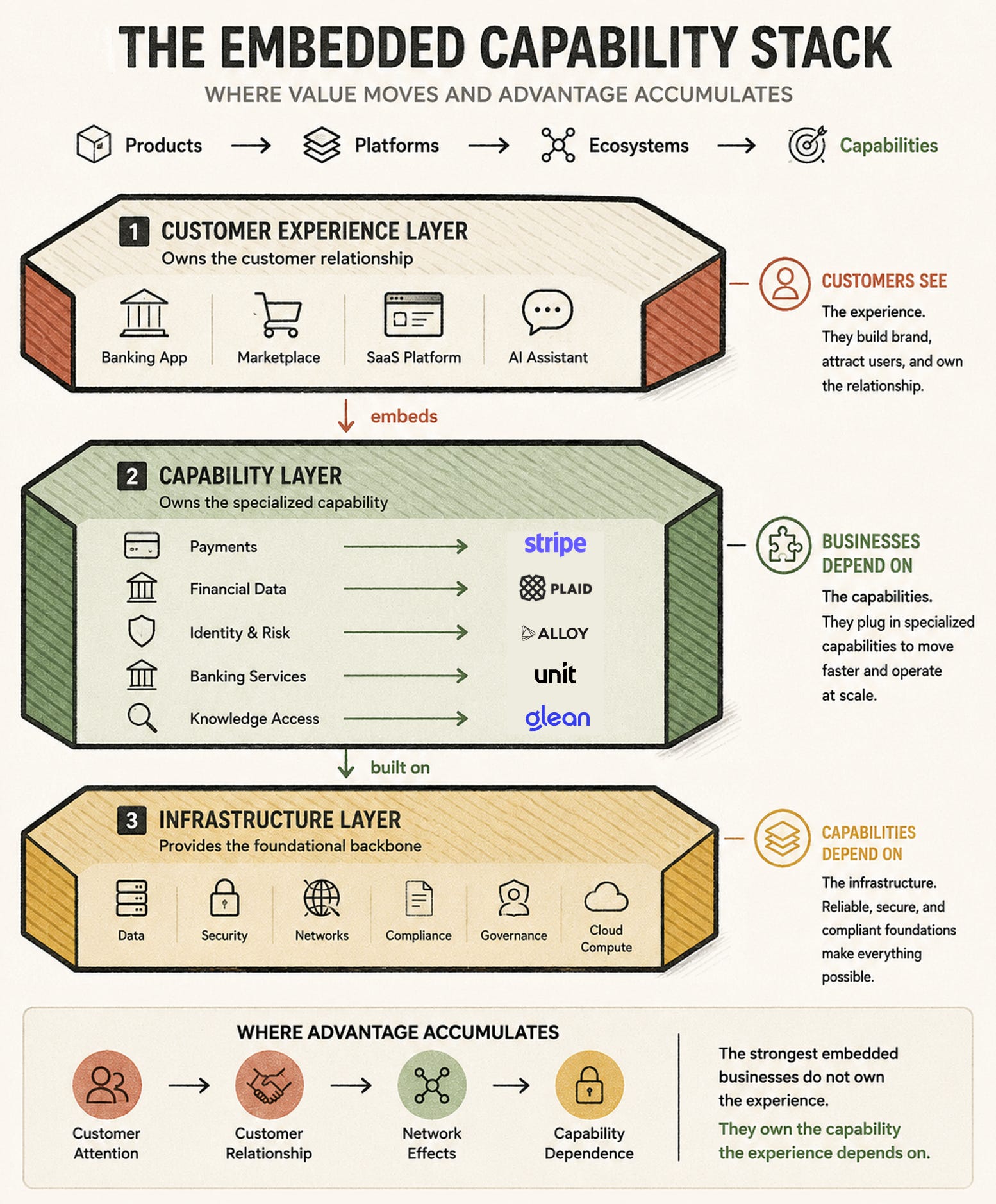
Identity providers verify customers. Banking infrastructure providers handle account creation. Fraud systems evaluate risk. Data providers enrich information. Payment networks coordinate transactions. Compliance engines monitor activity. Analytics systems generate operational insight.
The customer encounters one product.
The business operates on top of an ecosystem of capabilities.
This distinction becomes increasingly important because modern organizations are assembling products much like software developers assemble applications. Rather than building every layer from scratch, they combine specialized components into larger systems.
The visible experience belongs to the company.
The underlying capabilities often do not.
As a result, competitive advantage increasingly depends on understanding not only the products customers interact with, but also the capabilities those products depend upon.
4. The Embedded Advantage
Traditional strategic thinking tends to assume that power follows visibility.
Brands become valuable because customers recognize them. Market leaders strengthen their position through distribution, awareness, and direct customer relationships. Visibility and influence appear closely connected.
Embedded business models challenge this assumption.
Some of the most strategically important companies in the digital economy are largely invisible to the people benefiting from their services.
This creates what I think of as the Embedded Advantage.
As capabilities become integrated into workflows, their value increasingly derives from dependence rather than awareness.
A company may switch marketing agencies relatively easily. Replacing deeply integrated payment infrastructure, identity systems, financial connectivity layers, or enterprise knowledge architectures is significantly more difficult. The challenge is rarely technical replacement alone. It involves processes, workflows, operational procedures, data structures, compliance requirements, and organizational habits that have formed around the capability.
Over time, the capability stops behaving like a vendor relationship.
It starts behaving like infrastructure.
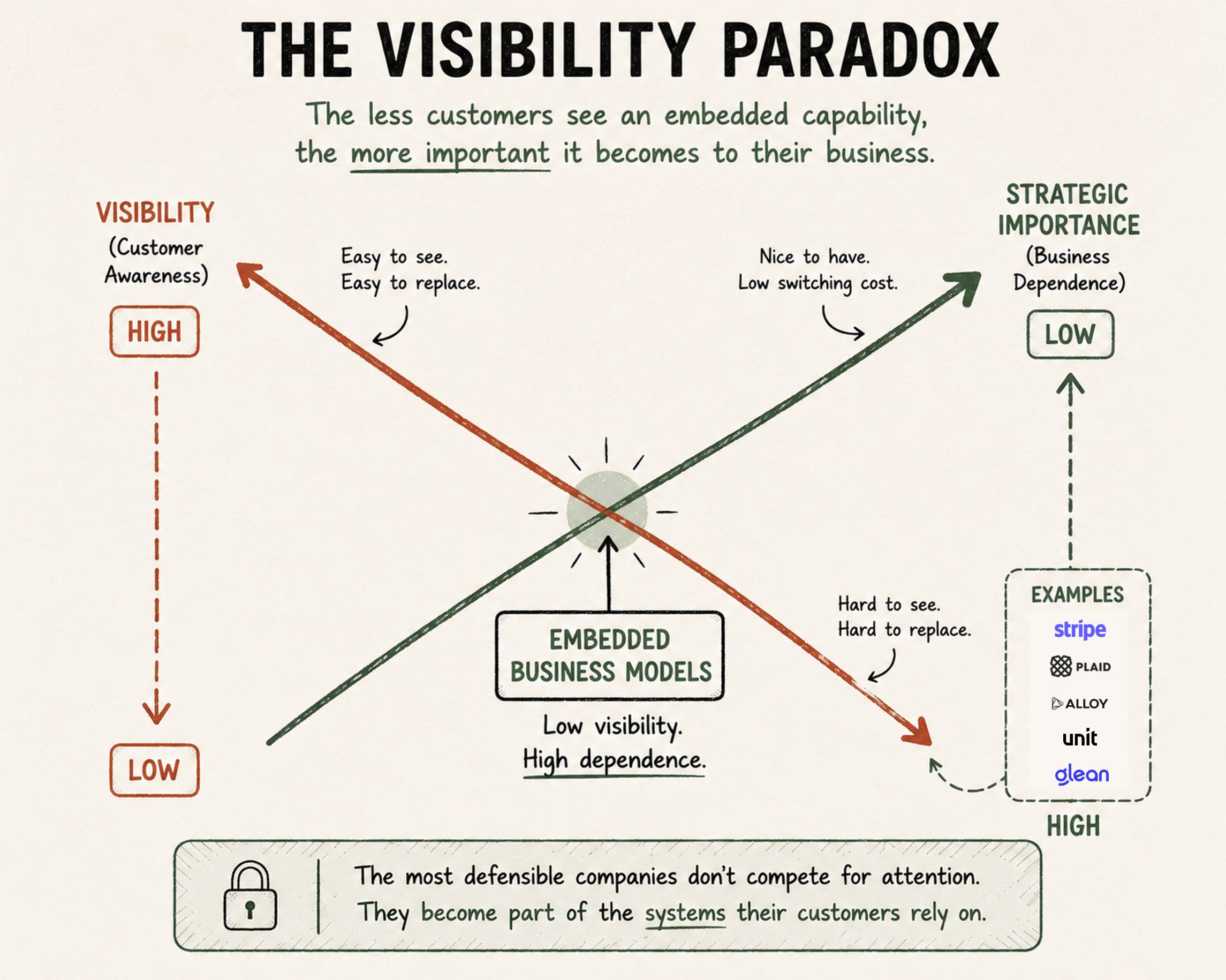
This distinction matters because infrastructure tends to compound. Every workflow built on top of it increases switching costs. Every integration deepens dependency. Every adjacent capability strengthens the position of the provider.
The strongest embedded businesses therefore become more valuable not because customers see them, but because organizations increasingly rely on them.

