
The AI Systems Playbook Is Live (3 Pages Free for Everyone)
A 12-issue field manual for mapping, governing, and auditing your AI workspace—start with the orientation, workspace map, and instruction stack, then unlock the full collection in the Operator Vault.


Most teams don’t have an “AI problem.” They have sprawls: tools multiply, rules pile up in chat, nobody can say what persists, what reads what, or where output is supposed to land.
STACK PLAYBOOK — The AI Systems Series is my answer to that. It’s a progressive field manual: one architectural idea per issue, one installable artifact per issue, built so each page feeds the next. By Issue 12, you’re not collecting prompts - you’re running a governed AI operating architecture.
Today I’m releasing the series—and giving every subscriber three pages to start with.
What you get in this email (free)
Three one-pagers are attached. Use them in order:
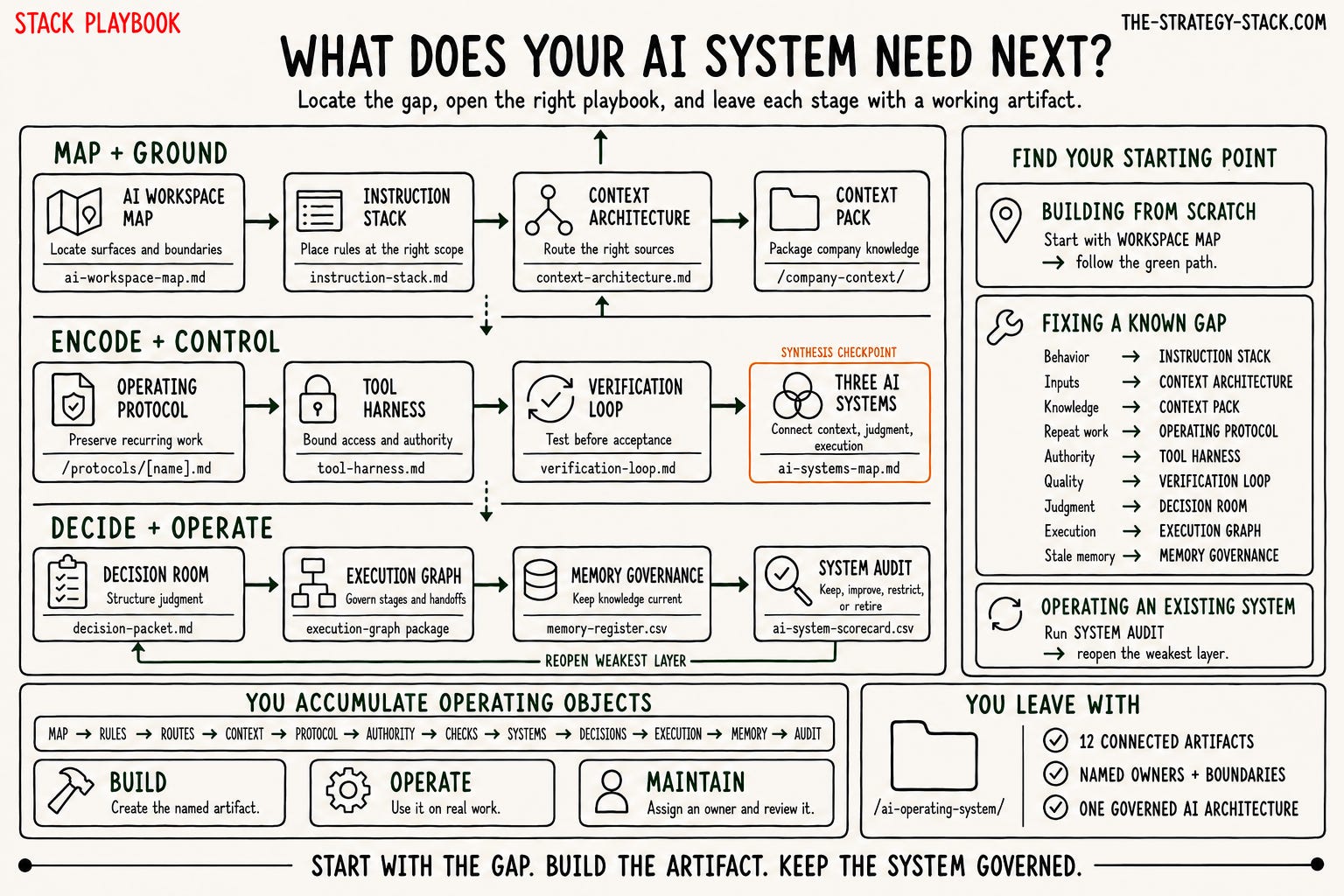
1. Issue 00 — What does your AI system need next?
The series map: twelve artifacts, three movements (Map + Ground → Encode + Control → Decide + Operate), and a honest “find your starting point” sidebar. If you only read one page first, make it this one.
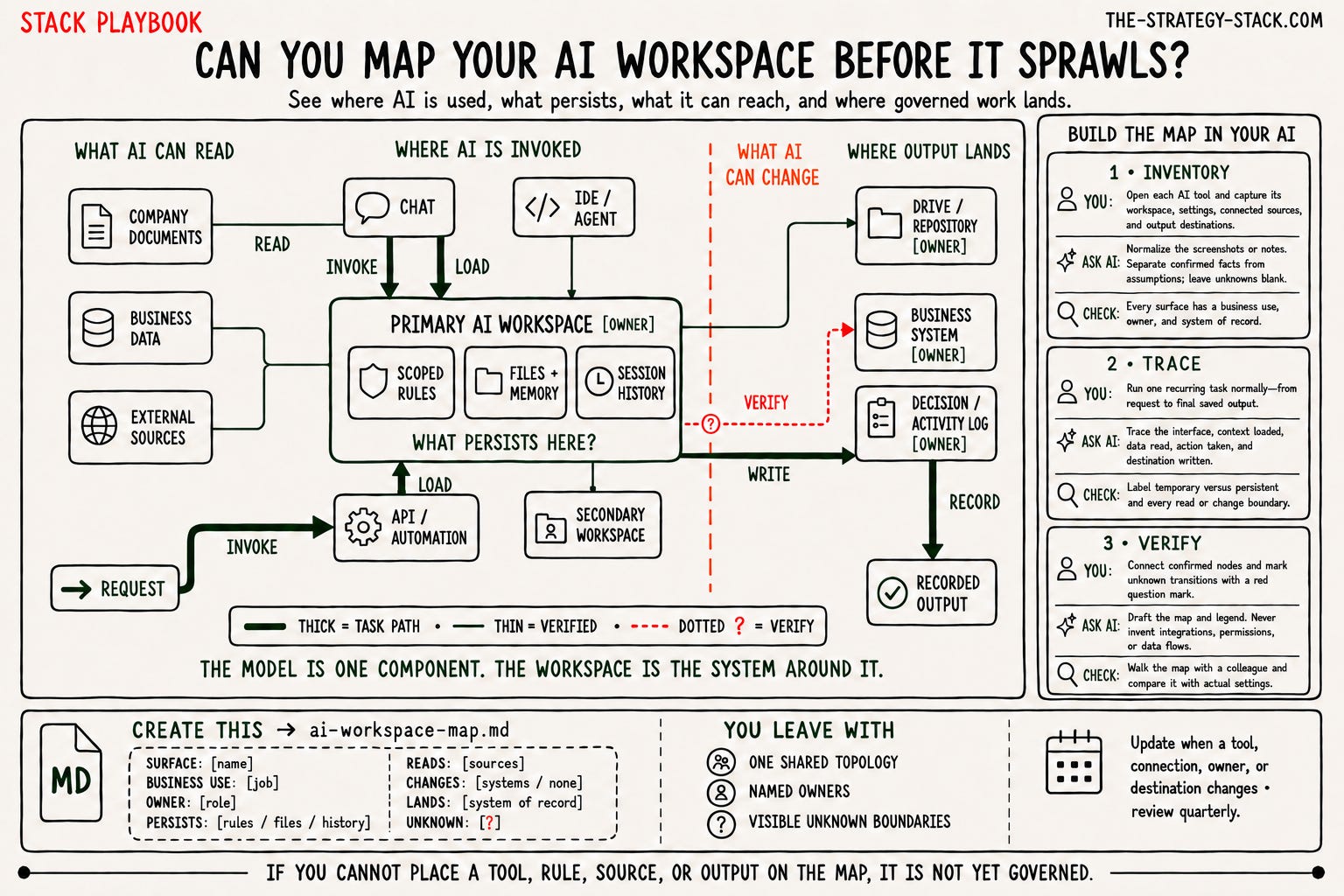
2. Issue 01 — Can you map your AI workspace before it sprawl?
Inventory surfaces, trace one real task, mark unknowns. You leave with an ai-workspace-map.md mindset: owners, read/change boundaries, and a line you can walk with a colleague.
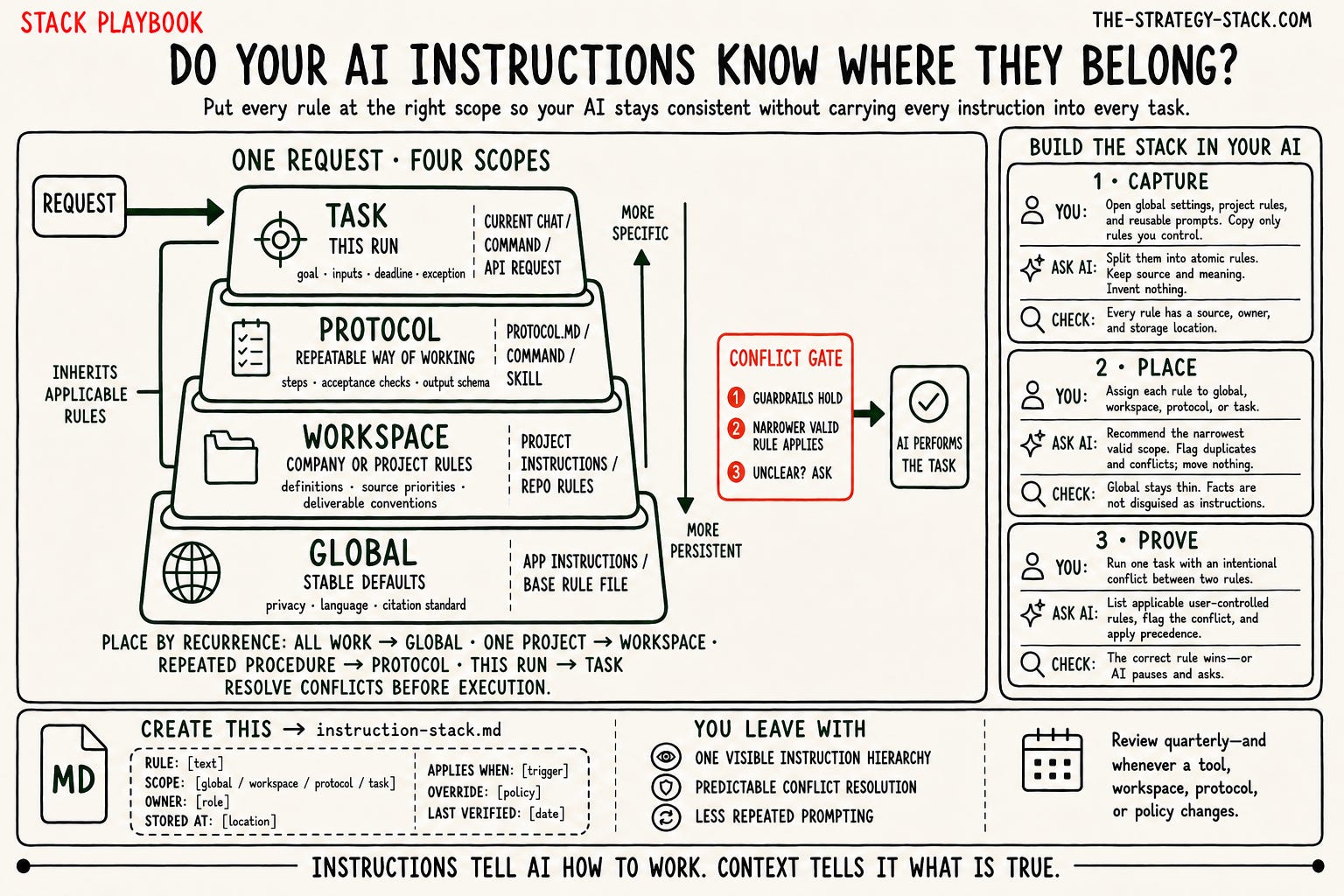
3. Issue 02 — Do your AI instructions know where they belong?
Global → workspace → protocol → task, with a conflict gate before execution. You leave with an instruction-stack.md so AI stops carrying every rule into every run.
That’s Part I of the arc - interface and instructions - before context packs, protocols, harnesses, and the three-system synthesis in later issues.
The full collection (Operator Vault)
All twelve issues are bundled as one PDF in the Operator Vault on the site:
→ Open the Operator Vault — Playbooks section
→ Jump straight to the AI Systems Playbook card
Paid subscribers: go to Operator Vault login, enter the same email you use on Substack, and open the magic link we send you. Then open Playbooks on the Vault and click Download PDF on the AI Systems Playbook card. Same gate as the Agentic Strategy book and paid-exclusive cheat sheets.
Free readers: the Vault shows a preview; the three pages in this post are your free start. For the full 12-in-1 PDF, subscribe here ($100/yr)—weekly essays plus the full Vault tier.
What this is (and isn’t)
This is not a feature tour of ChatGPT, Claude, or Cursor. It’s architecture for operators: where AI is invoked, what it may read and change, how recurring work becomes protocols, and how you audit whether the system is worth keeping.
It complements Business Model Sunday and the long IP OS build manuals - it builds the workspace those systems run in.
Other resources to learn more first:


What I’d do this week
Read Issue 00 and pick your starting gap.
Run Issue 01 on one tool you already use daily.
Split your current “custom instructions” using Issue 02’s four scopes.
Reply or leave a comment with which issue you want expanded first in the newsletter—I’ll follow the series in the stack, but I’m listening to where you’re stuck.
— Alex
P.S. Paid subs: if login fails, use the same email as Substack and hit “Subscriber login” on the Vault. The playbook lives under Playbooks at the top of page 1 - no digging through six pages of cheat sheets.

Hit subscribe to get it in your inbox. And if this spoke to you:
➡️ Forward this to a strategy peer who’s feeling the same shift. We’re building a smarter, tech-equipped strategy community—one layer at a time.
Let’s stack it up.
A. Pawlowski | The Strategy Stack
The strongest part for me is the move from “better prompts” to better boundaries.
Once AI is operating across recurring work, the important questions become architectural: what can it read, what can it change, which instructions outrank others, and where does the output belong? That feels much closer to governance than prompting.
We’re seeing a similar principle while building QUASAR EDU: reliability comes less from giving the model more freedom and more from defining the system around it precisely enough that useful behavior is repeatable.