


TL;DR
After Content OS #1 you can find, phase, and publish IP on rhythm. This piece completes the canonical audit from #1 - so you can name one canonical answer per concept, cite it in client work without contradiction, and route readers (and SEO entry pieces) to depth instead of parallel definitions.
A canonical map is a small living table: one row per core concept, one primary artifact, one owner, explicit fate for every duplicate. In the #1 stack it lives in your audits folder as a single map file (template in Part 11).
It fixes namespace collisions - when “agentic,” “platform,” or “moat” mean different things in proposals, decks, and essays.
What you can do in 30 days: answer which piece is the real one? in ten seconds; ship one live link upward from a duplicate; run a proposal footnote pass that proves vocabulary is owned; queue merge work on your ship list instead of in Slack limbo.
Owners = decision rights, not bylines. Wire the map into publish checks and (later) journeys so it is enforced, not decorative.

A personal note — written for you, the paid reader
If you are reading this, you already pay for frameworks that hold up in real decisions - Strategy OS , the Agentic Operating Model , capability and platform work.
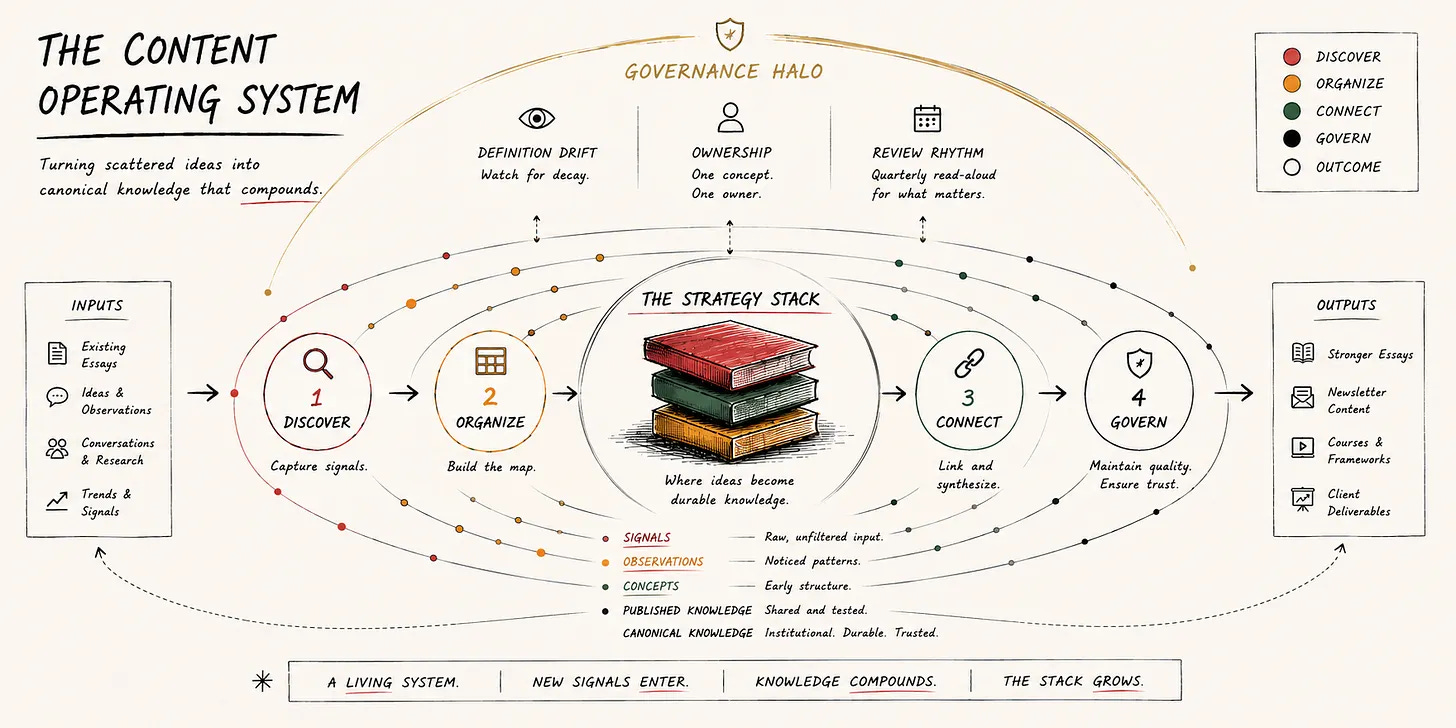
Lab Notes #1 showed how I run the publication as an operating system — phases, mesh, ship rhythm. You left with a machine that stores and moves IP. Lab Notes #2 is that stack’s belief layer - the canonical audit in full: what you actually believe, where each belief lives, who owns it. Not phases again. Not folder setup again. One job: one answer per concept, with enforcement you can show a client.
You are not here for another “thought leadership strategy.” You are here because:
Strategists (Archetype A) - you need one canonical answer per concept you cite in board decks and proposals - without embarrassment when footnotes disagree.
Builders (Archetype B) - you need entry pieces that link upward to depth, not five intros that each redefine the same term.
Platform thinkers (Archetype C) - you need explicit duplicate fate so hubs and SEO posts stop cannibalizing your spine.
Last year I watched a strong team lose a room - not on price, not on credentials - on vocabulary.
Page twelve of the proposal had three footnotes. Each cited internal work on the agentic operating model. Each used the term differently: org design, AI tooling, decision rights under uncertainty. The client’s CTO closed the deck and said, quietly: “It sounds like you haven’t decided what you believe.”
They were wrong about the team’s intelligence. They were right about the absence of a canonical map.
I run The Strategy Stack as proof environment - well over a hundred public essays, operator vault assets, propagation pieces. Without a map, I would have four acceptable introductions to platform strategy and no answer when a paid reader asks which essay to send before a board Q&A. The map is how I sleep at night: evolution has an address.
This is a build manual. Walk through Parts 0 - 12 in order, or jump to Part 0 if you only have ninety minutes today.
Part 0 — Who this is for, and where to start
Content OS #1 named the canonical audit in one paragraph (same job as “one home per concept” in the flagship). This piece is that audit as a full build manual.
What #1 enabled - and what this adds on top
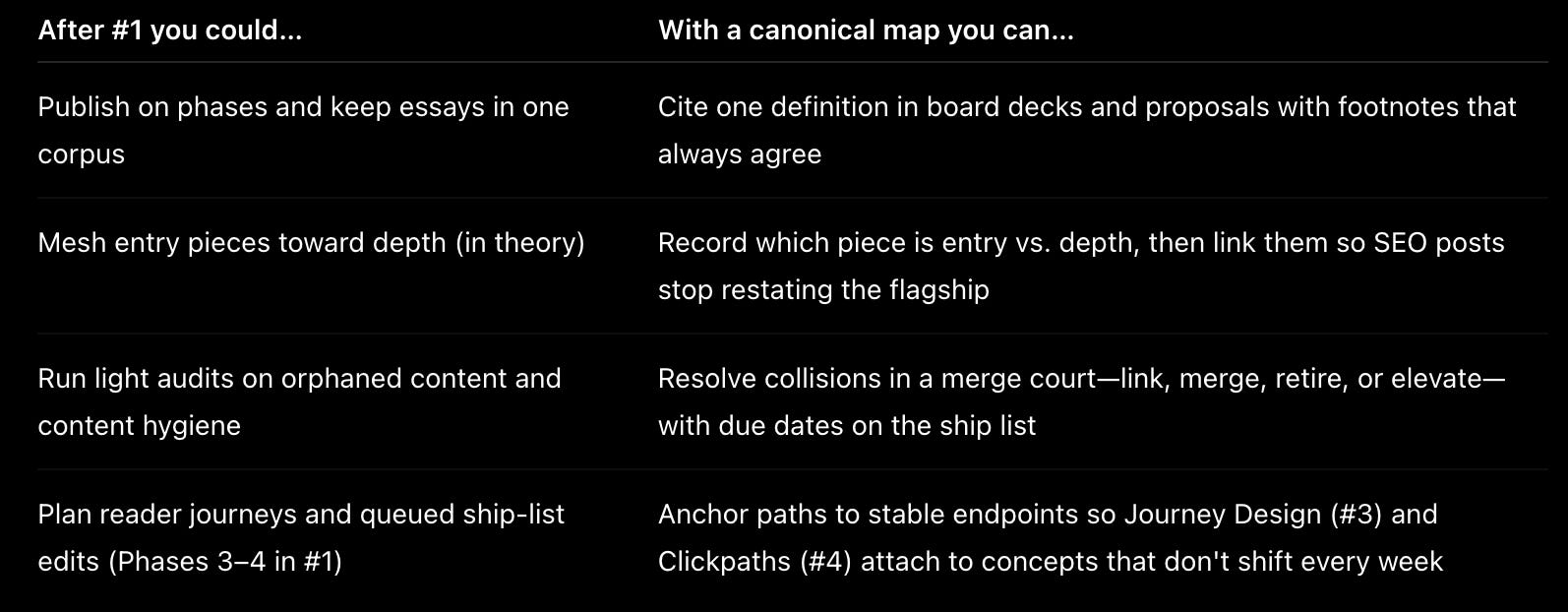
Without this layer, #1 still works - but you are governing volume without governing meaning. The CTO who said “you haven’t decided what you believe” was describing a team that had content ops, not a canonical namespace.
Pick your lane:
Strategists - client and board citations that never contradict; start Part 3 → Part 4 → Part 6 Session 4 footnotes Strategy OS · Capability Theory.
Builders - entry pieces that link upward; start Part 3 → Part 6 Session 3 link ship Agentic OM.
Platform thinkers - hub spine and duplicate fate on the record; start Part 3 → Part 12 mesh check → Journey #3 next Platform Strategy.
Upgrading from #1? You already have the essay library and master index from the flagship. Skip to Part 3 (Sessions 1–2), then Part 6 (ship one link). Return to Part 2 if column definitions are unclear.
If you only have 90 minutes: Part 4 belief inventory solo → walk out with a v1 map file + three lines on your ship list. Do not stop at the workshop - Part 6 Session 3 proves the system in public.
If you are a firm (not a publication): Bring partner memos into the same corpus shape as #1. Run Part 4 on client-safe concepts first; mark internal-only rows in status.
Part 1 — The namespace problem
Namespace collisions show up long before clients notice:
Proposal A links memo v3; Proposal B links the 2024 keynote summary; the live deck uses slides from neither.
A new director quotes the deprecated take in a steering committee because search surfaced the wrong PDF.
Your publication has four “intro to platform strategy” pieces; Google and your own search pick different winners on different weeks.
An associate drafts a client email using a Substack post you wrote eighteen months ago - before you changed how you define agentic strategy.
None of these people are careless. The system allowed parallel truths because nobody named the canonical row.
A canonical map does not stop you from evolving. It forces evolution to happen on the canonical row - or through an explicit merge - instead of through silent duplication.
Think of it like a product API: one endpoint per resource. Breaking changes get a version and a redirect, not a shadow endpoint nobody maintains. When your CTO-equivalent closes the deck, they are asking: Do you version your beliefs the way you version your software? The map is the honest answer.
Everything below is the full build manual - canonical map anatomy, 90-minute belief inventory, Operator Cards, merge court, link-ship sessions, starter template, and Replicate Monday tracks. Paid subscribers only.
