
Value Models vs Revenue Models: Why Monetization Destroys More Companies Than Competition
#142: Most companies don’t fail to make money — they fail to protect the value loop

Most companies don’t struggle with revenue ideas.
They struggle with restraint.
They find something users want — and then rush to extract value before it compounds.
And that single mistake explains most product stagnation, churn, and “mysterious” growth plateaus.
Because revenue does not create value.
It captures it.
And when capture runs ahead of creation, the system collapses.
The Confusion That Breaks Businesses
Many teams quietly conflate two very different things:
Value models
and
Revenue models
They sound related.
They’re not interchangeable.
A value model explains why users engage.
A revenue model explains how money is captured.
When companies blur that line, monetization starts doing the job value was supposed to do.
And that’s when trust erodes.
Why This Matters
Companies don’t fail because they lack ways to charge.
They fail because monetization breaks the value loop.
Here’s what that looks like in practice:
Revenue triggers before relief is felt
Pricing interrupts progress
Ads degrade the core experience
Lock-in replaces loyalty
Optimization replaces usefulness
The result is always the same:
Engagement stalls.
Trust decays.
Growth becomes fragile.
Sustainable businesses don’t extract revenue.
They let revenue system design emerge as a byproduct of delivered value.
The Core Distinction Most Teams Miss
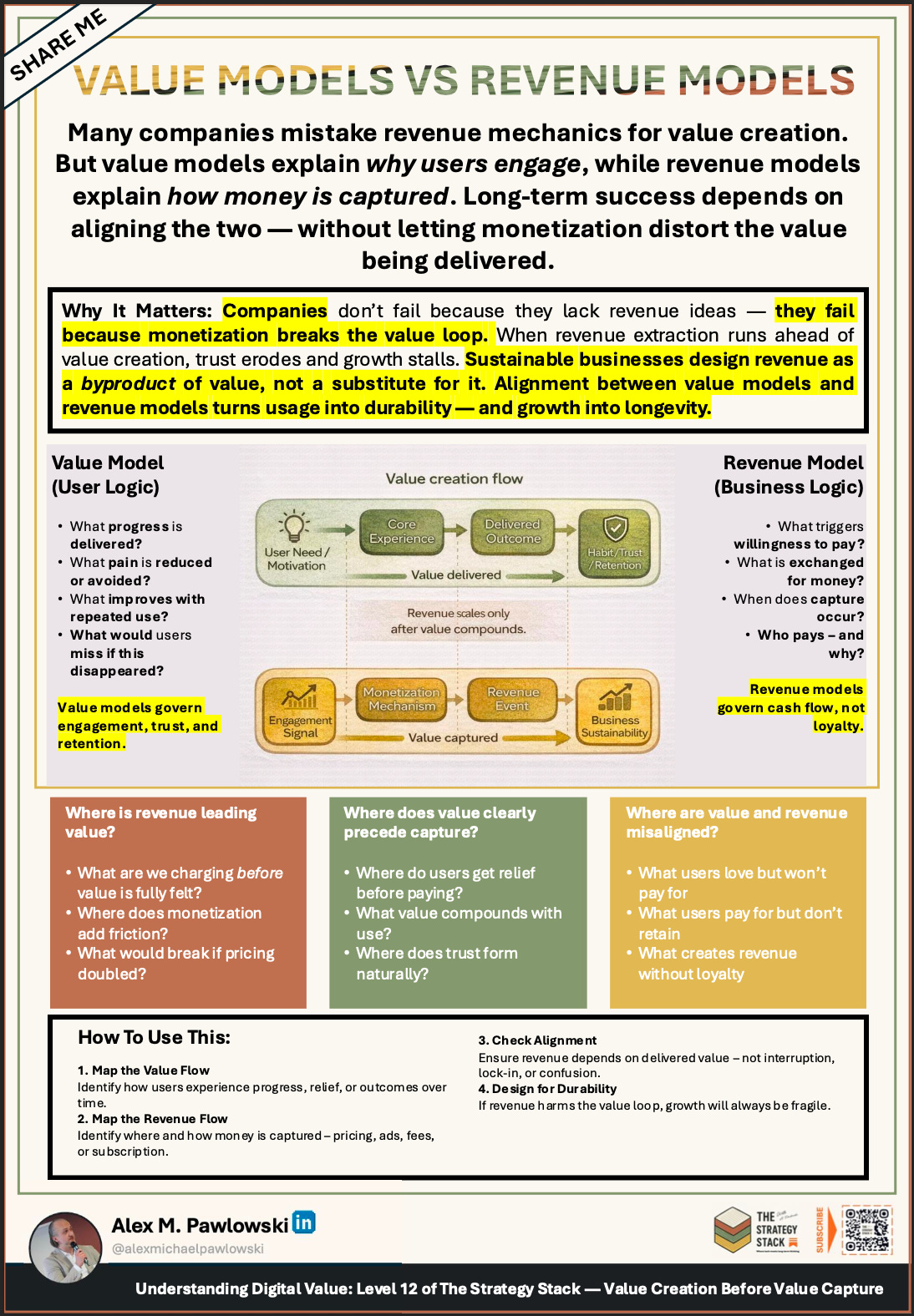
A value model answers user logic:
What progress is being delivered?
What pain is reduced or avoided?
What improves with repeated use?
What would users genuinely miss if this disappeared?
Value models govern engagement, trust, and retention.
A revenue model answers business logic:
What triggers willingness to pay?
What is exchanged for money?
When does capture occur?
Who pays — and why?
Revenue models govern cash flow, margins, and sustainability.
They are not the same system.
And they should not lead at the same time.
How Value Is Actually Created
Value follows a flow:
User need → core experience → delivered outcome → habit, trust, retention
This is where progress compounds.
This is where loyalty forms.
This is where the product earns the right to exist.
Only after that loop stabilizes does revenue scale safely.
Not before.
Revenue that precedes value doesn’t accelerate growth.
It taxes it.
How Revenue Should Enter the System
Healthy monetization follows signals, not ambition.
It activates when:
Value has already been demonstrated
The outcome is repeatable
Users feel relief without explanation
Trust is already present
At that point, monetization feels like alignment — not extraction.
Users don’t ask “why am I paying?”
They ask “how much is this worth to me?”
That’s the difference.
The Three Places Teams Should Look for Misalignment
1. Where Is Revenue Leading Value?
Ask yourself:
What are we charging for before value is fully felt?
Where does monetization add friction?
What would break if pricing doubled overnight?
If revenue leads here, the value loop is fragile.
2. Where Does Value Clearly Precede Capture?
Look for:
Relief before payment
Benefits that compound with use
Trust forming naturally
Engagement that persists without incentives
This is where durable growth comes from.
3. Where Are Value and Revenue Misaligned?
These are danger zones:
Things users love but won’t pay for
Things users pay for but don’t retain
Revenue that exists without loyalty
Revenue without retention is not a win.
It’s a warning.
The Silent Failure Mode: Optimization Over Value
One of the most common late-stage errors is this:
Teams optimize revenue mechanics instead of strengthening the value loop.
They tweak pricing.
Add tiers.
Increase friction.
Introduce lock-in.
All while the core experience stagnates.
That’s not strategy.
That’s erosion management.
How to Use This Framework
This cheat sheet exists to force sequencing discipline.
Use it like this:
1. Map the Value Flow
Identify how users experience progress, relief, or outcomes over time.
2. Map the Revenue Flow
Identify where and how money is captured — pricing, ads, fees, subscriptions.
3. Check Alignment
Ensure revenue depends on delivered value — not interruption, confusion, or coercion.
4. Design for Durability
If revenue harms the value loop, growth will always be fragile.
No exceptions.
The Real Insight
The best businesses don’t ask:
“How do we monetize this?”
They ask:
“How do we make value so obvious that monetization feels inevitable?”
That’s the difference between:
Short-term extraction
and
Long-term advantage
Between usage and durability.
Between growth and longevity.
Why This Layer Exists in The Strategy Stack
Most strategy failures aren’t competitive.
They’re internal.
They come from letting revenue logic override user logic too early.
This layer exists to prevent that.
Because value creation must always lead value capture.
Every time.
👉 Unlock the Strategy Stack
…and access the Business Model Series, advanced Cheat Sheets, the S-Vault, and various essays at the intersection of strategy and technology.

Hit subscribe to get it in your inbox. And if this spoke to you:
➡️ Forward this to a strategy peer who’s feeling the same shift. We’re building a smarter, tech-equipped strategy community—one layer at a time.
Let’s stack it up.
A. Pawlowski | The Strategy Stack
This is such an essential shift, Alex.
Aa bit like the difference between leading “input” metrics and lagging “output” metrics.