
Why AI Features Don’t Compound (And What Actually Does)
Why bolt-on AI features don't compound — and what actually builds durable advantage: the intelligence layer.

In short: Most AI features — copilots, recommendations, automation layers — don't compound into lasting advantage because they're easily copied and quickly plateau. What actually compounds is the intelligence layer beneath them: the proprietary data, feedback loops, and system design competitors can't replicate. This piece explains the difference and what to build instead.
Most companies are adding AI features.
Copilots. Recommendations. Automation layers.
And yet — almost none of these features create lasting advantage.
They get copied.
They plateau.
They fail to compound.
So what actually compounds in the AI era?
The answer is not better models.
It’s something most companies don’t build at all:
the intelligence layer.
Learning is the slow work of becoming better.
Intelligence is the moment you have to choose.
Most companies already know how to collect information. They instrument behavior, track performance, run analysis, and produce post-hoc narratives about what the numbers “mean.”
The modern firm is surrounded by observation.
Yet observation is not judgment — and judgment is what competition increasingly runs on.
As products become more adaptive and decisions more automated, what separates organizations is no longer access to tools or data.
Models travel.
Techniques spread.
Interfaces converge.
The lasting difference appears elsewhere:
in the structure that turns messy reality into coherent action.
That structure is what I call the intelligence layer.
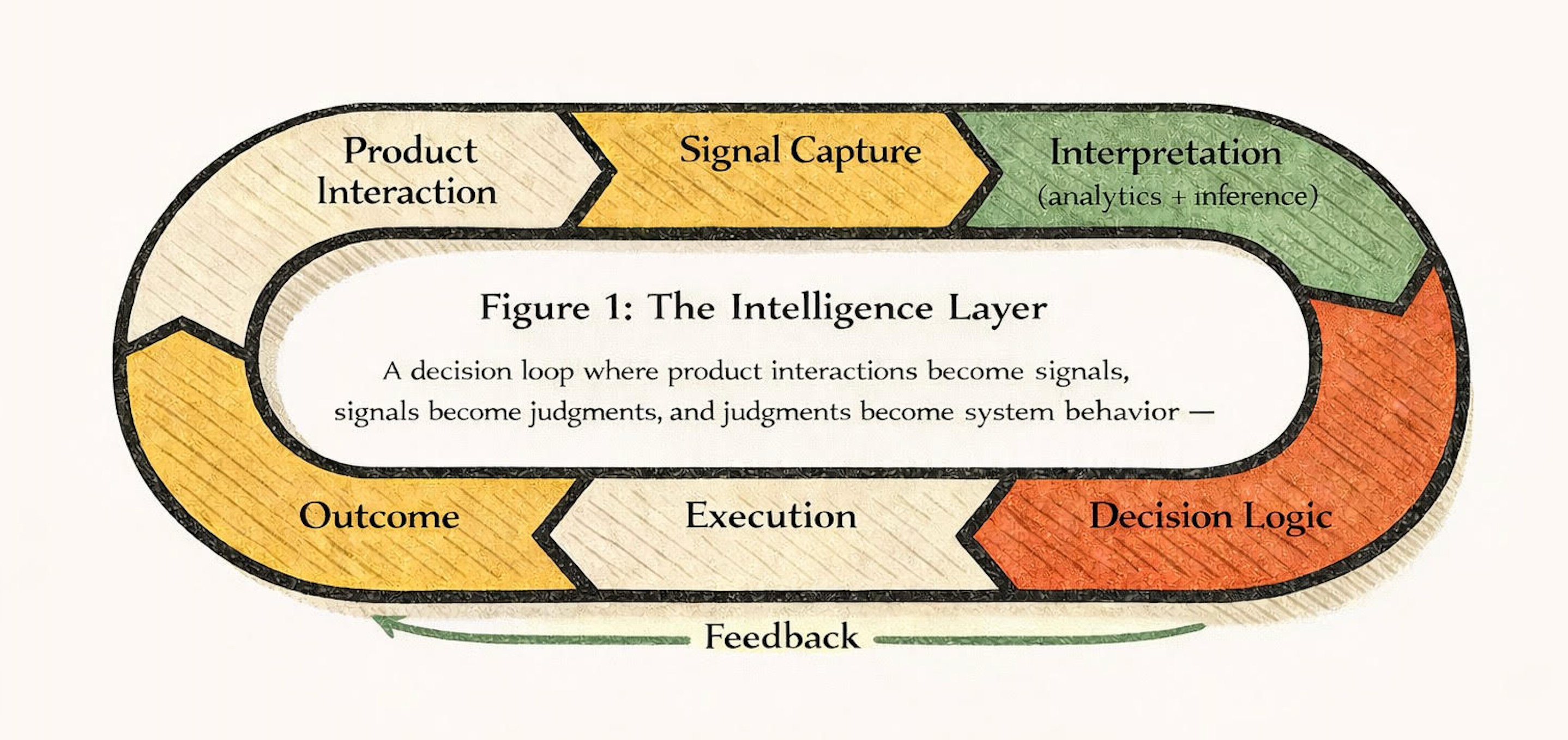
Not as metaphor, but as a practical description of where product design, analytics, machine learning, and operational decision-making collapse into a single surface. It is the machinery through which an organization decides what to notice, what to ignore, what to prioritize, and what to do next — at speed, at scale, and under imperfect information.
If strategy once meant committing to a plan and executing it efficiently, the AI economy shifts the problem. Planning doesn’t disappear, but it becomes less decisive than the compounding revenue system’s ability to revise itself without drama. The intelligence layer is the part of the business that makes that possible. It is where signals become meaning, meaning becomes choice, and choice becomes behavior — repeatedly, quietly, and sometimes invisibly.
And once that layer exists, AI competitive advantage stops looking like a portfolio of products and starts looking like a capability: the ability to make better decisions, faster, with less friction, and with fewer illusions about what the world is actually doing.
TL;DR — Intelligence Is the New Operating Layer
Companies won’t win the AI era by adding models.
They win by building a system that decides.
The intelligence layer is that system:
a mechanism that turns live signals into action,
improves through feedback,
and stays coherent as complexity grows.
Models commoditize.
Decision systems compound.
Table of Contents
Why AI Features Don’t Compound
Why the Intelligence Layer Matters Now
What the Intelligence Layer Actually Is
The Anatomy of the Intelligence Layer
Product as a Decision Surface
Decision Logic: The Hidden Interface
What Strong Intelligence Layers Have in Common
When Intelligence Turns into Noise
Designing the Intelligence Layer
How to Build an AI Advantage (Practical Takeaways)
Closing Thought — The Firm as a Decision System
1. Why AI Features Don’t Compound
Surface-level features → instantly copyable
No decision loop → no system learning
Models commoditize → advantage collapses
No integration → no compounding behavior
The problem isn’t AI. It’s where AI lives in the system.
Most companies build AI at the surface.
The winners build it into the system.
2. Why the Intelligence Layer Matters Now
For most of the platform era, the competitive story was simple: scale produces data, data produces improvement, and improvement attracts more users. The feedback loop was real, but it was slow enough to be managed with familiar tools — quarterly planning, retrospective analytics, executive judgment calls, and the occasional pivot when the market forced one.
AI changes the tempo.
When prediction becomes cheap and automation becomes common, the limiting factor shifts. The question is no longer whether a company can compute an answer. It’s whether the organization can decide quickly and correctly enough for the answer to matter.
Two firms can look at the same world. One treats uncertainty as a reason to delay. The other treats uncertainty as the condition under which it must act. Over time, that difference compounds. In adaptive markets, speed of judgment becomes a form of power.
This is why the intelligence layer matters. It is the difference between having information and having coordinated behavior. And in environments that change faster than committees, coordinated behavior is what survives.
This is where most implementations break—there’s no coherent agentic strategy →
3. What the Intelligence Layer Actually Is
The intelligence layer is the part of the business where signals become decisions.
Most companies meet AI at the surface. Advantage forms deeper.
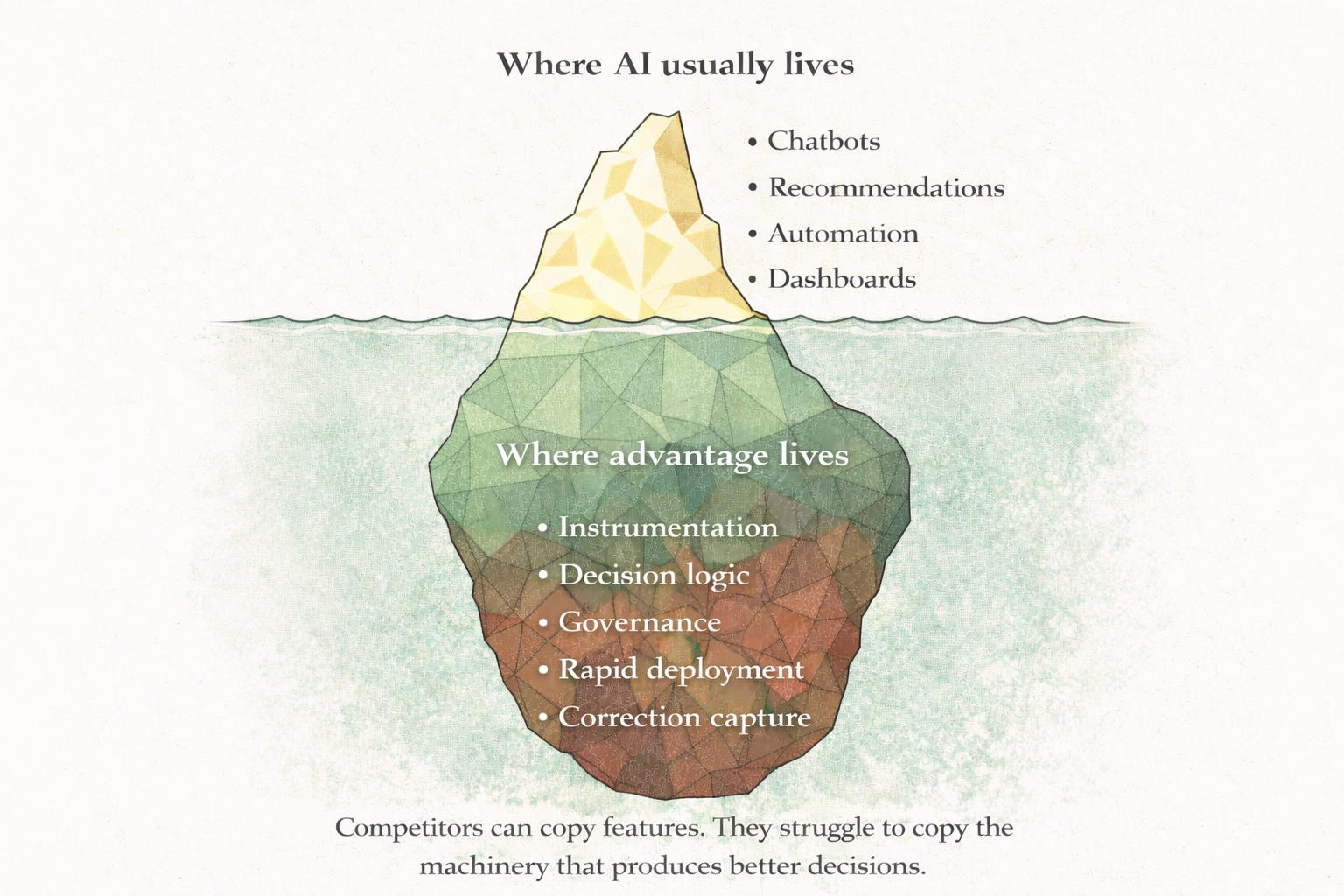
It sits between what the system encounters and how it responds. It blends measurement with interpretation, interpretation with judgment, and judgment with execution. Most organizations have pieces of it: a metrics layer, a modeling layer, some workflow automation, decision trees embedded in operations, maybe a recommendation system inside the product.
But the intelligence layer only becomes real when those pieces stop behaving like separate departments and start behaving like a single mechanism — one that can sense, choose, act, and update itself.
In practice, it includes:
the signals the system is capable of noticing
the meanings it assigns to those signals
the rules and objectives that shape decisions
the pathways through which decisions become action
the feedback channels that correct the system afterward
If this sounds abstract, it shouldn’t. Every business already runs on decisions. The intelligence layer is simply the engineered surface where those decisions are made explicit enough to improve.

In the next section, I’ll break this down into the decision stack: the layers where intelligence quietly succeeds — or fails.
