
Operating Leverage in the AI-First Firm
How AI changes the economics of the firm by turning knowledge, workflows, and expertise into reusable organizational capability



Every generation of business leaders inherits a different constraint.
For manufacturers, the challenge was increasing production without proportionally increasing labour. For software companies, it was serving millions of customers without rebuilding the product for every new user. Today, organizations face a different question: how can they increase organizational capability without expanding complexity at the same rate?
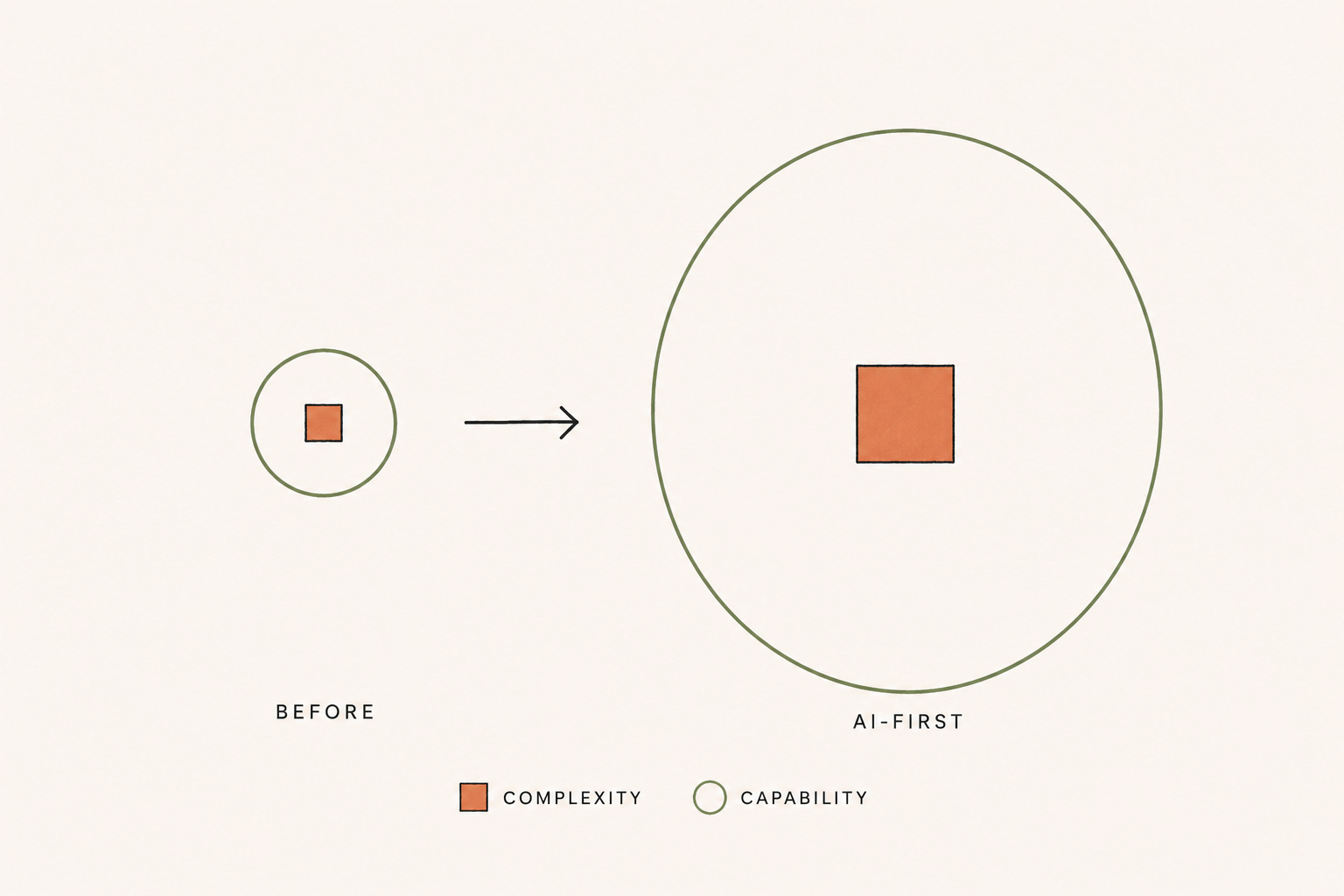
This question sits at the center of modern AI strategy. While much of the public discussion focuses on models, copilots, and automation, the more significant development is taking place inside the firm itself. A growing number of AI-first organizations are redesigning their operating models around reusable knowledge, intelligent workflows, and organizational capabilities that improve every time they are used. The result is not simply higher productivity, but a different relationship between growth, cost, and value creation.
Traditional theories of operating leverage explain how firms improve profitability by spreading fixed investments across increasing levels of output. Manufacturing achieved this through physical assets, while software companies relied on code, cloud infrastructure, and recurring revenue models. These ideas remain fundamental, yet they provide only a partial explanation for why many of today’s most successful AI-native companies are scaling differently from their predecessors.
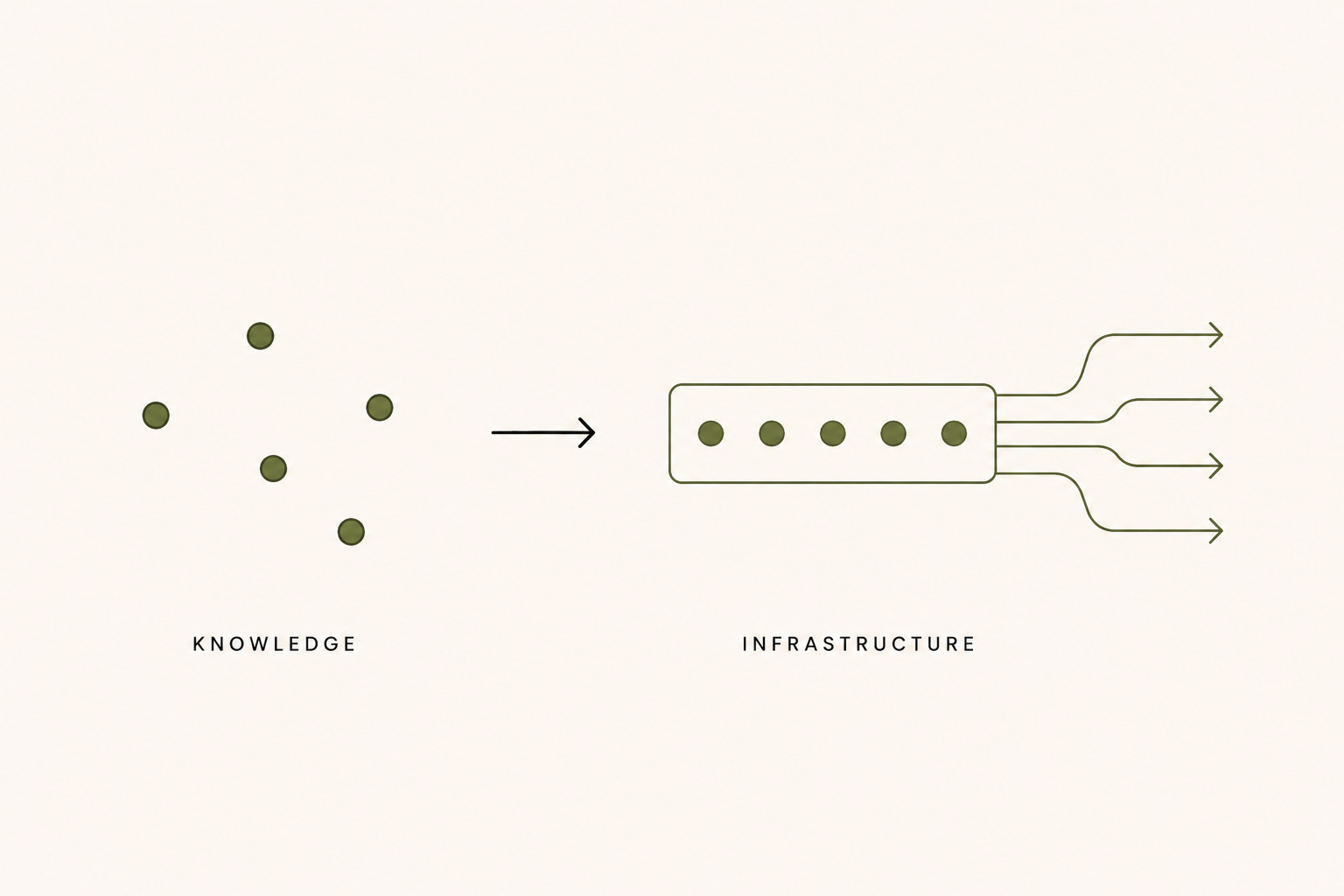
The missing piece is organizational knowledge.
For most of modern business history, knowledge has been one of the firm’s most valuable assets and one of its least scalable. Organizations invested heavily in creating expertise, but every additional application still depended on people locating information, interpreting it, and coordinating its use across teams. Artificial intelligence is beginning to alter those economics. As knowledge becomes easier to capture, structure, retrieve, and integrate into everyday work, it starts to behave less like a transient input and more like reusable infrastructure.
This article examines that transition through the lens of business model innovation and organizational design. Rather than asking how AI improves individual productivity, it asks a broader strategic question: how does AI change the economics of the firm?
To answer that question, we trace the evolution of operating leverage from industrial production to software, examine why organizational knowledge is becoming a new source of economic advantage, and develop a framework for understanding how AI operating models create value. Along the way, we draw on established economic theory, contemporary evidence, and examples from Salesforce, Cursor, Coinbase, and Palantir to show how different organizations are redesigning their businesses around reusable capability rather than simply automating existing work.
Understanding this shift matters because competitive advantage has always depended on identifying the assets that become more valuable as they are reused. The central argument of this chapter is that artificial intelligence expands that set of assets by making organizational knowledge increasingly reusable. If that interpretation is correct, the firms that outperform over the coming decade will not simply deploy better AI - they will build better organizations.
This chapter (9.3) follows:


Where optionality asked how one capability core can branch into platforms, spin-offs, and ecosystem nodes, operating leverage asks how reusable knowledge changes the economics of growth.
TL;DR
If you only have a minute, these are the central ideas of this chapter:
Operating leverage has always depended on reusable assets. Manufacturing created leverage through physical infrastructure, while software extended the same economic principle through code and digital distribution. Artificial intelligence expands this progression by making organizational knowledge increasingly reusable.
The defining characteristic of an AI-first organization is not higher productivity, but a different operating model. Competitive advantage shifts from coordinating labour toward designing systems that capture, reuse, and continuously improve organizational capability.
Knowledge is becoming an economic asset in its own right. When expertise can be systematically captured, structured, and integrated into everyday workflows, organizations reduce the cost of applying knowledge across projects, teams, and customer interactions.
The greatest opportunity lies in redesigning the firm rather than deploying AI tools. Organizations that simply automate isolated tasks improve efficiency. Organizations that redesign their AI operating model change the economics of growth by embedding reusable capability into the business itself.
Operating leverage is evolving. Physical assets, software platforms, organizational knowledge, and intelligent orchestration increasingly work together to create scalable business models. Understanding how these layers interact is becoming a strategic capability.
The firms most likely to outperform over the coming decade will not necessarily possess the most advanced AI models. They will build operating models that systematically convert experience into reusable organizational capability, allowing every project, workflow, and decision to strengthen future performance.
Table of Contents
The Evolution of Operating Leverage
Knowledge as Infrastructure
Designing an AI-First Cost Structure
The Evolution of Reusable Assets
The Operating Leverage Stack
The Organization That Compounds
Conclusion
Executive Cheat Sheet
The Evolution of Operating Leverage
Every era of business has produced companies that appeared fundamentally more scalable than those that came before them. During the Industrial Revolution, manufacturers achieved levels of production that individual workshops could never match. Decades later, software companies demonstrated that digital products could serve millions of customers without requiring a proportional expansion of production capacity. Today, AI-native firms are beginning to challenge another long-held assumption: that knowledge-intensive organizations must increase headcount and coordination as they grow.
Although these companies operate in very different industries, they share a common economic characteristic. Each discovered a new class of asset that could be reused at progressively lower marginal cost. That observation sits at the heart of operating leverage.
Operating leverage describes the relationship between fixed investments and the cost of serving additional customers or producing additional output. Organizations incur significant upfront costs to create an asset - whether a factory, a software platform, or increasingly an organizational capability - and then generate economic returns by reusing that asset across a growing volume of activity. The more effectively the asset can be reused, the more slowly operating costs increase relative to revenue.
This principle explains why some firms consistently expand profitability as they grow while others remain constrained by linear cost structures. It also explains why shifts in operating leverage have historically coincided with major changes in industrial organization. Whenever a new category of reusable asset emerges, firms capable of exploiting it begin to outperform competitors that continue relying on older economic models.
From Physical Assets to Digital Assets
The industrial economy created operating leverage through physical infrastructure.
Factories, machinery, transportation networks, and standardized production systems required substantial capital, but they enabled manufacturers to produce at a scale that individual competitors could not easily replicate. Once these assets had been built, each additional unit of output carried a lower average cost because the original investment was spread across increasing production volumes.
The strategic consequences were significant. Scale became a competitive advantage in its own right. Larger organizations negotiated better purchasing terms, invested more heavily in process improvements, and produced goods at lower unit costs than smaller rivals. Competitive advantage increasingly depended on owning and efficiently utilizing physical assets.
The software era preserved this economic logic while fundamentally changing the nature of the underlying asset.
Software requires considerable upfront investment in product development, engineering, testing, and maintenance. Once developed, however, the same application can be distributed repeatedly at negligible marginal cost. Serving an additional customer no longer requires another production line, another warehouse, or another manufacturing shift. Instead, organizations reuse the same software platform across thousands - or millions - of users.
Cloud computing accelerated this transition even further by reducing the infrastructure required to launch and scale digital businesses. Subscription pricing introduced recurring revenue models that improved predictability, strengthened customer lifetime value, and enabled continuous investment in product development. Together, these innovations produced business models with operating characteristics that differed markedly from those of traditional service businesses, where growth generally required proportional increases in labour.
The result was a generation of companies whose economics were defined not by the production of physical goods, but by the repeated reuse of digital assets.
In Practice: Salesforce
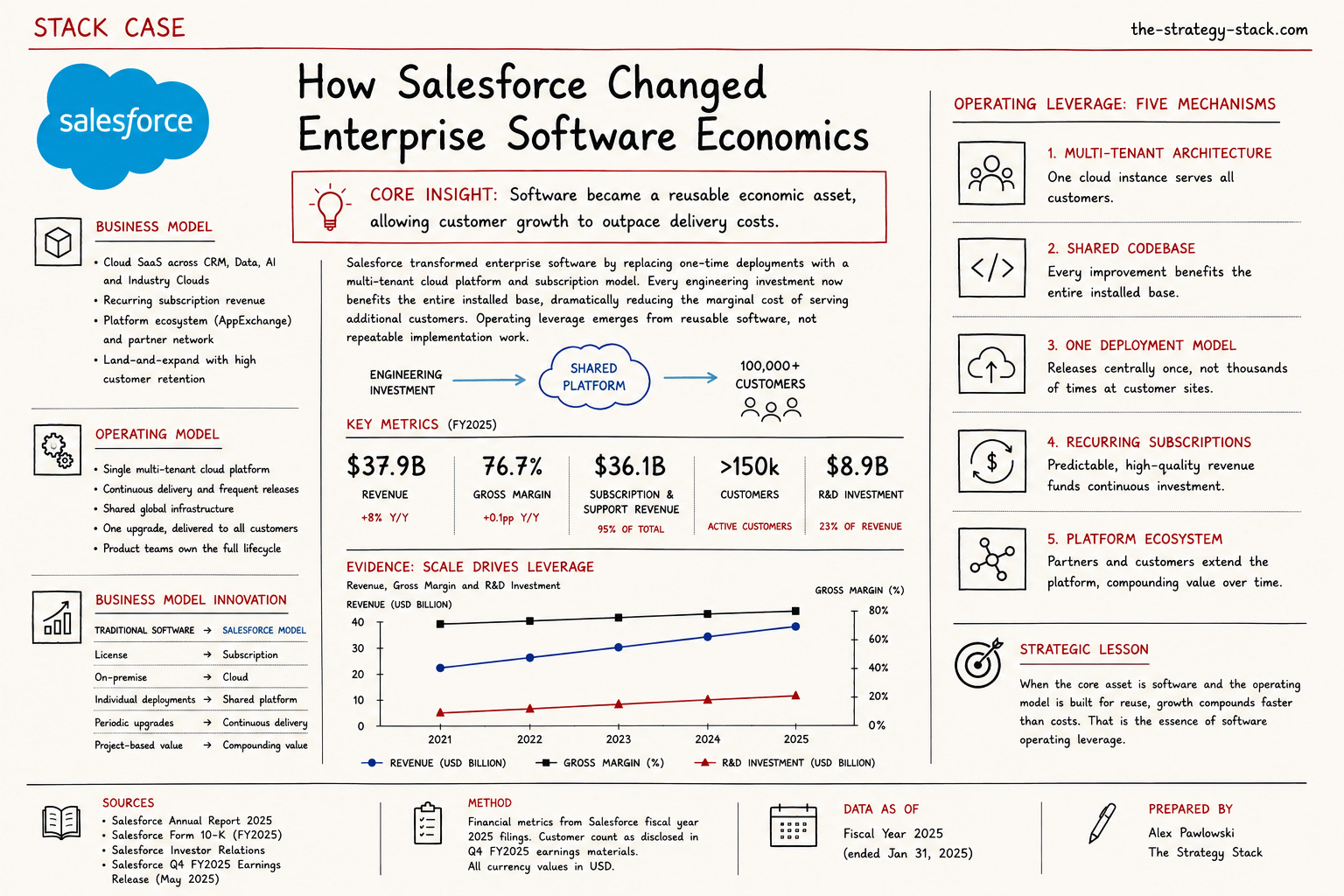
Few companies illustrate software-era operating leverage more clearly than Salesforce.
Founded in 1999, Salesforce challenged the prevailing model of enterprise software by delivering customer relationship management as a cloud-based subscription service rather than as software installed and maintained on individual corporate servers. Although the delivery model attracted considerable attention at the time, its greater significance lay in the economics it enabled.
Instead of generating revenue through one-time software licences, Salesforce built a recurring revenue business around a shared software platform. Every enhancement to the platform benefited the entire customer base simultaneously, allowing engineering investments to be reused across thousands of organizations rather than customized for each deployment. As the customer base expanded, the incremental cost of serving additional subscribers grew far more slowly than recurring revenue.
This economic model created several reinforcing advantages. Predictable subscription revenue supported continuous investment in research and development, expanding product capabilities while strengthening customer retention. Improvements made for one customer immediately became available to all customers, increasing the return on every engineering investment. Over time, Salesforce also built a broad ecosystem of partners, developers, and complementary applications that further increased the value of the platform without requiring proportional expansion of its core product.
While Salesforce’s financial performance reflects many factors - including market timing, execution, acquisitions, and product strategy - it also demonstrates the power of software operating leverage. Public financial reporting has consistently shown gross margins substantially higher than those of most asset-intensive industries, illustrating how digital platforms can scale revenue without corresponding increases in delivery costs. The company’s recurring revenue model also provides greater visibility into future cash flows than traditional perpetual software licensing, reinforcing its ability to invest over long planning horizons.
The broader lesson extends beyond Salesforce itself.
The software era did not rewrite the economics of operating leverage. It expanded the range of assets capable of generating it. Code became a reusable economic asset in much the same way that factories had once transformed physical production. Organizations that successfully built, maintained, and continuously improved software platforms gained structural advantages because each incremental customer increased the return generated by the same underlying asset.
Yet software also exposed an important limitation.
While digital products became remarkably scalable, the organizations creating and supporting those products remained dependent on increasingly complex forms of knowledge work. Engineers, product managers, consultants, legal specialists, customer success teams, and operational staff all contributed expertise that proved far more difficult to reuse than software itself. As companies expanded, coordination costs frequently increased alongside organizational complexity, even when product delivery remained highly efficient.
This distinction becomes particularly important because it reveals where software operating leverage reached its natural boundary. Digital platforms solved the problem of distributing functionality at scale, but they did not fundamentally change the economics of creating, coordinating, and applying organizational knowledge.
The next stage in the evolution of operating leverage begins precisely at that point.
Software solved the economics of distribution. The next section explores why AI changes the economics of organizational knowledge - and why that may prove to be an even bigger shift.
