
The Map Is Not the Territory
Why every strategic decision begins with a model of reality


Book 0 · Issue 1 of 100 · Thinking Like a Strategist
Why do intelligent people repeatedly make strategic mistakes despite having access to more information than ever before? The answer, I eventually realized, had surprisingly little to do with intelligence and almost everything to do with the mental models through which we interpret reality. That realization became the foundation for this series.
In short
You never act on reality directly. You act on a mental model — a map your mind has built to simplify a world too complex to hold in your head.
When that map stops matching the territory, even smart people make rational decisions that fail. Strategy is not choosing a direction. It is continuously asking whether the map you are using still describes the world that actually exists.
Why this series exists
Over the past decade, strategy has become strangely tactical. We spend enormous amounts of time discussing artificial intelligence, operating models, digital transformation, business models, competitive positioning, and whatever new framework happens to dominate the conversation that month. Those discussions matter because they solve real problems, but they all quietly assume something much deeper that is rarely questioned: that we already know how to think strategically in the first place.
The longer I work with organizations, the less convinced I become that this assumption is true. Most strategic failures do not begin with bad intentions or poor execution. They begin much earlier, with the way people perceive the world around them. Before we can build better companies, adopt better technologies, or make better decisions, we need to understand the mental machinery that produces those decisions in the first place.
That is the purpose of this series.
It is not another collection of strategic frameworks, nor is it a guide to the latest management techniques. It is an exploration of strategic thinking itself. Throughout these essays we will examine the habits of mind that allow some people to navigate uncertainty while others become trapped inside increasingly outdated assumptions. We will look beneath strategy and ask a simpler question: What does it actually take to think like a strategist?
Everything else in this publication ultimately depends on the answer.
The Map Is Not the Territory
Imagine arriving in a city you have never visited before. Someone hands you a beautifully designed map showing every street, subway line, and landmark you might need to navigate. Within minutes you feel a reassuring sense of orientation because the city suddenly appears understandable. Yet the longer you spend walking through it, the more obvious something becomes. The map cannot tell you how the neighbourhood feels late at night, where traffic unexpectedly builds every morning, which café has quietly become the place where entrepreneurs gather, or which shortcut every local takes despite it never appearing on the official route.
The map has not failed. It was never meant to reproduce reality. Its purpose is to simplify reality just enough that you can move through it without becoming overwhelmed.
Every strategic decision you have ever made follows exactly the same principle.
Whether you are leading a company, designing a product, investing in a market, or deciding how to organize a team, you are never acting on reality itself. You are acting on a representation of reality that your mind has constructed. The quality of your strategy therefore depends less on your intelligence than on the quality of the map you are using.
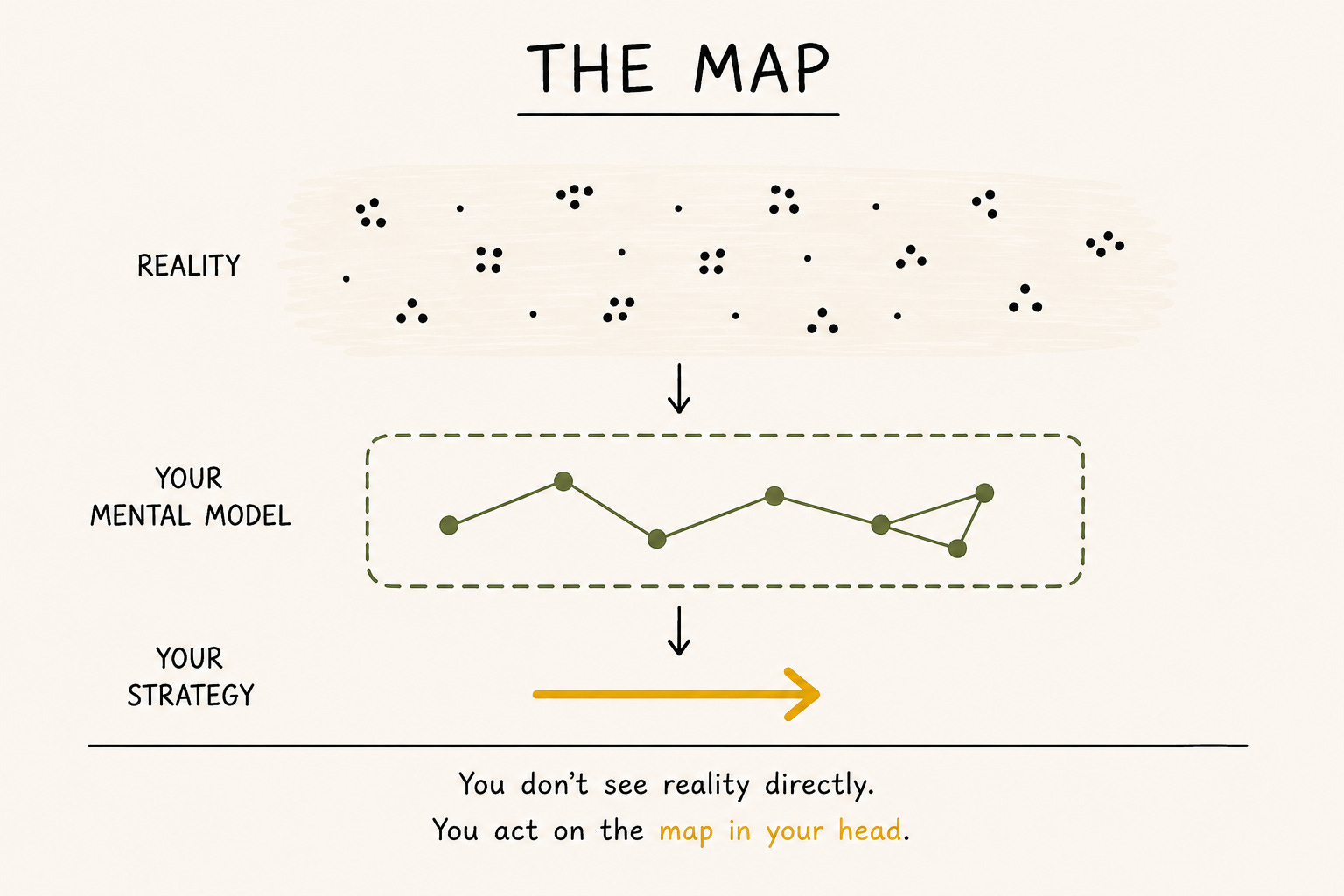
This distinction seems almost trivial until you begin noticing it everywhere. Organizations are full of maps. Organizational charts, process diagrams, KPIs, customer journeys, product roadmaps, business models, financial forecasts, and even language itself all attempt to compress an infinitely more complex world into something that human beings can actually reason about. Without these simplifications coordinated action would be impossible. Complexity must first become understandable before it can become manageable.
The danger begins when we quietly forget that these models are only representations. Over time the map starts replacing the territory in our minds. Meetings revolve around dashboards instead of customers. Teams optimize KPIs instead of outcomes. Leaders begin defending organizational structures long after the environment that originally justified them has disappeared. The model slowly becomes more real than the reality it was originally designed to describe.
This is where strategy actually begins—not with choosing between alternatives, but with questioning whether the picture of the world you are using still deserves your trust.
Reality, however, has one property that no model can escape.
It never stops moving.
Markets evolve while planning documents remain unchanged. Technologies create possibilities that did not exist six months ago. Customer expectations drift so gradually that they are almost impossible to notice from inside the organization. Competitors discover entirely new business models without asking for permission. Every day the territory changes just a little while the map hanging on the wall stays exactly the same.
History is filled with organizations that continued making perfectly rational decisions using perfectly outdated maps. Kodak understood photography but underestimated what digital photography would become. Nokia understood mobile phones but failed to recognize that the competitive landscape had shifted from hardware to ecosystems. Blockbuster understood video rental but underestimated the strategic importance of convenience and distribution. None of these companies suddenly became irrational. Their representations of reality simply stopped matching reality itself.
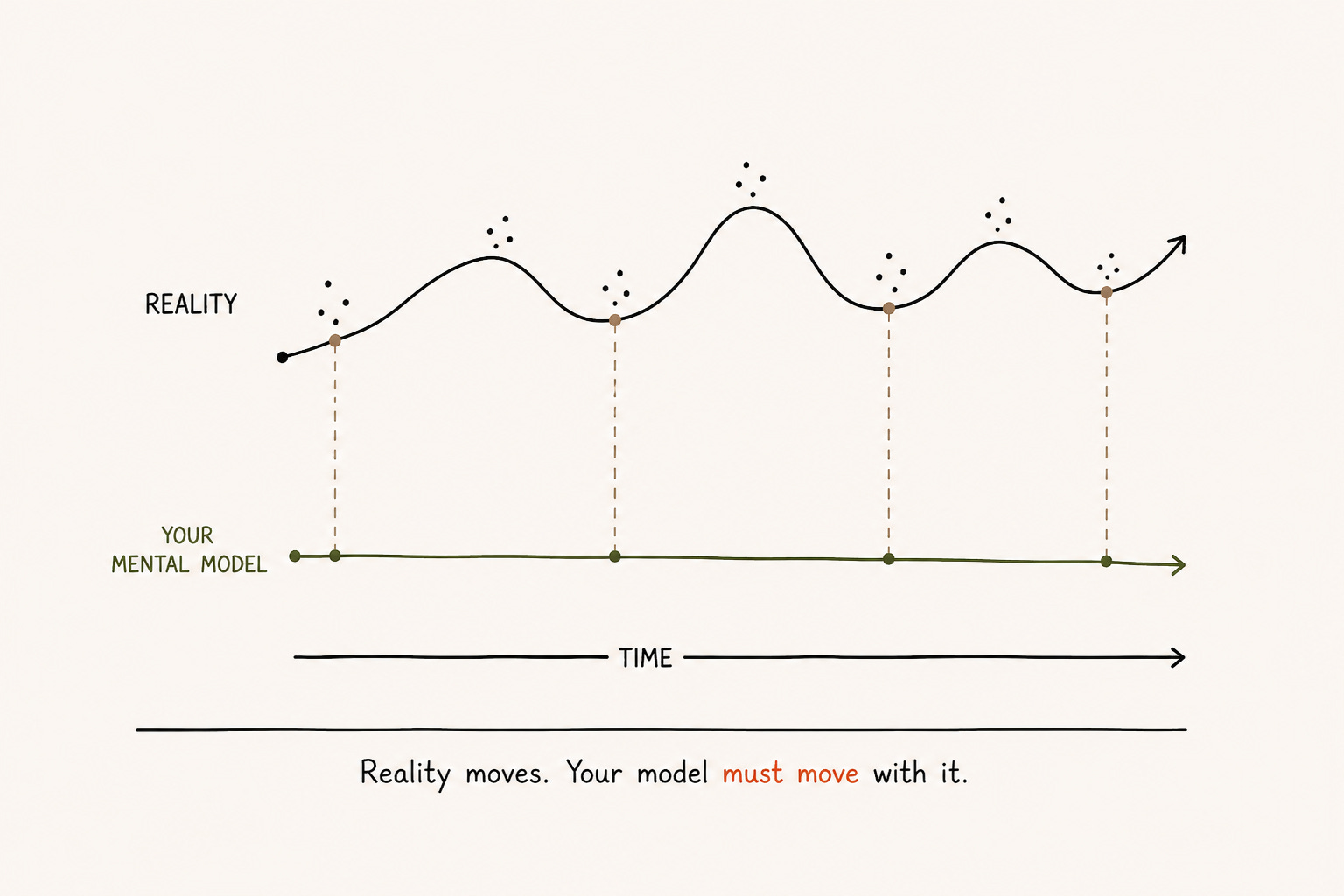
The emergence of artificial intelligence makes this distinction even more important. For most of history organizations updated their maps slowly through annual planning cycles, consultant presentations, management reports, and executive intuition. AI changes that rhythm entirely. Knowledge graphs continuously reorganize relationships. Process mining reveals how work actually flows instead of how process manuals claim it flows. Digital twins transform static documentation into living representations of complex systems. Organizational memory becomes searchable instead of disappearing inside emails and meetings.
For the first time in history, our maps have the potential to evolve almost as quickly as the environments they attempt to describe.
That sounds like a technological advantage, but it is actually a strategic challenge.
Because better representations do not eliminate judgment. They make judgment more valuable.
No model, regardless of how sophisticated, can ever eliminate uncertainty. Someone must still decide which signals matter, which assumptions no longer hold, and when yesterday’s understanding of the world has quietly become obsolete.
That is what separates planning from strategy.
Planning assumes the map is already correct.
Strategy continuously asks whether it still is.
The best strategists are rarely the people with the most detailed maps. They are the people most willing to abandon yesterday’s understanding before everyone else does. They revise assumptions before revising plans. They redraw their mental models before rewriting their budgets. They understand that adapting your understanding of reality is often more valuable than defending the elegance of an existing framework.
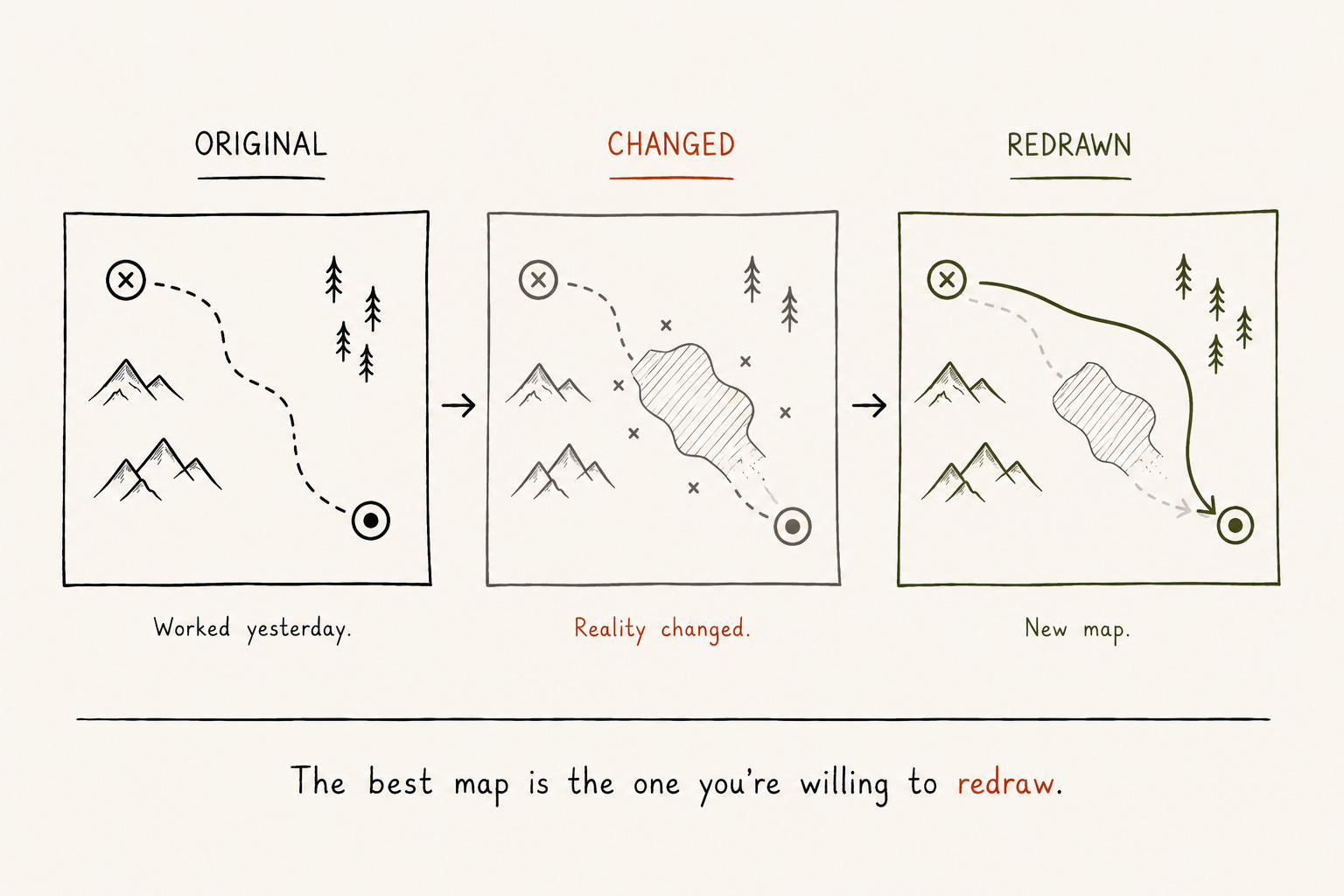
The largest strategic failures rarely begin with irrational decisions. More often they begin with perfectly rational decisions made inside an outdated representation of the world. By the time the consequences become visible, the real mistake has already happened. It happened the moment the map stopped evolving while reality continued moving.
Every strategy you will ever develop depends on one simple question.
Not whether your plan is clever.
Not whether your organization is efficient.
Not whether your technology is advanced.
But whether the map you are currently using still describes the territory you believe you are navigating.
Because strategy never truly begins with choosing a direction.
It begins by asking whether the world you think you see is still the world that actually exists.
If this resonated, two pieces from the archive apply the same idea in practice:
→ The Four Levers of Leverage — how mental models become compounding systems you can actually run
→ The Agentic Operating Model — what it looks like when the map has to move as fast as the environment

Hit subscribe to get it in your inbox. And if this spoke to you:
➡️ Forward this to a strategy peer who’s feeling the same shift. We’re building a smarter, tech-equipped strategy community—one layer at a time.
Let’s stack it up.
A. Pawlowski | The Strategy Stack
the Kodak point lands harder when you remember those decisions were defensible with the data they had. rational off a stale map beats irrational off a fresh one right up until it doesn't...