




Applied AI Strategy is a 25-part series on rebuilding the strategy function around AI. Each issue adds one working capability, until the pieces form an AI-native strategy function.
I designed this series as a build sequence rather than a collection of less connected articles.
We will move from better strategic workflows and decision protocols into AI analysts, agents, assumption monitoring, decision rooms, strategic memory, rolling reviews and eventually a closed-loop strategy function.
But all of that depends on something much less glamorous:
the system has to remember what the strategy actually was.
That is why the series starts here.

The first problem is surprisingly basic:
AI is getting very good at producing strategic answers but what it is much less naturally suited to preserving is the reasoning state behind those answers. If that state disappears, almost everything we build later becomes less reliable.
A strategy team can now put a market report, customer research, competitor material and an internal business case into a capable language model and receive something remarkably polished within minutes. The output may contain a market thesis, scenarios, risks, recommendations and even an implementation plan. Read in isolation, it can look like the finished product of serious strategic work.
If you have used AI inside a real strategy process, you may recognize the strange part: the document can feel finished before the reasoning underneath it feels settled. I find that this is where the difference between impressive output and useful strategic infrastructure becomes visible.
The gap usually appears the moment another executive challenges the recommendation rather than the prose:
Which three pieces of evidence actually changed the recommendation? Which statements are facts and which are assumptions? What would have to be false for the preferred option to collapse? Which internal constraint eliminated the apparently superior alternative? What did management believe when the decision was made, and what evidence would justify reopening it six months later?
A conventional AI conversation rarely preserves that structure unless we deliberately create it.
Strategy is built from relationships among different kinds of information. For example, a competitor price cut is an observation, the belief that it signals a structural shift toward commoditization is an interpretation, the expectation that customers will become more price-sensitive is an assumption, repositioning the product is a decision and a 15% increase in churn six months later is an outcome.
They belong to the same strategic story, but they do not have the same status.
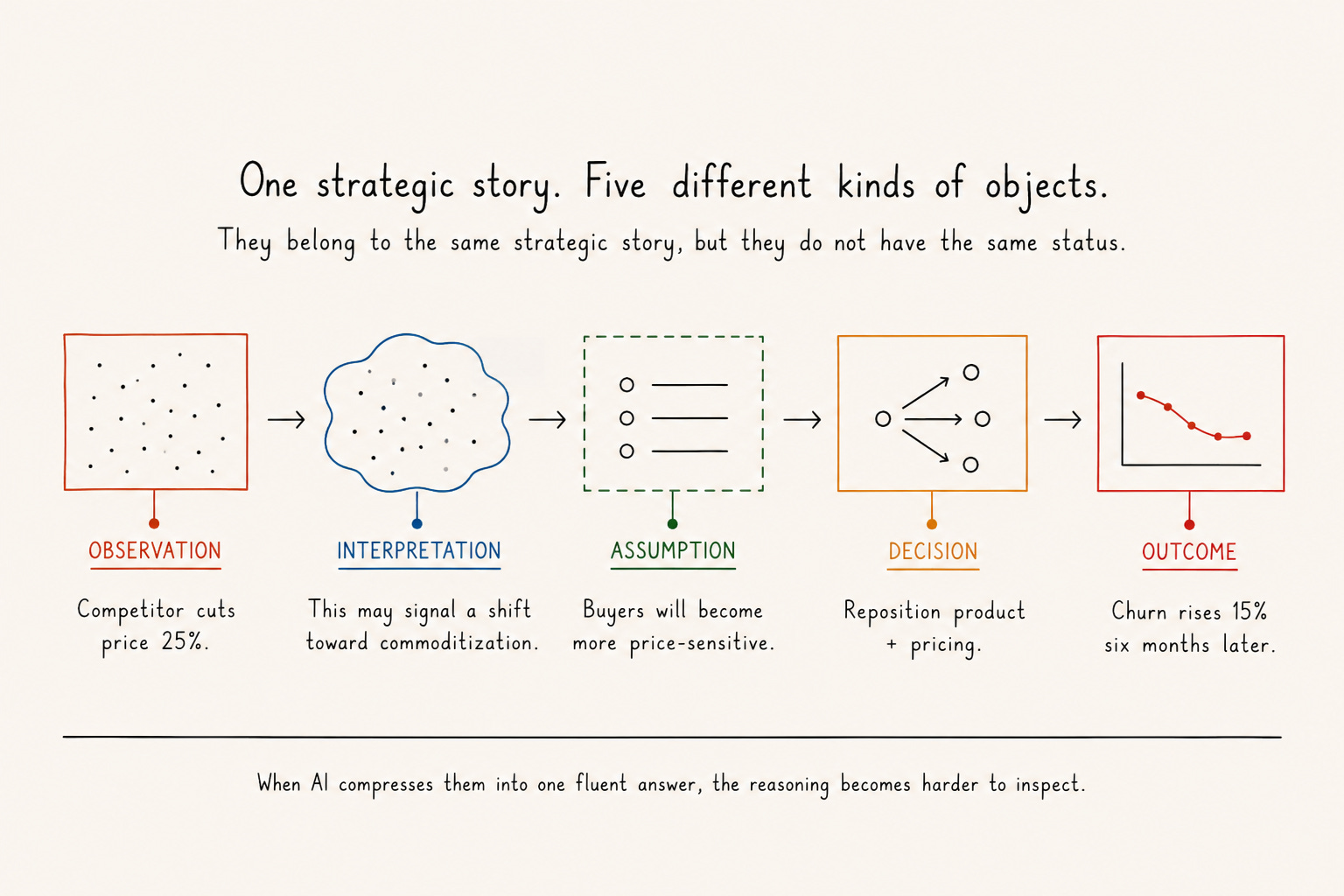
When AI compresses these objects into fluent prose, the distinctions become harder to inspect. A recommendation can become more convincing while its evidentiary foundation becomes less visible.
That is an important distinction because the dangerous recommendation is rarely the obviously bad one as it is usually easy to challenge. The difficult ones are the recommendations that sound complete before the beliefs carrying them have been exposed.
Language models are useful precisely because they can synthesize information, develop hypotheses, compare options, construct counterarguments and find inconsistencies. But a strategy function needs something beyond a good answer. It needs to know where the evidence came from, which beliefs connected it to the recommendation, which constraints shaped the option space, what was eventually decided and what happened afterward.
The design problem therefore sits one level above prompting.
We need to decide what strategic information should persist, what should remain traceable, which relationships should be explicit and which events should cause previous reasoning to be reopened.
Once those pieces exist, AI begins working with something more useful than a large pile of context.
It begins working with a strategic state.
That is what this article builds toward.
A quick test
Think about the last AI-assisted strategic recommendation you worked with.
Could you point to:
the exact evidence that materially changed the recommendation
the assumptions carrying the decision
the serious alternative that nearly won
the constraints that removed other options
and the event that should cause management to reconsider?
If not, some of the strategic state has probably already disappeared.
TL;DR
Problem: AI can produce persuasive strategic recommendations while losing the structure required to inspect, challenge and update them later. Evidence, interpretations, assumptions and decisions collapse into one fluent answer.
Principle: Strategic reasoning becomes more reliable when context, evidence, assumptions, constraints, decisions and review conditions remain distinct, connected and persistent over time.
Implication: The next AI strategy conversation should begin from the state of the previous decision, not from a blank chat. The goal is to move beyond isolated prompts toward a system that can update its reasoning when reality changes.
Build: Paid members get the complete Minimum Viable AI Strategy System: six connected strategy files, three operating commands, a 15-minute setup path, a completed market-entry case and a worked example of how new evidence reopens only the part of a decision that actually changed.
In this article
Understand
1. Why strategy has an information-structure problem
2. Why fluency can hide strategic uncertainty
3. The six structural ways AI strategy fails
4. The Strategy State: what should survive the conversation
5. The minimum viable architecture (MVA) for persistent strategy
Build
6. Install the six-file AI Strategy System
7. Run it with three commands: Start, Update and Reopen
8. Move beyond prompts into loops, harnesses and dependency graphs
9. Keep the strategic state alive as evidence and reality change
Q&A
1. Why Strategy has an information-structure problem
Consider a fairly ordinary strategic decision:
Should a European B2B software company enter the US market next year?
A capable model can immediately construct a sensible analytical agenda: market size, growth, competitive intensity, customer segments, pricing, regulation, distribution options, required investment and expected returns.
That is useful work but the harder problem begins once the analysis contains fifty or a hundred individual claims.
Some are directly observable:
three competitors increased US headcount
average contract values in a target segment exceed those in Europe
two existing customers have requested US support
implementation currently requires European engineering involvement
Others are interpretations:
the category appears to be consolidating
enterprise demand seems resilient
a channel strategy could reduce market-entry cost
the company’s European positioning may transfer poorly
And another set consists of assumptions about events that have not happened:
US customers will accept a higher price point
implementation costs will remain manageable
customer acquisition cost will fall after the first cohort
the sales organization can recruit the required talent
incumbents will not respond aggressively
In essence, a recommendation depends on all three layers.
Once the model synthesizes them into a polished market-entry memo, they begin to look surprisingly similar.
That is where strategic fragility enters.
Consider the sentence:
The company should pursue a focused US expansion because the larger enterprise opportunity compensates for higher acquisition costs.
It might be a sound conclusion.
It might also contain three untested beliefs:
achievable US contract value will materially exceed European contract value
higher acquisition costs are temporary rather than structural
implementation economics will remain attractive at US service levels
If those beliefs are not represented separately, they cannot easily be monitored.
The organization now has a recommendation and If you return to it six months later, this is often the frustrating part: the answer is still there, including the deck and the executive summary which may still look completely reasonable.
The problem: a part of the reasoning state that produced it has disappeared.
Someone now has to reopen the research, reconstruct which assumptions mattered and work out whether today’s information was already known when the original decision was made.
The result: the organization preserved the answer but lost part of the reasoning architecture that produced it.
2. Why fluency can hide strategic uncertainty
Language models are unusually good at turning incomplete information into coherent language. That capability is valuable because strategy teams spend significant effort doing exactly that: combining heterogeneous evidence into a view of what may happen and what management should do. The danger is premature coherence.
A messy evidence base naturally creates cognitive friction where analysts disagree, sources conflict or numbers do not reconcile because one customer says the product is essential while another regards it as interchangeable or a competitor claims a new product is successful without disclosing adoption data.
Most strategy practitioners know this feeling.
Sales may believe demand is accelerating while product telemetry tells a more ambiguous story where two credible market estimates may disagree while customer interviews can point in opposite directions.
That disagreement is inconvenient and it is also where much of the useful strategic work lives. I want AI to help interrogate that friction, not make it disappear before management has understood what the disagreement actually means.
A fluent synthesis can remove visible disagreement before the underlying uncertainty has actually been resolved. The answer is not to demand timid language from the model where “maybe,” “possibly” and “it depends” do not constitute uncertainty management.
The better solution is structural: give uncertainty somewhere explicit to live.
Instead of allowing the model to write:
Enterprise buyers will accept premium pricing.
require:
a) Observation
Four of six interviewed enterprise buyers indicated budget availability above the current price.
b) Inference
Price sensitivity may be lower in this segment.
c) Assumption
The broader target segment will support an average contract value at least 30% above the current European average.
d) Confidence
Medium.
e) Strategic dependency
US entry economics become unattractive below approximately 20% uplift.
f) Evidence that would change the view
The first ten qualified opportunities show willingness to pay below the threshold.
The result: uncertainty now has somewhere to live and management can inspect the reasoning without asking the model to reconstruct it later.
3. The six structural ways AI strategy fails
I think most recurring problems can be reduced to six structural failure modes.
That is useful because each one points toward a different piece of infrastructure.
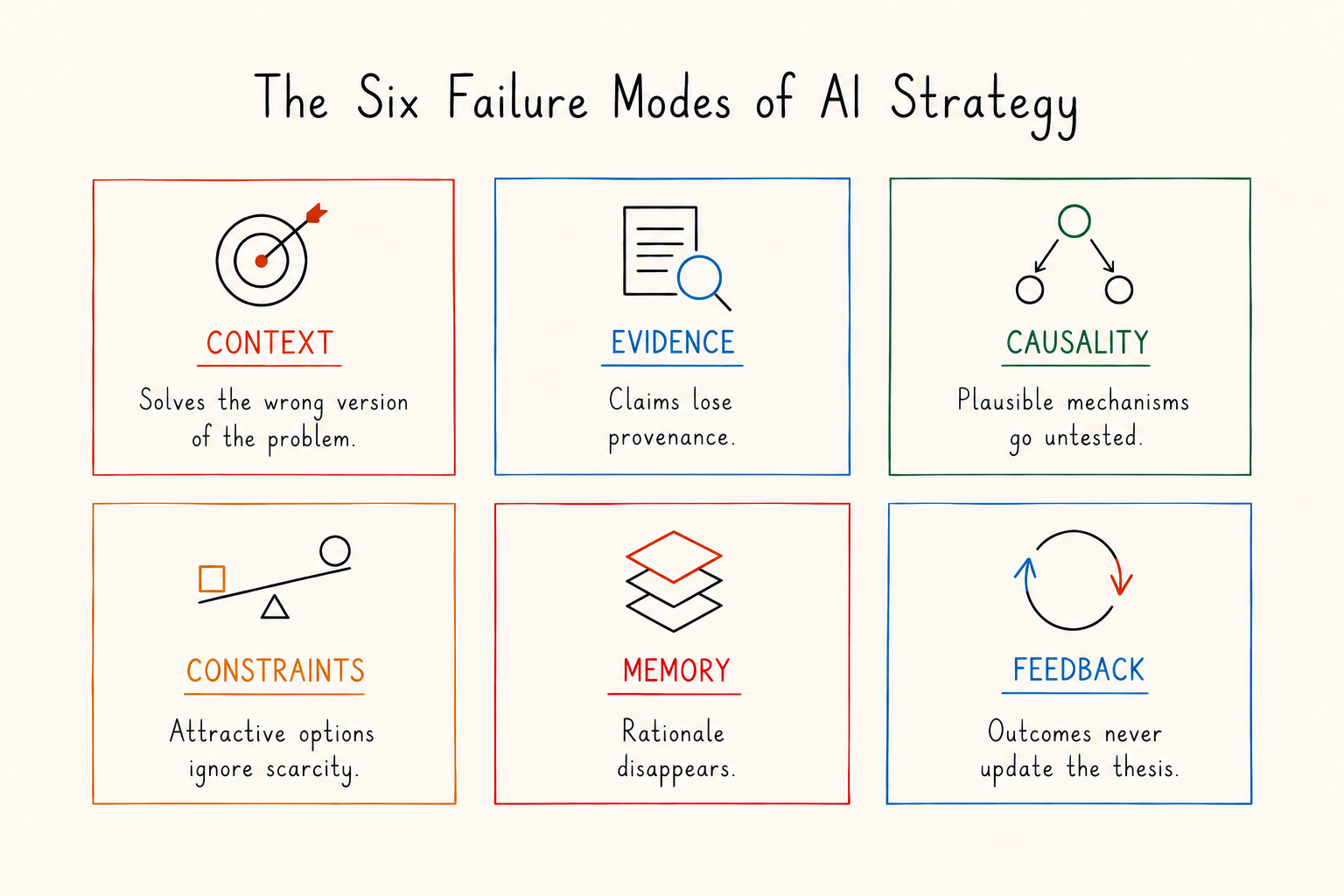
Failure 1 — The model has context, but no strategic context
Large amounts of information do not automatically create useful context.
A company could give an AI system hundreds of internal documents and still omit the few facts that determine a particular decision:
management has already committed capital elsewhere
a technically attractive option conflicts with the operating model
an earlier market entry failed for a specific reason
one important capability depends heavily on two employees
the board has imposed a leverage constraint
a seemingly adjacent product requires a completely different distribution model
As a strategist, you already perform this filtering almost instinctively because you know that a single board constraint can matter more than fifty pages of market research. Only one scarce capability can invalidate an otherwise beautiful recommendation and the AI system needs the same hierarchy.
The practical question is therefore not:
How much company information can the model access?
It is:
Which facts materially constrain or shape this decision?
As you can see the quality of context matters more than its volume as context windows grow.
Simply placing relevant information somewhere inside a large context does not guarantee that every piece of information will influence the model equally as position, structure and salience still matter.
That is an interesting wrinkle in the idea that “more context” automatically produces better strategic reasoning: the bottleneck increasingly shifts from access to information toward organization of information.
Strategic context should therefore be curated.
At minimum, the system should know:
a) Current strategic priorities
Where is management trying to create value?
b) Existing commitments
Which decisions have already constrained future choices?
c) Relevant capabilities
What can the organization actually execute well?
d) Binding constraints
Which limits cannot be wished away by a compelling recommendation?
e) Current strategic thesis
What does management presently believe about the market?
f) Explicit exclusions
Which paths have already been rejected, and why?
This changes the model’s task substantially because instead of solving a generic market-entry problem, it solves this company’s market-entry problem.
Failure 2 — Evidence disappears into the narrative
A research-heavy strategy process may contain excellent evidence and still produce an unreliable recommendation if the chain from evidence to conclusion becomes difficult to reconstruct.
Suppose the research includes:
six customer interviews
an industry forecast
competitor pricing pages
three job postings
management commentary
product telemetry
The final report states:
Competitors are rapidly moving upmarket.
Now we want to understand what supports that conclusion. It could be that competitors launched enterprise plans or hired enterprise account executives. It could also be that their customers became larger in size or management explicitly announced the move. Those are not equivalent pieces of evidence and therefore a useful AI workflow should preserve the distinction rather than reducing all of them to interchangeable “signals.”
One simple discipline helps enormously:
a) OBSERVATION
What can be directly supported?
b) INTERPRETATION
What meaning are we assigning to the observation?
c) ASSUMPTION
What are we treating as sufficiently likely to build a decision around?
d) IMPLICATION
What changes if the assumption is correct?
These four layers create an audit trail without turning strategy into academic research.
The practical benefit here is simple: when someone challenges the recommendation, the team can identify which part of the reasoning chain is actually being challenged.
Failure 3 — The causal mechanism remains implicit
All too often strategy makes claims about cause and effect where entering earlier creates an advantage, like increasing retention via bundling, accelerating adoption by lowering prices or increasing cross-selling by acquiring a capability.
AI can generate plausible explanations for all of them.
Here, management needs something stronger than plausibility when capital and organizational attention depend on the mechanism.
Take:
Moving upmarket will improve retention.
Several mechanisms might support the claim as larger customers may have higher switching costs. They may adopt more integrations because contracts may be longer or procurement processes may create institutional commitment.
But the same move could increase implementation complexity, service cost and sales-cycle duration.
A useful analysis therefore exposes the mechanism:
a) Action
Move toward larger enterprise customers.
b) Expected mechanism
Greater workflow integration + longer contracts + higher switching costs.
c) Expected outcome
Higher net retention.
d) Necessary conditions
Product reliability, implementation capacity and enterprise support remain sufficient.
e) Potential counter-effect
Longer onboarding and increased service burden reduce contribution margin.
The strategy can now be challenged at several meaningful points and that is a much better management conversation than simply asking:
“Do we believe enterprise is attractive?”
Failure 4 — Constraints arrive too late
Generative systems are extraordinarily capable option generators that become counterproductive when the model produces a portfolio of individually sensible recommendations that the organization cannot pursue simultaneously.
A typical strategy output might recommend:
accelerate international expansion
launch a new AI product
reposition toward enterprise
build a partner ecosystem
acquire a specialist capability
improve self-service economics
Each of these initiatives by themselves may hold merit while management sees another problem. The same product team appears in four of them but the same executives are expected to govern all six with the same investment budget somehow funding it all.
This is one of the places where AI recommendations can become strangely unrealistic because resource scarcity shapes strategy itself.
A strategic AI workflow should therefore expose constraints before recommendation generation.
At minimum:
a) Capital
What investment envelope is actually available?
b) Management attention
How many significant strategic changes can be governed simultaneously?
c) Capability
Which required skills are scarce or absent?
d) Technology
Which architectural dependencies determine sequencing?
e) Time
Which options expire, and which can wait?
f) Reversibility
Which decisions can be tested cheaply before commitment?
g) Organizational capacity
What volume of change can the operating system absorb?
Once these constraints enter the reasoning early, the model stops behaving like an unconstrained idea generator and begins making actual trade-offs.
Failure 5 — The organization remembers the answer and loses the decision
A slide deck can tell us what management approved but it may reveal remarkably little about what management believed (that gap becomes important later). Now Imagine a company chose direct US expansion over a channel partnership and a year later, direct sales underperform. Management now asks whether the original decision was poor.
That question is difficult to answer fairly because we need the original decision state:
What did we know at the time?
Which assumptions mattered most?
What did the channel alternative look like?
Why was it rejected?
What commercial outcome did we expect?
Which uncertainties did we knowingly accept?
Which event was supposed to trigger reconsideration?
This is particularly uncomfortable for decision owners because six or twelve months later, you can find yourself defending a decision using information that did not exist when the decision was made.
Certainly, the deck preserves the answer and certainly people remember fragments of the debate but very little may preserve the actual reasoning state and without that record, hindsight contaminates learning. A decision that was rational under the information available at the time can look foolish after the world reveals something new. The opposite can also happen: a poor process can receive a good outcome and later be remembered as excellent judgment.
The object worth preserving is therefore larger than “the final recommendation.”
A useful Decision Record contains:
Decision
What was chosen?
Rationale
Why?
Critical evidence
Which observations materially influenced the choice?
Critical assumptions
What did management need to believe?
Rejected alternative
Which serious option came second, and why did it lose?
Expected outcome
What did success look like?
Review trigger
What evidence would justify reopening the decision?
That record can be short.
Its strategic value tends to grow with time.
Failure 6 — Execution data never reconnects with the original thesis
Strategy creates expectations in one place; execution produces evidence in another.
Imagine the original US market-entry thesis assumed:
CAC below $15,000
sales cycles below five months
US ACV at least 25% above Europe
implementation falling below ten weeks after the first five customers
Twelve months later, reality looks different.
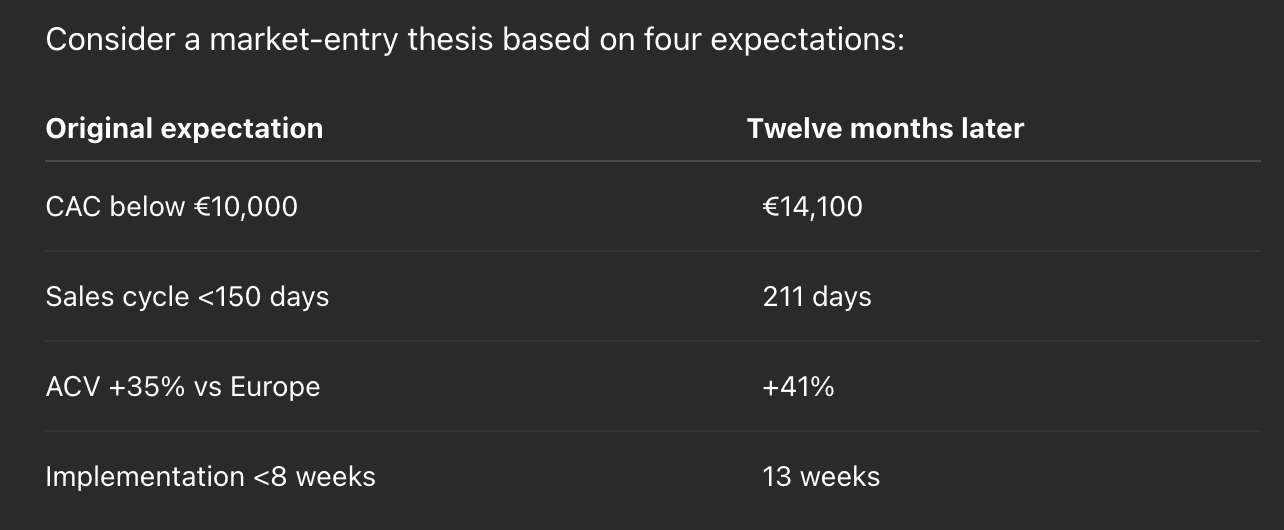
An operating review might treat the deviations as separate performance issues that strategically really tell a more interesting story. It could be that the pricing hypothesis held but the acquisition and implementation hypotheses did not. That changes the economics of the original entry thesis to the point where performance management and strategy begin to diverge.
Operations asks:
How do we improve CAC and implementation time?
Strategy asks:
Do these deviations invalidate the economics that justified entering the market in the first place?
Or perhaps the more useful answer is somewhere between those two:
Is the strategy wrong, or have we identified two capabilities that must improve for the strategy to work?
Answering that requires current evidence to reconnect with the original assumptions where the return path is easy to neglect. It is also where strategic learning becomes possible.
4. The Strategy State: what should survive the conversation
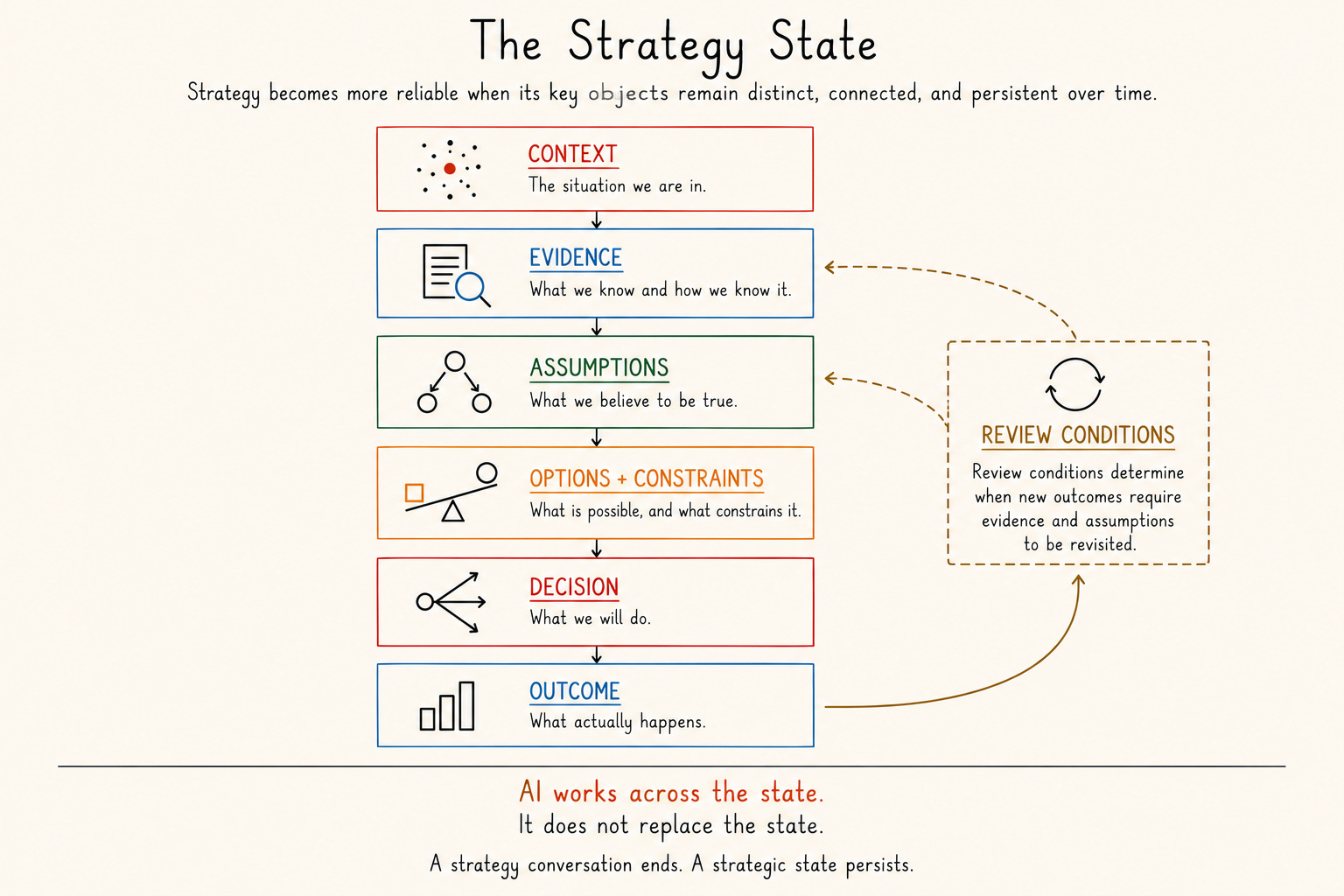
The six failure modes suggest a simpler way to think about AI-assisted strategy where every consequential strategic question should have a state that survives the conversation.
That state contains:
1. CONTEXT
What is true about the organization and the decision environment?
2. EVIDENCE
What have we actually observed?
3. ASSUMPTIONS
What are we currently choosing to believe?
4. OPTIONS + CONSTRAINTS
What can we realistically do?
5. DECISION
What did we choose, and why?
6. OUTCOME + REVIEW CONDITIONS
What actually happened, and what would cause the reasoning to be reopened?
The sequence is:
Why this matters more than the prompt
I increasingly think that prompts are the wrong unit of analysis for serious strategic AI work. My reasoning for that is rooted in the fact that a strong prompt can improve one interaction only while a persistent strategic state improves the relationship between interactions.
A prompt tells the model how to think but a strategic state gives it something durable to think with.
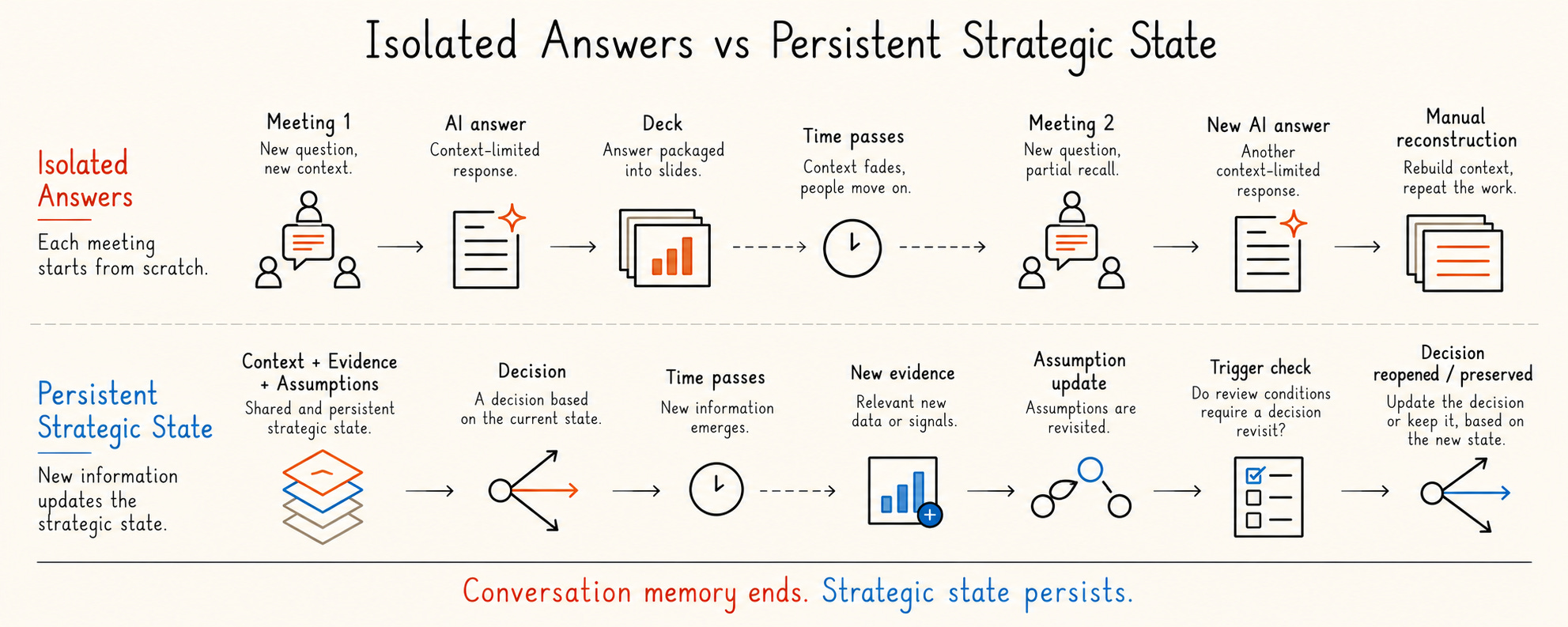
To exemplify this dynamic you can see the difference across repeated decisions in the following:
Without persistent state
Meeting 1
Research → AI analysis → recommendation → deck.
Three months pass.
Meeting 2
New research → new conversation → new recommendation.
Management now has two outputs and has to reconstruct why they differ.
With persistent state
Meeting 1
Context + Evidence + Assumptions → Decision.
Three months pass.
New evidence enters.
The system can ask:
Which assumptions does this evidence affect?
Did confidence increase or decrease?
Does any decision dependency cross a review threshold?
Which previous alternative becomes more attractive?
Does the decision need to be reopened?
That is a qualitatively different use of AI as the model is no longer producing a sequence of isolated strategic artifacts but is participating in the maintenance of a strategic model of the business.
5. The minimum viable architecture (MVA) for persistent strategy
Once we start talking about aspects like context architecture, institutional memory, agents, retrieval systems, decision graphs and feedback loops, the solution can become larger than the problem but here is the encouraging part: none of what you need to get started requires turning the strategy function into a software project.
If your current strategy process ends in a deck, a folder and a sequence of management meetings, you already have enough infrastructure to begin.
With six lightweight objects the minimum viable architecture (MVA) is surprisingly small and more than enough to change the workflow substantially.
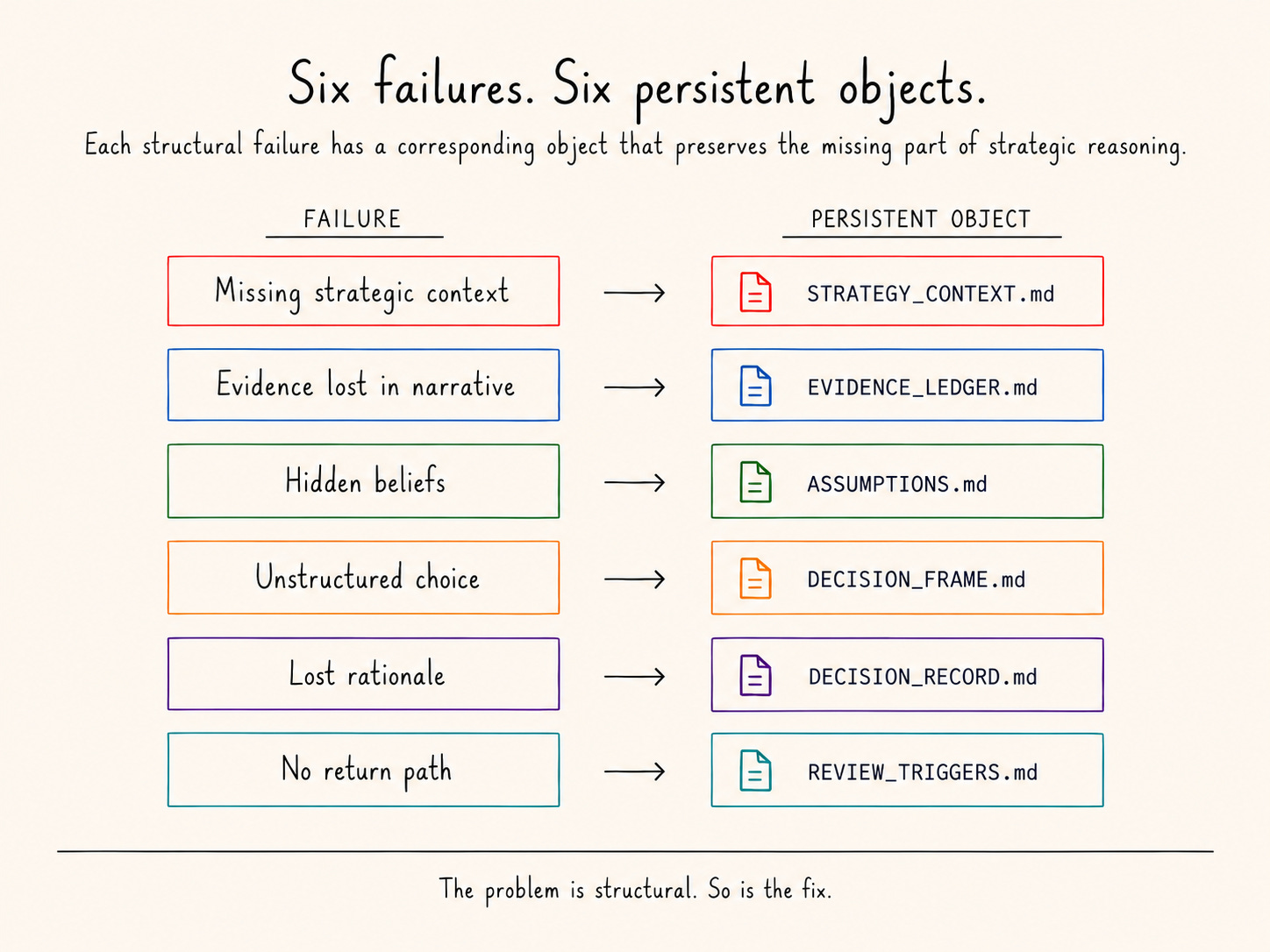
Together they form what I call the:
Minimum Viable AI Strategy System
The word minimum matters as each component can begin as a simple Markdown file or table. At this stage, autonomous agents, vector databases and enterprise platforms are unnecessary. That sophistication can come later.
The first objective is simply to stop throwing away the strategic state every time the conversation ends.
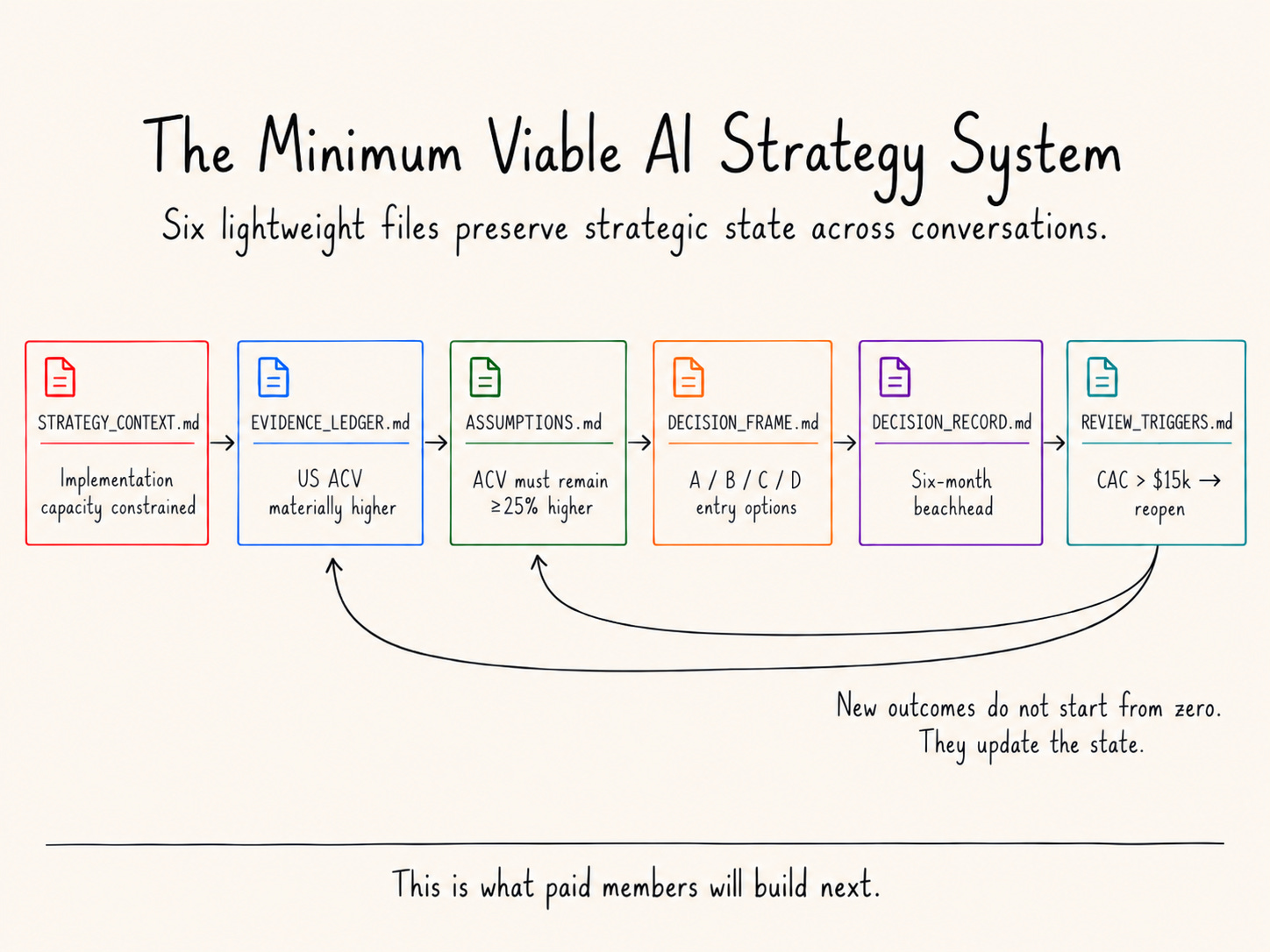
What the finished system looks like
ln order to understand this, let’s go through an example: imagine management is considering a limited US expansion.
The complete strategic state could be summarized like this:
STRATEGY CONTEXT
The company needs a second growth engine, but implementation capacity is constrained and management will not accept negative contribution margin beyond the first year.
EVIDENCE
US target customers show materially higher willingness to pay, while sales cycles and implementation requirements appear substantially heavier than in Europe.
ASSUMPTIONS
The economics work if average US ACV is at least 25% higher, first-year CAC remains below $15,000 and implementation falls below ten weeks after the first five customers.
OPTIONS
A: Full direct launch
B: Limited beachhead launch
C: Channel-led entry
D: Delay entry twelve months
DECISION
Run a six-month beachhead launch with a dedicated customer cohort rather than committing immediately to a full commercial build.
WHY
The approach preserves upside while creating evidence on the assumptions with the greatest uncertainty: acquisition economics and implementation load.
REVIEW TRIGGERS
Reopen the relevant parts of the decision if:
CAC exceeds $15,000 after ten qualified opportunities
implementation remains above twelve weeks after customer five
average achievable ACV falls below the defined threshold
a credible channel partner materially changes the economics
This representation in its compact form gives an AI system more strategic leverage than another thousand words of polished market-entry prose because the important objects remain connected.
The real test: can the reasoning survive contact with time?
At this point, I care less about whether AI can produce a good strategic recommendation.
Under the right conditions, it clearly can.
The more interesting question is:
Can the reasoning survive contact with time?
Ask yourself:
Can new evidence find the assumption it affects?
Can the organization reconstruct why a decision was made?
Can execution data challenge the original thesis?
Can another strategist enter the process six months later without rebuilding the context from scattered documents?
If the answer is no, the problem is no longer model quality so we know: the process is losing strategic state.
That’s it for the model.
For paid Strategy Stack members
You now have the model. Paid members get the operating system.
The download contains the complete six-file system, three reusable operating commands and the finished Northstar market-entry example.
You can use it as-is, adapt it to your organization and run your first consequential decision through it.
I also included a second-stage scenario in which a competitor cuts enterprise pricing by 25%. You can see the system identify the affected assumption, fire the relevant review trigger and reopen only the part of the original decision that actually changed.
